


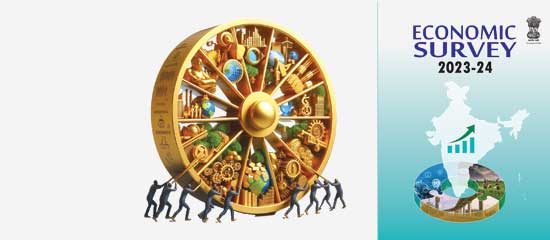
THE Economic Survey 2023-24, the annual flagship report card of the Finance Ministry provides a remarkably candid and pragmatic evaluation of India’s economic journey and the prospects for growth in an uncertain global economic environment.
Tabled in Parliament on July 22, the Survey meticulously traces the country’s economic status, particularly its recovery from the depths of despair it was driven into by the pandemic and its aftermath, and makes an in-depth examination of what lies in store.
The Indian paradox
The Survey brings to the fore the paradox where India’s corporate sector rakes in huge profits while interest margins of banks rise to multi-year highs, yet private sector investments remain subdued, productive employment growth is limited, and private consumption registers only a modest 4 per cent increase. While acknowledging that public sector investments have boosted capital formation, the Survey puts considerable onus on the private sector to take the lead and play a more proactive role. It notes increased investments in construction but points to deficiencies in machinery, equipment, and intellectual property investments.
These need to be addressed. Despite slower growth, the Survey identifies encouraging trends in corporate capital formation.
PLI, Mudra inadequacy
On the job crisis, a critical issue in the recent General Elections, the Survey underlines the need to create 78.5 lakh nonfarm sector jobs annually to absorb new entrants and agricultural labour force migrants. It questions the adequacy of existing schemes like PLI and Mudra in generating employment at this scale and highlights the challenge of ensuring employability among college graduates.
The Survey expresses reservations about India’s external outlook, forecasting a more arduous path to achieving the aspirations of a Viksit Bharat by 2047 compared to China’s trajectory. It cites geopolitical shifts, the waning of globalisation’s peak, and looming challenges from climate change and Artificial Intelligence as barriers to sustained high growth.
It emphasises the necessity for a unified effort among Central and state governments and the private sector to overcome these obstacles and outlines numerous policy proposals in this regard. Ultimately, while the Survey proposes various policy interventions, the crucial question is whether these will translate into actionable policies.
Economic Survey 2023-24
India’s real GDP grew by 8.2 per cent in FY24, marking over 7 per cent growth for the third consecutive year, driven by stable consumption and improving investment demand. Gross Value Added (GVA) at 2011-12 prices expanded by 7.2 per cent, reflecting broad-based growth
Net taxes at constant prices rose by 19.1 per cent, supported by robust tax growth at Central and state levels, and rationalisation of subsidies
Current account deficit (CAD) improved to 0.7 pc of GDP from 2.0 pc in FY23, managed well with comfortable foreign exchange reserves and stable exchange rates
Financial Sector
Banking and financial sectors showed strong performance in FY24, with doubledigit growth in bank credit and improved asset quality
Indian stock market, represented by the Nifty50 index, surged by 26.8 per cent in FY24, contrasting with a decline of 8.2 per cent in FY23
Market capitalisation ranked fifth globally, bolstered by a robust Digital Public Infrastructure and increased involvement of banks and microfinance institutions
Inflation Moderation
Despite global disruptions, domestic inflation eased in FY24, with retail inflation dropping to 5.4 per cent from 6.7 pc in FY23, aided by Government and RBI measures
Core inflation hit a four-year low, underscoring stable price trends amid volatile global conditions
Welfare Programmes
India’s sustained economic growth is complemented by social and institutional progress through effective implementation of Government programmes, enhancing welfare across health, education, sanitation, and rural living standards
Focus on women-led development and digitalised rural governance contributed to notable improvements
Agriculture Challenges
The agriculture sector grew at an average rate of 4.18 per cent annually over the last five years
Challenges such as low productivity, weather variability, and inadequate infrastructure persist, while allied sectors like animal husbandry and fisheries show potential for enhancing farmers’ incomes
Employment, Skills
Labour market indicators improved, with unemployment declining to 3.2 per cent in the financial year 2022-23
Adaptation to Artificial Intelligence (AI) and emphasis on agro-processing and care economy are crucial for sustained employment growth and gender equality in the workforce
SMSE Focus
Industrial growth accelerated, with manufacturing and construction leading the recovery. Measures to enhance efficiency, skills, and market access for MSMEs will bolster industrial expansion and reduce compliance burdens
Growth Strategy
Structural reforms of the past decade laid the groundwork for sustained growth, with future reforms focusing on inclusivity and sustainability
Public investment efforts enhanced physical and digital connectivity, emphasising the need for viable public-private partnership projects
Digital Advancement
Policy reforms and digital advancements are driving growth in business, financial, and high-tech services, leveraging India’s youthful demographic advantage
Streamlining regulations can foster a dynamic business environment, aligning with principles of efficiency and freedom advocated by ancient Indian philosophies.