


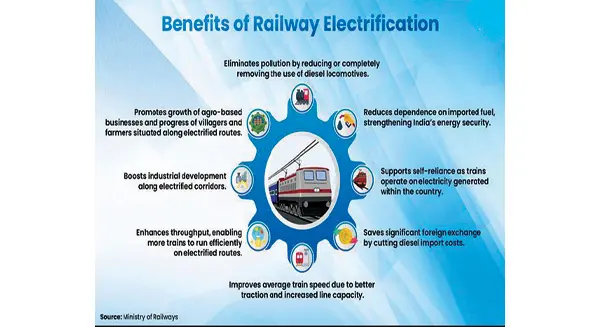
India’s Railways’ rapid shift to electric trains marks a major leap towards a modern and sustainable future. With wires spreading across the network under Mission 100-pc Electrification, the rail system is becoming faster and more efficient. This transformation represents India’s strong commitment to reducing pollution, and ensuring a cleaner environment and smarter transport for the nation.
Today, almost the entire rail network runs on electric traction. Renewable energy, like solar power, is also being integrated across stations and operations. The focus is clear: greener trains, reliable power, and a cleaner environment.
Electrification journey
India’s railway electrification story began in 1925, when the country’s first electric train, powered by a 1500 Volt DC system, ran between Bombay Victoria Terminus and Kurla Harbour. It was a short route, but a historic leap: the first operational use of electric traction in India.
Progress in the early decades was modest. By the time the country gained independence, only 388 Route Kilometers (RKMs) had been electrified, with coal and diesel locomotives continuing to dominate the tracks. Over the years, electrification expanded steadily, but the real transformation took shape over the last decade, when Indian Railways intensified its push towards cleaner and more efficient operations.
The impact has been remarkable. Electrification has accelerated from just about 1.42 km per day between 2004 and 2014 to an average of more than 15 km per day between 2019 and 2025. The pace underscores a transformative shift in how quickly the network is being modernised. Electrified track share rose from 24% in 2000 to 40 per cent in 2017, and crossed 96 per cent by the end of 2024. Today, that century-long journey is approaching its finish line. As of November 2025, India has electrified an impressive 69,427 RKMs, covering about 99.2 per cent of its railway network, out of which 46,900 RKMs have been electrified between 2014 and 2025.
Lighting the future
With the growing focus on sustainable and efficient transportation, Indian Railways is increasingly prioritising electric traction as it is more environmentally friendly and also about 70 per cent more economical than diesel traction.
With regard to Indian Railways’ Mission for 100-pc electrification, two significant positive developments stand out: The commitment to electrify the entire Broad Gauge network in mission mode, ensuring an environmentally friendly, clean, and green mode of transportation for the public.
The strategic decision to tap into renewable energy, particularly solar power, by leveraging the vast stretches of land available along railway tracks. The transition toward renewable energy marks a decisive step in building a greener and more sustainable transport system. The scale and speed of solar adoption across the network underline this commitment.
The solar leap
As of November last year, Indian Railways has commissioned 898 Mega Watt (MW) of solar power, a remarkable leap from just 3.68 MW in 2014, reflecting nearly a 244-fold increase in solar capacity.
This solar power is now installed at 2,626 railway stations, showcasing widespread adoption of clean energy solutions across diverse geographical and operational zones. Out of the total 898 MW of solar capacity commissioned, 629 MW (about 70 pc) is being utilised for traction purposes, meaning the solar power generated contributes directly to the electricity requirements of electric train operations.
The remaining 269 MW of solar capacity is used for non-traction purposes such as station lighting, service buildings, workshops, and railway quarters. By meeting these energy needs with solar, Indian Railways reduces conventional energy use and electricity costs in a clean and sustainable way. Modern, innovative Indian Railways is increasingly adopting modern technologies and innovative construction methods to improve efficiency, safety, and speed in railway electrification projects.
Traditional overhead electrification (OHE) foundations required intensive manual excavation and slowed project progress. The adoption of cylindrical foundations installed through mechanised augering has streamlined the process, reducing labour effort and significantly saving time. The Automatic Wiring Train enables simultaneous installation of catenary and contact wires with accurate tension control. This advanced system speeds up the wiring process and ensures the timely completion of electrification works.