


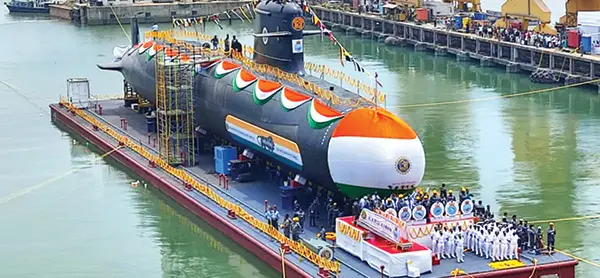
I N a recent perceptive piece in The Wire, Defence writer and analyst Rahul Bedi said: “The P75I was formally launched 19 years ago, in 2007, and the MRFA in 2017-18. Yet, mired in a labyrinthine and over-engineered acquisition process and constantly shifting qualitative requirements, both programmes had badly faltered. It seems that as India’s maritime and aerial threats mounted, the platforms meant to counter them remained stuck in files at the MoD and at respective Service headquarters”.
No amount of defence purchases can take away from the fact that the very process of acquisition has become so torturous that the final signing of a deal by itself is viewed as a great victory. Latest reports suggest that the India-Germany submarine deal (Project-75I) is delayed primarily because of three unresolved issues: pricing, terms for technology-transfer, and how much will be the level of indigenous content.
Process play-out
These unresolved issues have prevented the contract from being signed, despite strong momentum at the highest political levels. Now, let’s have a look at how the process has played out so far:
The Navy wanted a fully functional Air Independent Propulsion (AIP) system and a high Make in India matrix. That meant many competitors were out, including Spain’s Navantia.
There were RFP Redrafts galore, and innumerable deadlines were postponed.
There were changes in the procurement specifications, and the spinoff was an extension in the RFP innumerable times (Nov 2021 → Jun 2022 → Dec 2022 → mid-2023).
Many of the bidders either withdrew or were disqualified, and Germany’s Thyssen Krupp Marine Systems (TKMS) re-entered the process later, which resulted in considerable procedural gaps and pushed the schedule further.
The result of all this was a series of legal and technical objections from other bidders, which meant more reviews and more delays. And finally
The long talks for technology transfer, localisation, cost escalation, and mission systems are, by themselves, a timeconsuming, complex process that extends timelines further.
Financial outlay No wonder the former Chief of Army (later a Union Minister of State) and now the Governor of Mizoram, VK Singh, remarked in 2012 in answer to a question on the acquisition of artillery guns: “the procurement game is a version of snakes and ladders where there is no ladder but only snakes, and if the snakes bite you somewhere, the whole thing comes back to zero.”
No amount of defence purchases can take away from the fact that the very process of acquisition has become so torturous that the final signing of a deal by itself is viewed as a great victory
Meanwhile, the financial outlay for the Project-75I submarine programme has surged from Rs 70,000 crore to potentially Rs 90,000-100,000 crore, attributed to delays, alterations in design, inflation, and prolonged discussions. This signifies that the country is already facing an additional expenditure of Rs 20,000– 30,000 crore purely due to these delays. In addition, the Navy’s outdated fleet and the escalating activities of China and Pakistan impose their own strategic cost, not quantifiable in cash terms.
The talks for this deal are now described as being in an “advanced stage”. Now, what defines ‘advanced’ is something that only the babus in the Ministry of Defence will know. With the German Chancellor having come and gone, there is now no desperate hurry to wrap up the deal. The earliest it is likely to be finalised is March-April 2026. But one never knows. As you climb a ladder, there may be a snake waiting around the corner to bite you.