


Blitz Bureau
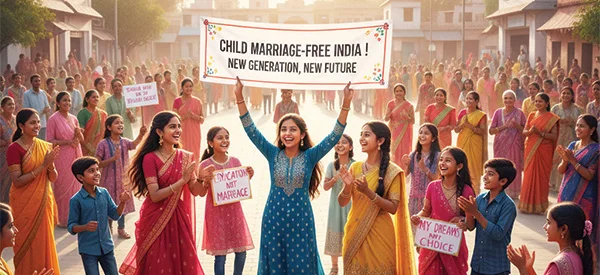
NEW DELHI: Despite being legally prohibited, child marriage remains a pervasive social challenge in India, impacting millions of young girls and boys. Launched on November 27, 2024, the Bal Vivah Mukt Bharat (BVMB), also known as Child MarriageFree India, represents a bold national commitment by the Ministry of Women and Child Development to eradicate child marriages across the country. This mission is deeply aligned with Sustainable Development Goal (SDG) 5.3, which aims to eliminate all harmful practices, including child, early, and forced marriages, by 2030.
Rooted in India’s constitutional mandate under Article 21 (right to life and personal liberty) and supported by landmark legislation like the Prohibition of Child Marriage Act (PCMA), 2006, Bal Vivah Mukt Bharat addresses a pervasive social issue that disproportionately affects young children. In a landmark judgment delivered on October 18, 2024, the Supreme Court issued a comprehensive framework and detailed directions to all states and Union Territories to effectively prevent and eliminate child marriage across the country.
The court prohibited child betrothals as they undermine autonomy and often lead to forced marriages, urging legislative amendments for an explicit ban. To strengthen enforcement under the Prohibition of Child Marriage Act, 2006, states and UTs were directed to appoint full-time dedicated child marriage prohibition officers at district/sub-district levels and establish special child marriage prohibition units for coordination, monitoring, and grievance redressal.
The judgment decisively shifted focus from punishment to prevention, protection, and empowerment, making the framework more robust and child-centric. The initiative, Bal Vivah Mukt Bharat, thus is a sincere attempt to build on prior efforts like the Beti Bachao Beti Padhao (BBBP) scheme but introduces a more integrated, technology-driven approach to prevention and response towards child marriages.
100-day campaign
On December 4 last year, a high-intensity 100-day special drive was rolled out across all states and UTs, dedicating each month to a specific outreach. To foster healthy competition and celebrate excellence, the campaign introduces two prestigious honours: Child Marriage-Free Village Certificate: Awarded to villages/panchayats that formally pledge to end child marriage and maintain zero reported cases over a sustained period.
Bal Vivah Mukt Bharat Yodha Award: The top 10 performing districts – evaluated on reporting efficiency, prevention success, and overall reduction in child marriage cases – will be conferred this national title. These districts will be featured on the official Bal Vivah Mukt Bharat portal and publicly recognised at the national level for their outstanding leadership and commitment. The nationwide campaign officially commenced on December 4, 2025 with a major launch event in New Delhi at Vigyan Bhawan, accompanied by a synchronised national pledge-taking ceremony.
In full swing
Bal Vivah Mukt Bharat portal, a flagship initiative of the Ministry of Women and Child Development, offers a centralised, publicly accessible platform that lists all appointed Child Marriage Prohibition Officers across India, enables real-time reporting of child marriage cases, and tracks awareness campaigns and actions undertaken to engage stakeholders and citizens in creating a child-marriage-free India. The campaign to prevent child marriage is currently in full swing; states and Union Territories across the country are participating with unprecedented energy and coordination. Millions of students, along with other key stakeholders have taken the anti-child-marriage pledge