


Blitz Bureau
NEW DELHI: By promoting continuous improvement, the Industrial Park Rating System (IPRS): drives innovation, efficiency, sustainability, and ease-of-doing business. Its feedback reports serve as actionable roadmaps for infrastructure upgrades and service enhancement, while its collaborative approach promotes knowledge sharing and sector-wide growth beyond conventional rankings.
According to the IPRS 2.0 Top Rated Parks Report, a total of 41 industrial parks have been classified under the ‘Leaders’ category, representing highperforming parks with strong infrastructure, resilient industrial activity, and a well-established mix of sector-specific and multi-sector facilities.
Further, 90 industrial parks have been identified as ‘Challengers’, representing parks that have shown substantial growth momentum. These parks display improving infrastructure and operational performance and are well-positioned to advance into the top tier with focused development initiatives.
In addition, 185 industrial parks have been recognised as ‘Aspirers’, indicating parks that hold significant potential for future development. These parks are in earlier stages of growth and stand to benefit from targeted support to strengthen their infrastructure, services, and operational maturity. In September last year, the IPRS 3.0 was launched to further strengthen industrial ecosystem and enhance the competitiveness of its infrastructure.
Ease-of-doing biz
India has strengthened the ease-ofdoing business by supporting domestic and international investors, with industrial parks becoming central to attracting investment and meeting large-scale employment needs. Investors can remotely evaluate suitable land parcels using detailed information on infrastructure, connectivity, business support services, and environmental and safety standards, thereby enabling well-informed investment decisions. National Business Reforms Action Plan: Accelerated improvements across key reform areas, including Information Wizard, Single Window Systems, Online Building Permission System, Inspection Reforms, and Labour Reforms. One District One Product initiative: Promoted district-specific products and strengthened local enterprises across the country.
Goods and Services Tax: Unified multiple indirect taxes, such as excise duty and service tax, into a streamlined and transparent national tax framework. Startup India: Under this initiative, eligible companies can obtain DPIIT recognition to access a host of benefits, including tax incentives, simplified compliance, and fast-tracking of Intellectual Property Rights (IPR)-related processes. Remission of Duties and Taxes on Exported Products: Encouraged entrepreneurship and enhanced the attractiveness and competitiveness of Indian exports.
Compliance and legal burden reduction: Decriminalised 3,700 legal provisions and reduced more than 42,000 compliances to build a predictable, transparent, and business-friendly regulatory landscape. India ranks among the world’s top five destinations for international project finance deals and Greenfield Project Investments, according to the United Nations Conference on Trade and Development 2025 World Investment Report. Foreign Direct Investment inflows have continued on a mounting trajectory. During the April-August 2025-26, total FDI inflows reached $43.76 billion (provisional), compared with $37.03 billion in the corresponding period of FY 2024-25.
Economic development
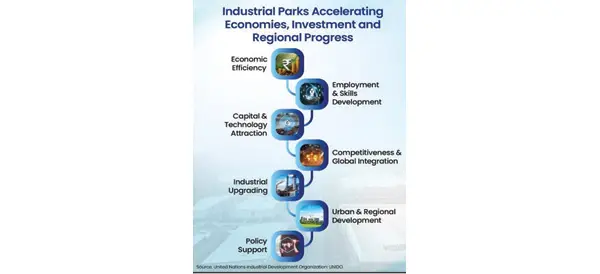
Industrial parks play a critical role in stimulating a country’s economic development by attracting FDIs and domestic capital, enhancing industrial performance, strengthening value chains, and expanding employment opportunities. They also support export-led growth and improve enterprise capabilities by enabling knowledge exchange and technology diffusion.
Enhanced FDI strengthens the development of industrial parks that align with national strategies. Supported by comprehensive feasibility studies and enabling policies, these platforms are significantly enhancing the investment environment, deepening regional value chains, and attracting higher levels of foreign capital.