


India’s efforts to build a strong semiconductor ecosystem are supported by a coordinated institutional framework led by key national agencies. These institutions provide policy direction and programme support that enable the design, and development of indigenous processors.
The Ministry of Electronics and Information Technology (MeitY) plays a central role. It guides national programmes through policy support, funding and long-term planning under schemes; such as the Microprocessor Development Programme, DIR-V, C2S and the India Semiconductor Mission.
C-DAC leads the design of the country’s indigenous processors. It creates processor Intellectual Properties (IPs), Systemon-Chips (SoCs), development boards and related tools under MeitY’s flagship programmes, supporting the growth of a complete domestic processor ecosystem. The organisation is now advancing work on the next processors in the RISCV roadmap, Dhanush and Dhanush+.
Key programmes
The Government has launched flagship programmes that strengthen design capability, expand research infrastructure and encourage innovation across academia, startups and industry. The India Semiconductor Mission (ISM), launched in December 2021 under MeitY, provides structured support and works with global companies to bring large semiconductor investments into the country. As of 2025, the mission has approved ten projects across six states.
Digital India RISC-V (DIR-V) Programme, launched in April, 2022, has played a central role in advancing the country’s indigenous chip design efforts. It enabled the development of advanced RISC-V processors in India. The programme aims to bring researchers, startups and industry into a shared design ecosystem, improving collaboration and innovation. The Chips to Startup (C2S) Programme, launched by MeitY in 2022, is a capacitybuilding initiative implemented across 113 institutions.
Design infrastructure
The Design Linked Incentive Scheme, launched in 2021, aims to offer financial incentives as well as design infrastructure support across various stages of development and deployment of semiconductor design for Integrated Circuits (ICs), Chipsets, System on Chips (SoCs), Systems & IP Cores and semiconductor linked design over a period of five years.
Indian Nanoelectronics Users Programme – Idea to innovation (INUPi2i): This programme, launched by MeitY, gives researchers, students and startups access to national nanofabrication facilities at leading institutions. It provides hands-on training in chip and device fabrication, helping innovators understand how semiconductor components are built. A total of 49 familiarisation workshops, 42 hands-on-training workshops, 36 industrial trainings and 10 hackathons have been conducted. More than 8,000 skilled manpower has been trained and around 348 short term and 220 midterm R&D projects are being supported under the project.
Aatmanirbhar Bharat
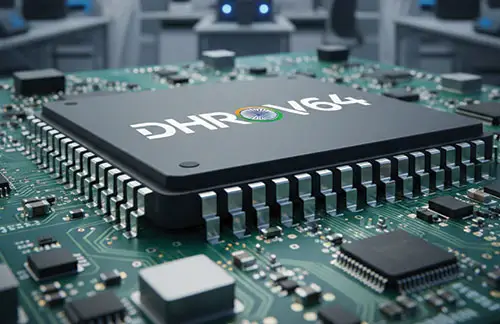
India’s progress in indigenous processor development reflects a strong commitment to Aatmanirbhar Bharat in the semiconductor sector. DHRUV64, powered and supported by national programmes such as DIR-V, C2S, ISM, DLI and INUP-i2i, showcases the country’s growing capability to design, develop and prototype advanced processors.
With coordinated efforts across MeitY, C-DAC, academic institutions and industry, India is building the talent, research strength and infrastructure needed for long-term leadership in advanced technologies. The progress from THEJAS32 to DHRUV64, and the ongoing development of Dhanush and Dhanush+, illustrates a confident national pathway toward indigenous processor innovation and technological self-reliance.