


Dr Pratap Singh
NEW DELHI: In recent months, we have heard a great deal about India becoming a developed country, Viksit Bharat by 2047. Developed country status simply doesn’t mean economic development but overall societal progress, including high per capita incomes ($14,000), a developed manufacturing ecosystem and diversified economy, good infrastructure and high level of human development.
This journey for developing country like India will be long and arduous, unless a country is blessed with bountiful natural resources like oil or critical minerals (Shankar Acharya, 2024). History tells us that only a few countries have transitioned from middle income countries to high income ones and that too which were close to lower range of high income. Studies by RBI indicate that India has to grow at sustained 8 pc or more during 2024-2047 to reach per capita incomes of $14,000. Can we sustain a growth rate of 8 pc, will depend upon several factors.
It may be stated that in last 30 years post economic reforms, Indian economy has grown on average at 6 per cent, including boom years of 2002-2010. Prime Minister Narendra Modi envisions that India will achieve, a developed country status by 2047. In the same vein, the global consultancy firm PwC projects that India could become the world’s third-largest economy as early as 2030 and may even surpass the US GDP by 2060. However India, despite being the fifth-largest economy and one of the fastest growing major economies in the world, ironically continues to be a lower middle-income country, with a per capita income of only $2847, global rank at 112. A significant share of its population (about 10 per cent) is still poor, and reaching per capita income level of $14,000 looks like a distant dream.
Complex and arduous
Shankar Acharya says that actual trajectory of our economic progress will depend upon global economic and geo-political context, the nature of technological progress, the looming perils of climate change, water scarcity, energy availability and host of other external factors. Above all our long term economic performance will depend upon the quality and strength of our economic and social policies across all dimensions, including fiscal and financial management, foreign trade, education and health, employment, industry, agriculture, infrastructure, urbanisation, and overall governance, law and justice.
History has shown that sustained rapid economic development is a hugely complex and arduous enterprise, with a great deal of luck and circumstances thrown in. No doubt, India is entering an exciting yet uniquely challenging phase in its history. By any measure, India is already an economic powerhouse, achieving one of the world’s highest growth rates in the past two decades and quintupling its per capita income since 2000. India should, however, take a few inevitable steps to reach these milestones, which are discussed below:
The inevitable steps
Building a modern economy: To realise its future ambitions, however, India ought to transition from a low-end manufacturing, agrarian and informal economy to an advanced manufacturing, services, and knowledge-led global hub, coupled with AI, ML, 3-D printing, automation and robotics, following mechanism of Industry 4.0. It is time to position itself to take full advantage of the world’s increasing technological sophistication and drive for sustainability.
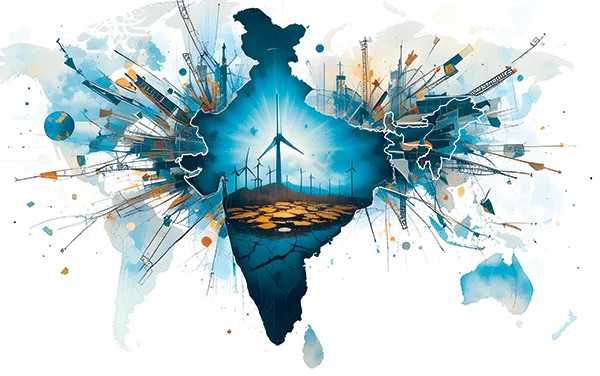
Building a climate resilient and sustainable economy: The first inescapable step is to build a climate-resilient and sustainable economy, transitioning from a high to a low-carbon economy. India is at the vanguard of this transition, growing new sectors from solar and wind to green hydrogen and biofuel. The International Energy Agency believes that India could become a global leader in renewable batteries and green hydrogen, bringing India potential revenues of USD 80 billion in the near future if it gets its policy mix right.
Increasing investment in R&D: The next inevitable step is to innovate and to invest heavily in R&D and technological upgradation, which includes space, advanced manufacturing, bio-tech, nanotechnology, as also fin-tech and ed-tech, which currently at 0.62 pc of the GDP. We need to build industries and organisations rivalling the United States and China, with tech companies equal in their sophistication and prominence to international counterparts like Microsoft, Apple, etc. ISRO’s successful landing of Chandrayan-3 on the moon’s surface is a great example.
Digital tech leader
Digitalisation of economy and the Government processes: For India to become a superpower, it should be at the forefront of digital technology, be it 5G/6G, Blockchain, AI, ML, Chat GPT, broadband connectivity, fintech, ed tech, etc. The digital revolution is well underway in India, and the country is rapidly establishing itself as a major player in the digital economy, with the IT and digital industries at the forefront of enabling seamless digitalisation and to achieve the goal of making India a $1 trillion digital economy. The need of the hour is to invest in digital transformation and integrate next-generation technologies.
Being part of global supply chains: The next important step is to make India a reliable manufacturing hub, embracing the global supply chain and thereby, augmenting its share in global trade, from the present level of 4%. The country is making the right moves to enhance its manufacturing capacity through ‘Make in India’, ‘Make for the World’ and ‘Vocal for Loca’ and PLI initiatives and to improve its share in gross value added. India has also been building the infrastructure to support a modern, connected, service-led economy.
History has shown that sustained rapid economic development is a hugely complex and arduous enterprise, with a great deal of luck and circumstances thrown in