


Blitz Bureau
NEW DELHI: India and the European Union have concluded a free trade agreement that both sides hailed as “the mother of all deals”.
India ‘concluded’ a “historic” Free Trade Agreement (FTA) with the European Union, Prime Minister Narendra Modi said on January 27, announcing the end of negotiations that began nearly two decades ago and were revived in 2022. The deal between India and the 27-nation EU covers about 2 billion people and represents a combined market of nearly $27 trillion and about 25 per cent of the global gross domestic product (GDP).
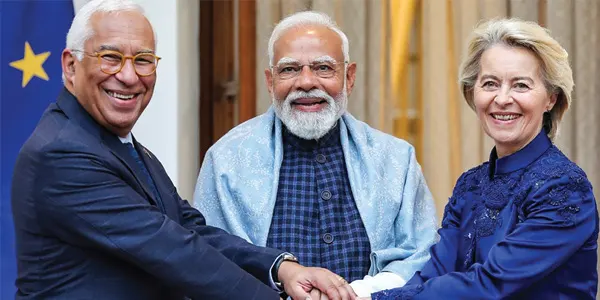
Speaking at the end of delegation-level talks with the visiting EU leaders – European Council President Antonio Luis Santos da Costa and European Commission President Ursula Von der Leyen – PM Modi said that alongside the “ambitious FTA”, India was also entering into a new Security and Defence Partnership and a system of mobility that would allow secure and legal movement of Indians to the EU region.
“Europe and India are making history today,” von der Leyen wrote in a post on X. “We have created a free-trade zone of two billion people, with both sides set to benefit. We will grow our strategic relationship to be even stronger.” Designed as modern, rules-based trade partnership, the FTA responds to contemporary global challenges while enabling deeper market integration between the world’s fourth and second largest economies.
With a combined market estimated at over Rs 2091.6 lakh crore, bringing unparalleled opportunities for the 2 billion people of India and the EU, the FTA unlocks significant potential for trade and innovation.
The agreement delivers unprecedented market access for more than 99 per cent of India’s export by trade value, while preserving policy space for sensitive sectors and reinforcing India’s developmental priorities.
Legal scrubbing of the final text of the FTA is now underway from both sides. The ratification of the deal is required by the European Parliament and the Indian Cabinet in this calendar year. It is thereafter expected to be operational by late this year or early next year.