


Blitz Bureau
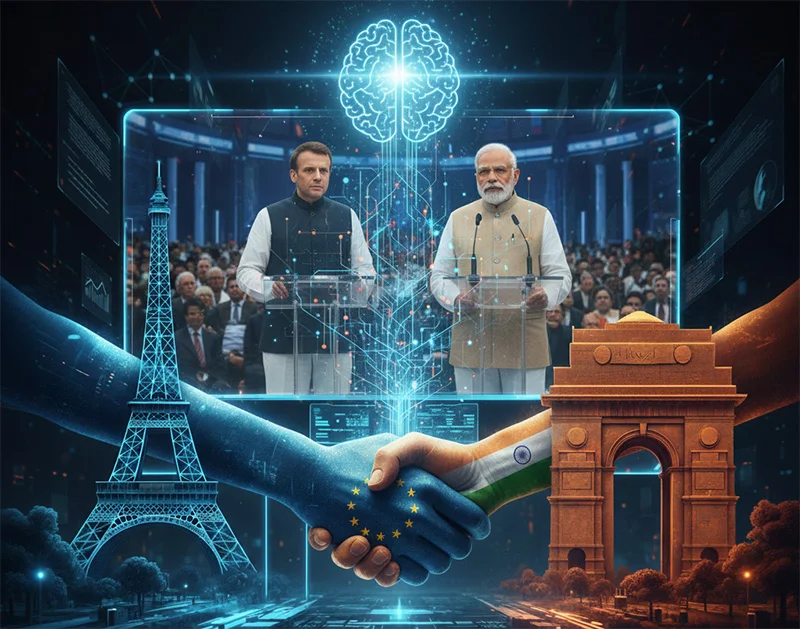
NEW DELHI: French President Emmanuel Macron’s visit to India this week is set to give fresh momentum to the expanding India-Europe partnership in Artificial Intelligence, underlining a shared ambition to shape global AI governance, research and innovation standards.
Macron, in India from February 17 to 19, will engage with Indian leaders and officials and their European counterparts on February 19 to discuss the future of AI cooperation. The visit follows his cochairing of the 2025 AI Action Summit in Paris with Prime Minister Narendra Modi, underscoring continuity in bilateral technology engagement. Senior advisers from the European Commission and AI governance experts are expected to participate in both presummit and summit discussions.
A strategic pillar
Artificial Intelligence has emerged as a strategic pillar of India-France ties. Both countries have committed to collaboration in high-performance computing, AI research, climate modelling, and defence technologies. France’s AI ecosystem – backed by strong public investment and anchored in institutions such as INRIA and leading technology firms – complements India’s scale in digital public infrastructure, data innovation and software talent.
Macron has consistently advocated a ‘third way’ in global technology governance – balancing innovation with regulatory guardrails. This approach aligns with India’s emphasis on responsible AI, data protection and inclusive growth.
Beyond France, India’s AI engagement with Europe has broadened significantly. The India-EU Trade and Technology Council (TTC), launched in 2023, has identified Artificial Intelligence as a core area of cooperation, focusing on standards, semiconductors, secure connectivity and trusted digital infrastructure. European policymakers see India as a key democratic partner in shaping global AI norms amid intensifying geopolitical competition in emerging technologies.
Ethical framework
Several European nations are keen to collaborate with India on ethical AI frameworks and interoperable regulatory systems. The European Union’s AI Act, one of the world’s most comprehensive regulatory regimes, has sparked debate on riskbased governance. Indian policymakers are examining aspects of this framework while pursuing a model tailored to domestic priorities. For Europe, India represents both a vast technology market and a strategic partner capable of scaling AI solutions across healthcare, agriculture, clean energy and urban planning. Joint projects in climate analytics and smart mobility are expected to feature in Macron’s talks with PM Modi.
Diplomats say Macron’s visit signals Europe’s intent to remain closely engaged with India as AI reshapes global economic and strategic dynamics. As nations race to build sovereign AI capabilities, the IndiaEurope axis is positioning itself as a collaborative alternative rooted in democratic values and regulatory dialogue. This week’s exchanges in New Delhi reinforce a central message: India and Europe see each other not merely as markets, but as long-term partners in shaping the future architecture of Artificial Intelligence.