• About us
  • Team
  • Privacy Policy
  • Contact
Friday, July 31, 2026
  • Login
No Result
View All Result
World's first weekly chronicle of development news
  • Blitz Highlights
    • Special
    • Spotlight
    • Insight
    • Entertainment
    • Sports
  • Opinion
  • Legal
  • Perspective
  • Nation
    • East
    • West
    • North
    • South
  • Business & Economy
  • World
  • Hindi Edition
  • International Editions
    • Dubai
    • Tanzania
    • United Kingdom
    • USA
  • Blitz India Business
  • Blitz Highlights
    • Special
    • Spotlight
    • Insight
    • Entertainment
    • Sports
  • Opinion
  • Legal
  • Perspective
  • Nation
    • East
    • West
    • North
    • South
  • Business & Economy
  • World
  • Hindi Edition
  • International Editions
    • Dubai
    • Tanzania
    • United Kingdom
    • USA
  • Blitz India Business
No Result
View All Result
World's first weekly chronicle of development news
No Result
View All Result

A stitch in time

by Blitz India Media
May 15, 2025
in News
0
A stitch in time
Deepak Dwivedi

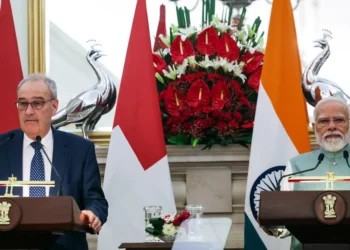
ON May 6, India and the UK concluded a landmark free trade agreement (FTA), marked as a historic milestone by Prime Minister Narendra Modi. The deal grants India zero-duty access to all industrial goods and eliminates import tariffs on over 99.3 per cent for animal products, 99.8 pc for vegetable/oil products, and 99.7 pc for processed foods. Currently, India is UK’s 12th largest trading partner with a share in goods imports of a meagre 1.8 pc. As of 2024, India-UK trade in goods stands at $23.3 billion. The UK imports $15.3 billion worth of goods from India and exports $8.06 billion worth of goods. It largely exports pearls, nuclear reactors, spirits and vehicles, and imports machinery, mineral fuels, pharmaceuticals, apparel, and footwear, etc. The FTA has set an ambitious target of taking the trade partnership to $120 billion by 2030.

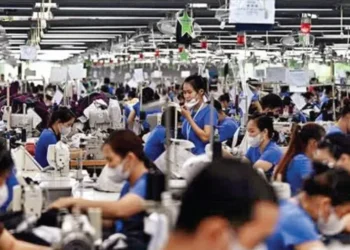
For the FTA promise to translate into real gains, trade must open both ways. India is willing to let British whisky and gin flow more freely, cutting tariffs from 150 pc to 75 pc, and further down to 40 per cent over the next 10 years. Also, British cars can run on Indian roads with a tariff slashed from 100 pc to just 10 per cent. On the other hand, India can gain in labour-intensive sectors like footwear, toys, and textiles and apparel (T&A). The last one (T&A) is of particular interest to India as it employs over 45 million workers, and access to high-end markets can benefit those engaged in this value chain. To make this happen, India needs to stitch many loose ends in its T&A value chain to design high-value apparel products for the UK market.

The UK imports T&A valued at $26.9 billion, of which apparel makes up $19.6 billion. Its apparel imports are primarily from China followed by Bangladesh, with India accounting for a meagre $1.19 billion. So far, the UK imposed average tariffs of 11-12 pc on apparels from major importing countries. With the FTA, India gets preferential treatment with zero-tariff entry which can be a game-changer vis-à-vis its competitors. To take advantage of this, we need to set a few things in order.

India’s T&A sector has structural challenges. It has a fragmented manufacturing base, with MSMEs operating in silos across states. The value chain is disjointed. Cotton is grown in Gujarat and Maharashtra, yarn is spun in Tamil Nadu, fabric is processed in other parts, and garments are stitched across India. This geographical dispersion raises logistics costs and causes delays – a lead time of 63 days from order to delivery, compared to 50 days in Bangladesh. Moreover, India’s policies on man-made fibres lag global preferences, hampered by an inverted goods and services structure and restrictive quality norms.

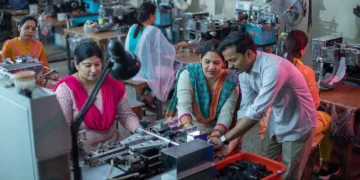
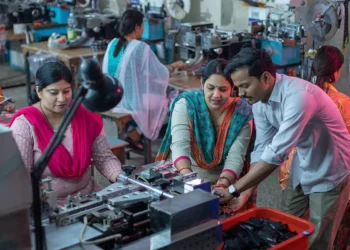
Textiles and apparel sector has a fragmented manufacturing base, with MSMEs operating in silos across states

To address these issues, India must move swiftly on policy, practices, and products to realign the sector with global market demands. The FTA offers a timely blueprint for ongoing trade negotiations with the US and the EU. But deals alone won’t suffice; we must reimagine India’s textile future through integrated hubs, modern manufacturing, compliant supply chains, and demand-driven exports. The opportunity is massive, but so is the urgency. As the saying goes, a stitch in time saves nine. For India’s textile sector, this is that critical stitch.

Related Posts

A historic Indian stepwell built to store and access groundwater
News

448 Billion Cubic Metres: India Is Winning the Groundwater Argument, Slowly, and in the Wrong Places Fastest

July 31, 2026
Historic Indian cinema hall
News

Sixteen Films in Five Weeks: July’s Crowded Calendar Concentrated the Audience Instead of Splitting It

July 31, 2026
ISRO plans seven space missions this financial year while advancing Gaganyaan with key crew-module qualification tests and new space technologies.
News

Three Tests Nobody Watches, and Why They Decide Whether an Indian Comes Home Safely

July 31, 2026
The Sabarmati riverfront in Ahmedabad, Gujarat
Agriculture Bureau

A Red Alert Over Gujarat Closes Ahmedabad’s Classrooms, and the Month Ends Drier Than It Looks

July 31, 2026
electric vehicles
Business

Auto Earnings Carried a Cautious Market — and India’s Electric Car Sales Just Doubled in a Year

July 31, 2026
United Kingdom Parliament
Economy

Two Weeks of CETA: What Changes for an Indian Exporter When 99% of the Tariff Lines Go to Zero

July 31, 2026
Load More
Next Post
India asserts

India asserts

Recent News

A historic Indian stepwell built to store and access groundwater
News

448 Billion Cubic Metres: India Is Winning the Groundwater Argument, Slowly, and in the Wrong Places Fastest

by Blitz India Media
July 31, 2026
0

Blitz Bureau NEW DELHI: India is the world's largest consumer of groundwater, and for three decades the story of that...

Read moreDetails
Historic Indian cinema hall

Sixteen Films in Five Weeks: July’s Crowded Calendar Concentrated the Audience Instead of Splitting It

July 31, 2026
ISRO plans seven space missions this financial year while advancing Gaganyaan with key crew-module qualification tests and new space technologies.

Three Tests Nobody Watches, and Why They Decide Whether an Indian Comes Home Safely

July 31, 2026
The Sabarmati riverfront in Ahmedabad, Gujarat

A Red Alert Over Gujarat Closes Ahmedabad’s Classrooms, and the Month Ends Drier Than It Looks

July 31, 2026
electric vehicles

Auto Earnings Carried a Cautious Market — and India’s Electric Car Sales Just Doubled in a Year

July 31, 2026

Blitz Highlights

  • Special
  • Spotlight
  • Insight
  • Entertainment
  • Health

International Editions

  • US (New York)
  • UK (London)
  • Middle East (Dubai)
  • Tanzania (Africa)

Nation

  • East
  • West
  • South
  • North
  • Hindi Edition

E-paper

  • India
  • Hindi E-paper
  • Dubai E-Paper
  • USA E-Paper
  • UK-Epaper
  • Tanzania E-paper

Useful Links

  • About us
  • Team
  • Privacy Policy
  • Contact

©2024 Blitz India Media -Building A New Nation

Welcome Back!

Login to your account below

Forgotten Password?

Retrieve your password

Please enter your username or email address to reset your password.

Log In

    No Result
    View All Result
    • Blitz Highlights
      • Special
      • Spotlight
      • Insight
      • Entertainment
      • Sports
    • Opinion
    • Legal
    • Perspective
    • Nation
      • East
      • West
      • North
      • South
    • Business & Economy
    • World
    • Hindi Edition
    • International Editions
      • Dubai
      • Tanzania
      • United Kingdom
      • USA
    • Blitz India Business

    ©2024 Blitz India Media -Building A New Nation