
• About us
  • Team
  • Privacy Policy
  • Contact
Wednesday, October 14, 2026
  • Login
No Result
View All Result
World's first weekly chronicle of development news
  • Blitz Highlights
    • Special
    • Spotlight
    • Insight
    • Entertainment
    • Sports
  • Opinion
  • Legal
  • Perspective
  • Nation
    • East
    • West
    • North
    • South
  • Business & Economy
  • World
  • Hindi Edition
  • International Editions
    • Dubai
    • Tanzania
    • United Kingdom
    • USA
  • Blitz India Business
  • Blitz Highlights
    • Special
    • Spotlight
    • Insight
    • Entertainment
    • Sports
  • Opinion
  • Legal
  • Perspective
  • Nation
    • East
    • West
    • North
    • South
  • Business & Economy
  • World
  • Hindi Edition
  • International Editions
    • Dubai
    • Tanzania
    • United Kingdom
    • USA
  • Blitz India Business
No Result
View All Result
World's first weekly chronicle of development news
No Result
View All Result

Fertiliser Squeeze as Good Monsoon Spurs Demand

by Blitz India Media
September 5, 2025
in News
0
farmer
Blitz Bureau

NEW DELHI: India’s abundant southwest monsoon has been a blessing for farmers but has also laid bare the country’s fertiliser fault lines. While rainfall has brought relief to parched fields and spurred kharif sowing, it has simultaneously triggered a scramble for fertilisers, exposing supply gaps and heavy dependence on imports.

Fields Flourish, Demand Surges

From June to August, cumulative rainfall stood at more than 60 per cent above the seasonal average, spread evenly across most regions. Encouraged by the timely showers, farmers expanded acreage under rice, pulses and cotton. Rice sowing alone rose sharply, pushing overall kharif coverage to record levels.

This expansion naturally lifted demand for plant nutrients. Sales of urea crossed 124 lakh tonnes between April and July, while diammonium phosphate (DAP) jumped by nearly 29 per cent. Single superphosphate and muriate of potash also logged strong double-digit growth. Many cultivators even shifted part of their requirement from DAP to NPK and SSP, highlighting both affordability concerns and the urgency of securing nutrients at sowing time.

Supply Strains and Import Rush

Domestic production failed to keep pace. Urea output during April–July slipped below last year’s levels, and DAP production too declined. To fill the gap, India leaned heavily on imports: urea inflows almost doubled in the April–June quarter, while DAP imports surged to over nine lakh tonnes. Yet, despite these efforts, queues and rationing were reported in several states.

Global Dependence, Local Stress

India’s fertiliser safety net is still tied to global supply lines. China, once a major exporter of DAP and other phosphatic products, has tightened shipments, fuelling uncertainty. This has forced India to scout more aggressively in Morocco, Saudi Arabia and Russia.

“When the skies deliver plenty, the soil must not be left waiting. India’s next agricultural revolution lies not in rainfall, but in securing the nutrients that sustain it.”

At home, the government has kept urea prices frozen at ₹242 per 45-kg bag since 2018, with subsidies bridging the gap. A special subsidy of ₹3,500 per tonne has been extended to DAP as well, keeping retail prices steady despite volatile international markets. But subsidies alone cannot solve the problem of physical availability. Reports of black-marketing and diversion in some districts underline how supply shortages translate into farmer distress at the ground level.

Blitz View

The crisis offers clear lessons. India must expand domestic capacity, reduce its reliance on imported DAP, and encourage balanced fertiliser use through NPK and SSP. Without such steps, every good monsoon could paradoxically become a stress point, turning bounty into bottleneck.

Related Posts

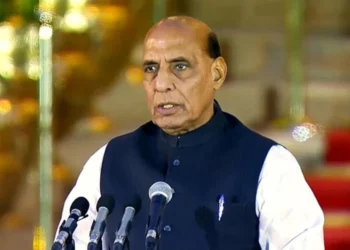
Rajnath Singh
News

India offers ASEAN joint manufacture of defence systems

October 14, 2026
India Canada diplomatic ties
News

India News: Canada Ties, Ports, Minerals and Stubble Fires

October 14, 2026
Asian Champions Trophy 2026
News

Pathak returns as India names squad for Asian Champions Trophy

October 13, 2026
Electronics production grows seven-fold : MeitY
News

New Delhi, 13 October : India’s fintech sector raised $2.2 billion in the first nine months of 2026 (January 1, 2026–September 30, 2026), up 14 per cent from $1.9 billion in the same period a year earlier, a report said. The report from data intelligence platform Tracxn Technologies Limited said funding rounds dipped from 260 to 153, adding that the funding was concentrated in a smaller number of large late‑stage rounds, with five mega‑rounds of $100 million or more accounting for $1.1 billion or 48 per cent of total capital. The report said in the first nine months of 2026, digital lending and payments topped the category rankings, while Bengaluru accounts for over three-fifths of all capital raised. On the exit side, IPOs saw a 50 per cent uptick while overall acquisitions slowed. As many as 30 companies raised their first funding round, down 49 per cent from 59 in the previous year. Series A and later rounds totalled 77, down 31 per cent from 112. Late-stage funding (Series C+, PE, and pre-IPO) led the mix, rising 95 per cent to $1.5 billion in the first nine months of 2026 — up from $751 million during the same period in the previous year. This capital surge pushed late-stage investments to 67 per cent of total market funding, the report noted. Earlier stages experienced contractions in capital and deal counts. Early-stage funding fell 33 per cent to $668 million across 52 rounds, compared to $1 billion across 82 rounds in nine months of 2025. Seed funding fell 57 per cent to $73.8 million across 76 rounds, down from $173 million across 148 rounds. New unicorns crossed the billion-dollar threshold in an average of 7.1 years after their Series A funding. Moreover, the industry saw 3 IPOs in nine months of 2026, up 50 per cent from 2 in the previous year, alongside 11 acquisitions, down 45 per cent from 20.

October 13, 2026
Indian stock market
News

IBM and MeitY Startup Hub partner to support India’s deep-tech startups with AI, cloud, quantum computing and mentorship.

October 13, 2026
IBM
News

IBM, MeitY sign MoU to boost India’s deep-tech

October 13, 2026
Load More
Next Post
Urjit Patel

Urjit Patel at the IMF puts India’s reform story on the global stage

Recent News

Rajnath Singh
News

India offers ASEAN joint manufacture of defence systems

by Blitz India Media
October 14, 2026
0

NEW DELHI, 14 October— India is ready to explore building patrol vessels, radars, air-defence systems, helicopters and drones together with...

Read moreDetails
India Canada diplomatic ties

India News: Canada Ties, Ports, Minerals and Stubble Fires

October 14, 2026
Asian Champions Trophy 2026

Pathak returns as India names squad for Asian Champions Trophy

October 13, 2026
Electronics production grows seven-fold : MeitY

New Delhi, 13 October : India’s fintech sector raised $2.2 billion in the first nine months of 2026 (January 1, 2026–September 30, 2026), up 14 per cent from $1.9 billion in the same period a year earlier, a report said. The report from data intelligence platform Tracxn Technologies Limited said funding rounds dipped from 260 to 153, adding that the funding was concentrated in a smaller number of large late‑stage rounds, with five mega‑rounds of $100 million or more accounting for $1.1 billion or 48 per cent of total capital. The report said in the first nine months of 2026, digital lending and payments topped the category rankings, while Bengaluru accounts for over three-fifths of all capital raised. On the exit side, IPOs saw a 50 per cent uptick while overall acquisitions slowed. As many as 30 companies raised their first funding round, down 49 per cent from 59 in the previous year. Series A and later rounds totalled 77, down 31 per cent from 112. Late-stage funding (Series C+, PE, and pre-IPO) led the mix, rising 95 per cent to $1.5 billion in the first nine months of 2026 — up from $751 million during the same period in the previous year. This capital surge pushed late-stage investments to 67 per cent of total market funding, the report noted. Earlier stages experienced contractions in capital and deal counts. Early-stage funding fell 33 per cent to $668 million across 52 rounds, compared to $1 billion across 82 rounds in nine months of 2025. Seed funding fell 57 per cent to $73.8 million across 76 rounds, down from $173 million across 148 rounds. New unicorns crossed the billion-dollar threshold in an average of 7.1 years after their Series A funding. Moreover, the industry saw 3 IPOs in nine months of 2026, up 50 per cent from 2 in the previous year, alongside 11 acquisitions, down 45 per cent from 20.

October 13, 2026
Indian stock market

IBM and MeitY Startup Hub partner to support India’s deep-tech startups with AI, cloud, quantum computing and mentorship.

October 13, 2026

Blitz Highlights

  • Special
  • Spotlight
  • Insight
  • Entertainment
  • Health

International Editions

  • US (New York)
  • UK (London)
  • Middle East (Dubai)
  • Tanzania (Africa)

Nation

  • East
  • West
  • South
  • North
  • Hindi Edition

E-paper

  • India
  • Hindi E-paper
  • Dubai E-Paper
  • USA E-Paper
  • UK-Epaper
  • Tanzania E-paper

Useful Links

  • About us
  • Team
  • Privacy Policy
  • Contact

©2024 Blitz India Media -Building A New Nation

Welcome Back!

Login to your account below

Forgotten Password?

Retrieve your password

Please enter your username or email address to reset your password.

Log In

    No Result
    View All Result
    • Blitz Highlights
      • Special
      • Spotlight
      • Insight
      • Entertainment
      • Sports
    • Opinion
    • Legal
    • Perspective
    • Nation
      • East
      • West
      • North
      • South
    • Business & Economy
    • World
    • Hindi Edition
    • International Editions
      • Dubai
      • Tanzania
      • United Kingdom
      • USA
    • Blitz India Business

    ©2024 Blitz India Media -Building A New Nation