 The Indian freedom movement got renewed momentum in 1919 after a characteristic display of brutal British despotism, as manifest in the Jallianwala Bagh massacre, and the broken promises of World War I. Within the next seven decades, the world map changed beyond recognition. There were about 50 recognisable states in 1920; 80 after the realignments following World War II; and around 190 by the 1990s after the collapse of the communist Soviet Union. Communism, after promising liberation to the oppressed classes, became as multinational a concept as any empire hiding behind an ideology.
The anomaly of 1947 was Pakistan, created through a tortured argument which diminished a universal faith, Islam, into a parochial nationalism. Within a decade, Pakistan had degenerated into a ‘jelly state’.
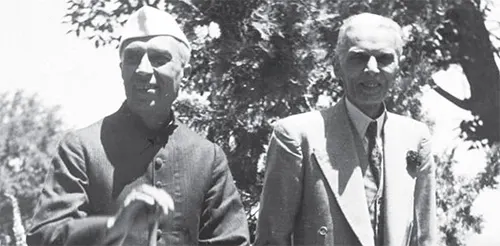
Its sole architect Muhammad Ali Jinnah, who used hyperbole with the panache of a lawyer uncertain of his brief, fought for freedom from Hindus rather than the British. In 1946, speaking in Cairo, which was a stopover on the air route to London, he said that “Hindu India” would become an “imperialistic power” and a greater “menace for the future” than the British Empire had ever been. Paradoxically, Jinnah accepted that Pakistan would not be able to preserve its independence without a powerful ally, and selected America as its shield through reductive reasoning.
Britain and France had become crippled; the Soviet Union was communist, atheist and hence anti-Islam. America was a natural benefactor given the geography of West Pakistan. In November 1946, Jinnah sent his friend, the industrialist MAH Ispahani, on an exploratory tour to America. Ispahani reported that Americans were amenable to “sweet words” and first impressions mattered.
Sweet geopolitical music
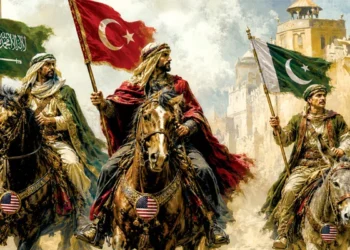
Jinnah turned on some sweet geopolitical music. Wearing what was described as a satisfied smile, he told the American journalist Margaret Bourke-White in September 1947 that Russia was not far away from Pakistan. “America,” he volunteered, “needs Pakistan more than Pakistan needs America. Pakistan is the pivot of the world, as we are placed – the frontier on which the future of the world revolves.” That was the geography of the Cold War, but the Jinnah doctrine prevails: Pakistan would become a Western base for ‘Middle Eastern defence’, a fortress against the southward pressure of the Soviet Union.
On September 11, 1947 Jinnah set the context for his America tilt by telling his Cabinet that Russia alone had not sent a congratulatory message on Pakistan’s birth. He then sent a formal request to Charles Lewis, the American chargé d’affaires in Karachi, for $2 billion in aid over the following five years. Pakistan has never underestimated the price of the sale of Pakistan.
America was listening with interest. In 1950 President Harry Truman sent an aircraft to London to pick up Pakistan Prime Minister Liaquat Ali Khan on his way for his first visit to the States, and was at the airport on May 3 to receive Khan. It was a deliberate snub to India, whose Prime Minister Jawaharlal Nehru had gone to the White House armed with lectures and advice on world peace. Khan pledged full support to the US against communism, and voted with America in the United Nations on North Korea.
Jinnah did not live to see his dreams come true, but they did. On January 5, 1954 President Eisenhower agreed in principle to send military aid to Pakistan, and on May 19, 1954 America and Pakistan signed the Mutual Defence Agreement in Karachi.
Refusal to admit
What Jinnah did not realise, or refused to admit, was that Pakistan would become a base against American foes among Muslim countries to Pakistan’s west. Pakistan supported the Anglo- French-Israeli invasion of the Suez Canal in 1956, which India opposed. By 1958 Washington had decided that it had had enough of fractious civilian politicians in Karachi and backed the military coup by General [later Field Marshal] Ayub Khan. Generals spoke straight, and shot straight, in the decisive view of the Pentagon. America was also being governed by a General, albeit democratically elected.
In December 1959 Eisenhower visited Pakistan in a public endorsement of the military takeover of Pakistan, which has not ended. Pakistan has what can only be described as bicameral authority: instead of two chambers of the legislature, it has two sources of power. The Army controls its levers on a permanent basis; the civilians come and go, and go more often than they come.
Washington has never permitted any fog over the relationship. Pervez Musharraf was brought to heel when America moved against Afghanistan, and then Iraq, after 9/11. In both instances, Musharraf had to silence his own country’s public opinion to obey Washington. Bringing knowledge up to date, America bombed Iran from bases in Pakistan when it joined Israel in the recent war against Iran. Israel is not a popular country in Pakistan but no generalissimo in Islamabad can do anything but obey and collect reward points from the Pentagon.
Nothing sentimental
The powerful American lobby in Delhi refuses to understand a basic truth, with India paying a price for its misapprehensions. For America, India will be a friend but Pakistan will be an ally.
There is nothing sentimental in the American position. India will not permit American Generals to order bombers to lift off from its territory to bomb any other nation. Pakistan does. Its President also decorates the American General who ran the operation with its highest military award. Pakistan was born in the name of Islam. This does not prevent Pakistan from cooperating with America or the West against Muslim countries: Egypt in 1956, Afghanistan in 2001, Iraq in 2003, Iran in 2025.
Pakistan’s birth mistake was to confuse Islam with nationalism, and so it keeps silent about contradictions. It surrendered, in the Jinnah doctrine, its independence to preserve its freedom. Pakistan was shocked when America could not do enough in the 1971 war with India which led to the emergence of Bangladesh, another reminder that Islam had nothing to do with nationalism.
Perhaps our only recourse in such a discourse is to return to divinity. Thank you, Lord Buddha, for such good advice: “What is the use of discussing doctrines about the soul? Do good and be good and this will take you to freedom and whatever truth there is.”