Blitz Bureau
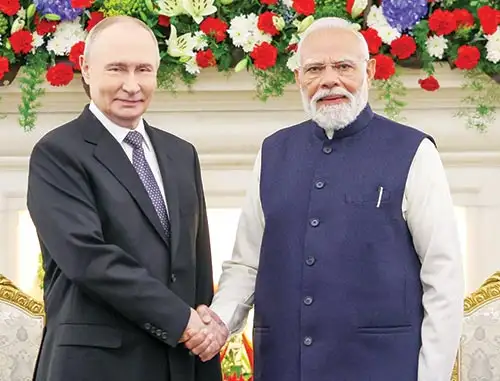
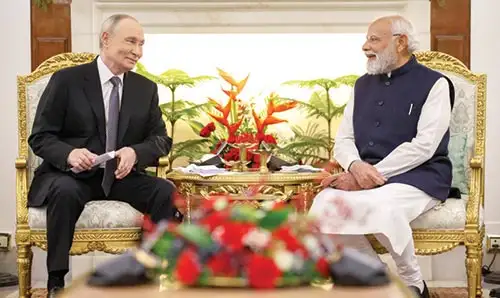
NEW DELHI: Russian President Vladimir Putin’s India visit on December 4-5 marked a paradigm shift in bilateral ties – from historical depth to a strategic future. Beyond ceremonial warmth and signing of 10 inter-governmental agreements and 15 commercial deals, top leaders of the two countries discussed the ongoing geopolitical concerns and explored a common approach to deal with them.
US President Donald’s Trump’s punitive tariffs against Indian import of Russian crude and his latest initiative to end Ukraine war provided the backdrop. But President Putin’s summit meeting with Prime Minister Narendra Modi also explored a common approach to address emerging economic, energy, technology, defence and security challenges. Putin’s previous visits to India have been predictable. His decision to attend the 23rd India-Russia this time, however, created an unusual flutter in New Delhi’s diplomatic enclave. A highly polemical article by top diplomats from the UK, France and Germany on the eve of Putin’s arrival underscored the West’s unease.
Independent analysis saw this as a desperate bid to scuttle India’s ties with its traditional ally in a bid to make Russia friendless. The tangible outcomes of the India-Russia summit, however, shows that India can assert its strategic autonomy.
The Putin-Modi talks have not only opened a way out to address India’s energy security despite US sanctions on import of crude oil from Russia, but also ensured more significant support from Moscow to meet its medium-term defence requirements.
The most assuring feature of India’s arms transfer relationship with Russia is that the Russians are willing to offer systems that others would hesitate to provide, and do so without any pre-conditions. India and Russia have agreed to proceed with a project to make the Brahmos-II, which will be based on the Russian missile Zircon, a scramjet-powered, hypersonic cruise missile.
While the expectations from the decade old India-US civil nuclear deal are yet to be met, Russia has already helped India in expanding its nuclear power generation. Now that India has opened its nuclear power sector for private players, Russian companies have started negotiations with their Indian counterparts.
Putin’s visit has fortified Russia’s commitment to India’s defence preparedness and energy security. In the somewhat turbulent geopolitical environment of the day, the visit by a longstanding and steady partner will be well-received by the country. The US will be closely watching the outcome, both from the point of view of the oil issue and additional arms deals between India and Russia.