Parth Nadpara
NEW DELHI: The world of global finance is officially on notice. The Gujarat International Finance Tec-City (GIFT City), a project once dismissed as a vision for tomorrow, is now the fully operational system powering India’s integration into the global economy.
In a week of high-velocity institutional milestones, this International Financial Services Centre (IFSC) has signaled its arrival as a mature global financial hub, successfully on-shoring the kind of complex, dollar-denominated activity that was once the exclusive domain of established rivals like Singapore and Dubai.
From the launch of a revolutionary retail investment platform to the successful closing of its first-ever dollar-denominated initial public offering (IPO), the momentum is undeniable. As of March 2026, GIFT City has ascended to 43rd position in the Global Financial Centres Index (GFCI), critically securing the coveted top spot in the index’s reputation category.
With a surging count of over 1,034 registered entities and a formidable banking asset base that has punched through the $100 billion barrier, the ‘project of the future’ is officially delivering.
How banking rewrote the rules
The cornerstone of GIFT City’s meteoric rise remains its powerful banking ecosystem. Aggregate assets within IFSC Banking Units (IBUs) have now surpassed the staggering $100.14 billion mark, with total transaction volumes soaring to $142.98 billion.
This is not merely a number; it represents a seismic shift in global financial architecture. Leading the charge are global giants such as JP Morgan, HSBC, and Barclays, which have strategically shifted high-value transaction hubs away from traditional financial capitals and into this dedicated enclave.
Crucially, a structural pivot is dramatically underway in the debt markets. IBUs now account for roughly 36 per cent of India’s total External Commercial Borrowings (ECBs).
This demonstrates a massive vote of confidence, as multinational corporations and Indian giants are choosing to raise dollar debt on home soil rather than incurring the costs and complexities of issuing in London or Singapore.
This momentum is not expected to slow down; the recently released Union Budget 2026-27 solidified the city’s long-term appeal by extending the tax holiday for IBUs to an unprecedented 20 years within a 25-year block, offering generational fiscal certainty that rivals any jurisdiction globally.
Retail access and ‘equity moment’
For common investor, the most electrifying development unfolded on March 20, 2026, with the launch of the “Global Access” platform by the NSE International Exchange (NSE IX). This platform is a game-changer, shattering old barriers and providing Indian retail investors and non-resident Indians (NRIs) with the ability to seamlessly invest in nearly 30 global markets including the US, UK, and Japan all through a single, easy-to-use mobile application.
The platform champions financial inclusion through features like fractional investing, allowing users to buy small portions of high-value stocks such as Apple and Alphabet, democratising access to global wealth creation.
Simultaneously, the city celebrated its profound “equity moment” on March 16, 2026, with the highly anticipated launch of the XED Executive Development IPO. This was the first-ever public offering from GIFT City.
Crucially, the $12 million issue was fully denominated in US dollars and listed on both the NSE IX and India INX. The successful closure of this IPO is more than just a fundraising event; it is a vital proof-of-concept that firmly establishes GIFT City as a premier, credible venue for global capital raising, offering unparalleled regulatory and tax advantages for issuers.
From dollars to euros and the ‘master key’
GIFT City’s ascent is founded on its capacity for regulatory agility, facilitated by its unified and autonomous regulator, the International Financial Services Centres Authority (IFSCA). This unified framework allows for rapid, impactful policy changes that keep the hub competitive.
On March 20, IFSCA proposed the introduction of real-time foreign-exchange settlements in euros. This proposal follows the wildly successful implementation of real-time dollar settlements, which slashed transaction times from 24 hours to mere seconds, revolutionising the speed of global trade.
The strategic move into euros is designed to deepen financial ties and transactional volumes with the European Union, positioning GIFT City as a critical bridge between Asia and Europe.
Innovation, meanwhile, is being protected and accelerated. The March 16 approval of the new Fintech Sandbox Framework is being hailed as the “master key” for financial technology.
This framework formalises a critical separation: high-risk, frontier fintech innovation is distinct from stable “techfin” services, creating a secure, low-risk environment for breakthroughs in disruptive technologies like AI and blockchain.
This regulatory clarity has paid dividends, attracting fresh investment, including Wipro’s high-profile launch of an AI-powered BFSI (Banking, Financial Services, and Insurance) transformation hub on March 19. The message is clear: GIFT City is where the future of finance is being coded.
The scarcity premium
The city’s physical and social landscape is evolving as fast as its ledger. Planners have adopted a shrewd “scarcity by design” model within the master plan, dedicating only 22 per cent of land for residential use.
This strategic limitation has created a premium, driving high rental yields between 4.5 per cent and 6 per cent that significantly outperform traditional Indian metropolitan areas and ensure sustained value appreciation.
To achieve genuine global parity, the city has focused on resolving operational frictions for multinational firms. The relaxation of the controversial “wine & dine” policies in late 2025 was a watershed moment.
Foreign nationals and visitors can now consume alcohol at licensed venues simply by presenting a valid ID, removing a major hurdle for attracting and retaining high-value global talent.
Looking toward 2030, the city’s skyline will be dramatically redefined by the towering “GIFT Eye,” a 158-meter tall Ferris wheel that will anchor a new, vibrant 20.5-acre social infrastructure zone, ensuring a world-class lifestyle.
Global trio: A new competitive edge
As GIFT City’s trajectory steepens, the inevitable comparison with the established giants – the Dubai International Financial Centre (DIFC) and Singapore’s MAS-regulated ecosystem – has become the central debate for global investors.
While Singapore remains the global benchmark for stability and Dubai leads in lifestyle branding. GIFT City has aggressively carved out a unique competitive advantage founded on three core pillars: cost, legal evolution, and geopolitical neutrality.
The most immediate differentiator is cost. GIFT City provides Grade A office space at roughly $10-$15 per square foot, a mere fraction of the $45-$60 seen in Dubai and the prohibitive $70-$100 commanded by Singapore.
When coupled with India’s vast, skilled talent pool, firms are reporting operational costs that are a decisive 30 per cent to 40 per cent lower than in traditional offshore hubs.
This efficiency allows multinational firms to onshore high-skilled, high-value functions – such as sophisticated risk management, complex legal compliance, and advanced analytics – that would simply be cost-prohibitive elsewhere.
Fiscal policy is equally aggressive. The 2026 Union Budget’s proposal to extend the tax holiday to two decades (within a 25-year block) provides a level of multi-decade certainty that directly challenges Dubai’s zero-tax zones.
Unlike Singapore’s 17 per cent corporate rate, GIFT City units enjoy a 100 per cent exemption on eligible income, alongside zero GST, Securities Transaction Tax (STT), and Dividend Distribution Tax (DDT). This tax regime is an unmissable incentive for capital.
Crucially, to bridge the institutional trust gap, GIFT City is rapidly evolving its legal framework. While both Dubai and Singapore operate under English common law, GIFT City’s new Alternative Dispute Resolution Centre (ADRC) now allows contracting parties the flexibility to select foreign law (including English or Singapore law) for their agreements.
The cornerstone of GIFT City’s meteoric rise remains its powerful banking ecosystem. Aggregate assets within IFSC Banking Units (IBUs) have now surpassed the staggering $100.14 billion mark, with total transaction volumes soaring to $142.98 billion.
A meticulously planned three-phase judicial approach will eventually incorporate international judges, ensuring the jurisdictional credibility required by global institutional capital.
Finally, in an era defined by global volatility and uncertainty, GIFT City is positioning itself as a strategic “safe haven.” Sovereign wealth funds and large family offices are increasingly viewing the hub as a secondary, neutral “lifeboat” for capital.
It offers essential operational immunity from regional conflicts – such as those currently impacting West Asia – while maintaining a physical and symbiotic connection to the high-growth Indian economy.
With an ambitious target of 100,000 jobs by 2030, the Gujarat Gambit is no longer just “India’s answer.” It is a credible, compelling, and rapidly emerging global contender, fundamentally redefining the power map of international finance.
Rival Dubai and Singapore?
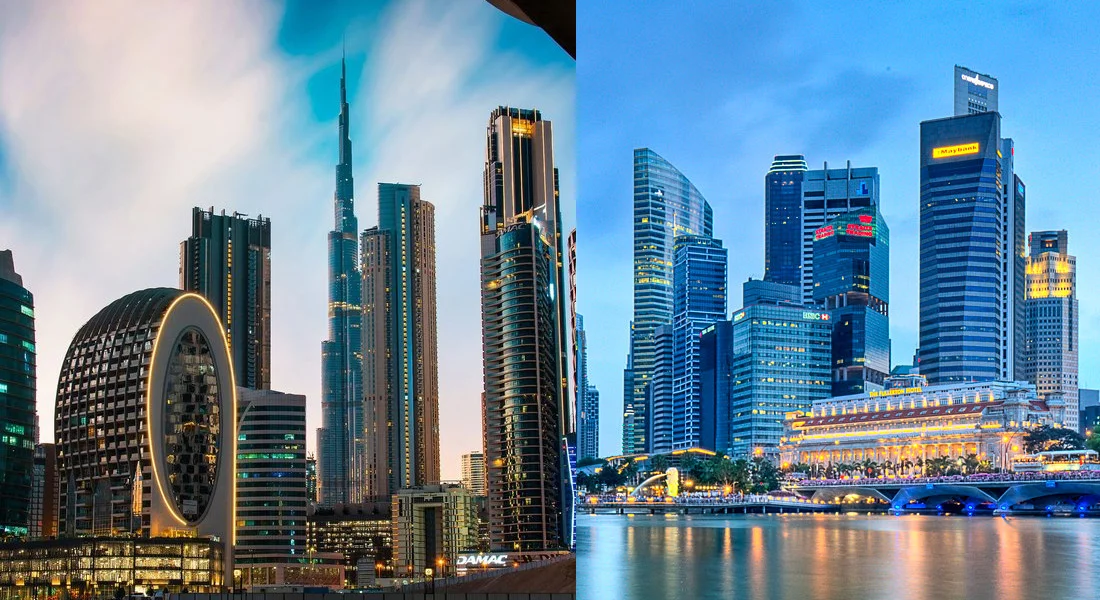
GIFT City can rival Dubai and Singapore in select India-linked businesses, but not yet across the full spectrum of global finance. The gap is still large in scale and global connectivity.
In the September 2025 Global Financial Centres Index, Singapore ranked fourth globally and Dubai 11th, while GIFT City-Gujarat ranked 43rd. The same report noted that GIFT has fewer connections to other financial centres than established hubs such as Hong Kong, which is a proxy for the network depth that major centres enjoy.
Where GIFT does have a real edge is India-linked intermediation. It offers a unified regulator in IFSCA, an offshore-style foreign-currency jurisdiction inside India, tax incentives, direct access to Indian opportunity, and now local foreign-currency settlement infrastructure.
The 2026 budget move to extend the IFSC profit-linked tax deduction to 20 years out of 25 strengthens that proposition further. That makes GIFT especially competitive for India-focused offshore borrowing, treasury activity, fund relocation, aviation and ship leasing, and potentially equity listings.
Dubai and Singapore, however, still have advantages that take years to build: deeper pools of global capital, stronger international investor familiarity, richer professional-services ecosystems, thicker secondary-market liquidity, and more mature liveability for expatriate and regional talent.
Recent reporting has also highlighted that GIFT still needs better housing, talent availability and urban vibrancy if it wants firms to move senior decision-makers, not just back-office or booking functions.
So the realistic answer is this: GIFT City is not yet a like-for-like replacement for Dubai or Singapore as a broad global financial centre, but it is becoming a credible alternative for India-centric global finance.
If current momentum in banks, funds, payments infrastructure and listings continues, GIFT may not need to beat those hubs at everything. It only needs to become the default location for international financial business connected to India. On that narrower, commercially important test, it is making visible progress.