
Harvinder Ahuja
The new Fiscal Health Index 2026, released recently by NITI Aayog, is a stress map of India’s federal economy. The index assesses state finances for 2023-24 across five pillars — quality of expenditure, revenue mobilisation, fiscal prudence, debt index and debt sustainability — and in doing so throws up a national message that is unmissable: India’s macro story may look steady from New Delhi, but the fiscal foundations beneath it are far from even.
States account for a large share of public spending in India, especially in health, education, agriculture, local infrastructure and welfare delivery. If their finances weaken, national growth does not collapse immediately, but it becomes more brittle.
NITI Aayog says the index has been designed to “evaluate fiscal soundness, guide reforms, and encourage evidence-based fiscal policymaking,” which is official language for a fairly blunt concern: too many states are still spending under pressure, borrowing heavily, and leaving themselves with too little room to respond to future shocks.
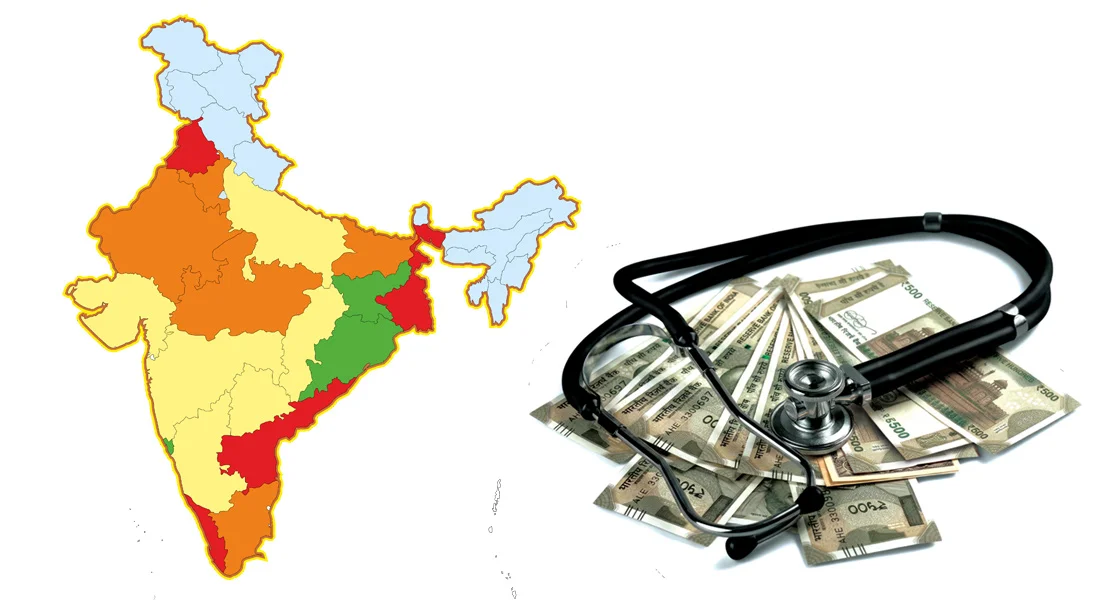
The rankings themselves underline that divergence. Among the 18 major states, Odisha, Goa, Jharkhand, Chhattisgarh and Gujarat are among the better performers, while Punjab, Andhra Pradesh, West Bengal and Kerala occupy the bottom end.
In the Northeast and Himalayan group, Arunachal Pradesh leads. The spread is politically important because it shows that fiscal stress in India is no longer a neat ideological story of one model versus another. It cuts across regions and party lines.
What separates stronger states from weaker ones is less rhetoric than the basic arithmetic of revenue strength, debt control and the ability to spend on productive heads rather than being trapped by committed liabilities.
At the national level, the first implication is that India’s public finance debate can no longer be confined to the Union Budget. The Centre may be meeting its consolidation path, but if several states remain fiscally stretched, the broader public sector balance sheet stays vulnerable.
This is especially true in a country where the states carry much of the burden of day-to-day development spending. A fiscally stressed state government cuts capital expenditure, postpones payments, leans more heavily on borrowing, or squeezes maintenance and service delivery.
None of that shows up as a dramatic national crisis overnight. But over time it drags down investment quality, public service outcomes and growth potential.
The second national message is about the quality, not just the quantity, of spending. The index’s emphasis on “quality of expenditure” is an important corrective to the old habit of judging fiscal health only by deficit numbers.
A state can look politically active and administratively busy while still allocating too much to salaries, subsidies, interest payments and other committed heads, leaving too little for capital creation. That is why this index matters more than a simple debt league table.
It asks whether public money is building future capacity or merely financing the present. For India as a whole, that is a crucial distinction, because the country’s growth ambition depends not only on how much governments spend, but on what they spend on.
A third implication is that debt stress is no longer a peripheral issue. NITI’s framework explicitly separates debt levels from debt sustainability, which is smart because a state can carry high debt for some time if its revenues are robust and its liabilities are manageable.
But where revenue growth is weak and committed expenditure is high, debt quickly becomes a structural trap. Recent reporting around the index has highlighted exactly that pattern in states such as Punjab and Himachal Pradesh, where liabilities remain elevated and fiscal space narrow.
Telangana, by contrast, illustrates a more mixed case: stronger revenue mobilisation has improved its standing, but debt concerns remain alive. This tells us something important at the national level: India’s next fiscal challenge may not be a spectacular sovereign blow-up, but a prolonged subnational squeeze in which some states steadily lose room to invest while continuing to borrow.
There is also a federalism angle here. Suman Bery, NITI Aayog’s Vice-Chairman, has repeatedly argued in recent public discussions that India’s development path depends on competitive and cooperative federalism working together.
The Fiscal Health Index is a tool built in that spirit: it names the stronger performers, exposes the weaker ones and nudges states to compare themselves with peers rather than only negotiate with the Centre.
NITI’s own presentation of the index frames it as a mechanism to identify reform priorities and spread best practices. That matters because Indian federalism increasingly runs on benchmarking. The politics of rankings now shapes policy in everything from logistics to school education, and fiscal management is joining that list.
NITI Aayog’s new Fiscal Health Index makes clear that the real test of India’s fiscal resilience lies not only in the Union Budget, but in whether state governments can raise revenue, control debt and spend productively
Experts on public finance have long made the same point in less bureaucratic language: weak state finances eventually become a national problem. Rathin Roy, former director of the National Institute of Public Finance and Policy, has often argued that India’s fiscal debate is distorted when it treats the Centre and the states as separate silos, because macro stability depends on the general government picture, not just on the Union’s books.
That broader view fits the message of the new index. A strong headline GDP number can coexist with fragile state balance sheets for a while. It cannot do so indefinitely.
The politics of welfare will also hang over the report. Across states, electoral competition has increased pressure for cash transfers, power subsidies, social support schemes and other recurring commitments.
Many of these outlays are politically popular and, in some cases, socially necessary. But the index quietly asks whether states are financing them on a sustainable base. That is a tough national question because India’s development model cannot rely on a permanent mismatch between rising expenditure promises and weak own-revenue capacity.
The better-ranked states are not simply spending less; many are mobilising more revenue and managing debt more prudently. That is the real lesson.
There is a deeper warning too. India is entering a period when states will be expected to do more, not less: urbanisation, climate adaptation, local infrastructure, public health resilience, water stress and skilling all require capable subnational finances.
A state already weighed down by debt and rigid expenditure has less ability to respond to a flood, heatwave, commodity shock or employment slowdown. So the index is not just about bookkeeping. It is about resilience.
At one level, then, the Fiscal Health Index 2026 is a technocratic exercise. At another, it is a political-economic document with a clear national message. India’s growth story will be only as durable as the states that carry it.
If stronger states use their fiscal room for productive investment while weaker ones remain trapped in debt, deficits and rigid spending, the country will see a widening gap in development capacity across its federal map. That would weaken the national project itself.
In that sense, the report is both a mirror and a warning. It shows that India has pockets of fiscal strength worth emulating. But it also shows that national macro comfort can be misleading if the states beneath it are fiscally uneven.
The real takeaway is plain enough: the next chapter of India’s economic reform story will not be written only in North Block. It will be written in state capitals, in how they raise revenue, manage debt and choose between spending that buys votes and spending that builds capacity.