Blitz Bureau
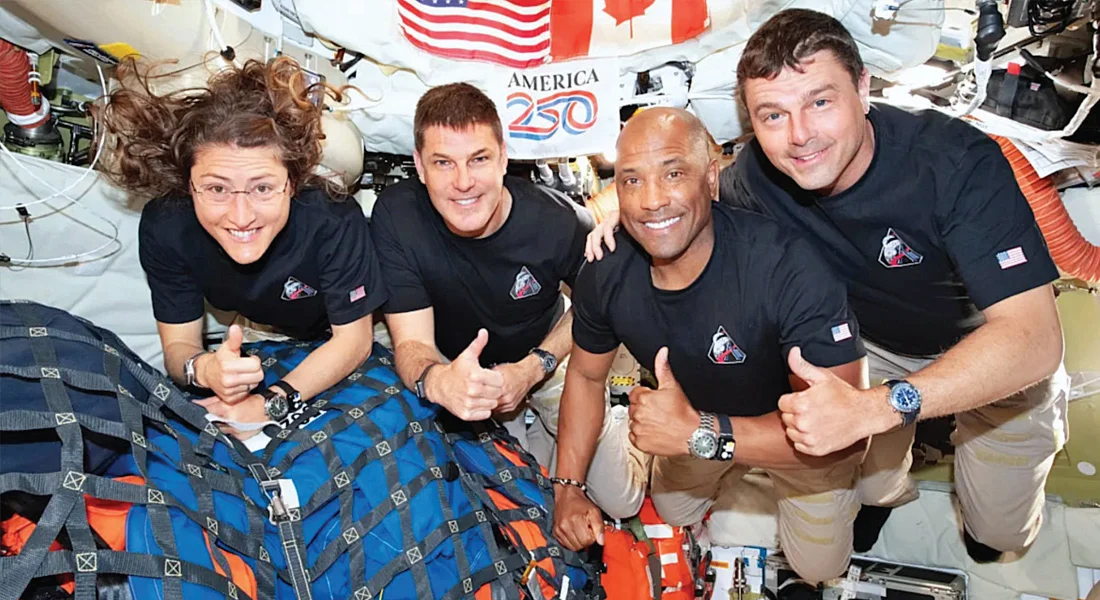
NEW DELHI: The Artemis II capsule and its four-member crew streaked through Earth’s atmosphere and safely splashed down in the Pacific Ocean on April 10 after nearly 10 days in space, capping the first voyage by humans to the vicinity of the moon in over half a century.
NASA’s gumdrop-shaped Orion capsule, dubbed Integrity, parachuted gently into calm seas off Southern California, concluding a mission that four days prior took the astronauts 252,756 miles away from Earth, deeper into space than anyone had flown before.
First of a kind
The Artemis II flight, travelling a total of 694,392 miles (1,117,515 km) across two Earth orbits and a climactic lunar flyby about 4,000 miles from the Moon’s surface, was the first crewed test flight in a series of Artemis missions that aim to return astronauts to the lunar surface starting in 2028.
It took NASA and US Navy recovery teams less than two hours to secure the floating capsule and retrieve the four crew members – US astronauts Wiseman, 50, Victor Glover, 49, and Christina Koch, 47, along with Canadian astronaut Jeremy Hansen, 50.
They became the first astronauts to fly around Earth’s only natural satellite since the Apollo programme of the 1960s and ’70s. Glover, Koch and Hansen also made history as the first Black astronaut, the first woman and first non-U.S. citizen, respectively, to take part in a lunar mission.
Artemis II didn’t land on the moon or even orbit it. But it broke Apollo 13’s distance record and marked the farthest that humans have ever journeyed from Earth.
The astronauts documented scenes of the moon’s far side never seen before by the human eye along with a total solar eclipse.
Then in the mission’s most heart-tugging scene, the teary astronauts asked permission to name a pair of craters after their moonship and Wiseman’s late wife, Carroll.
The crew’s homecoming was the riskiest test of the mission and its Lockheed Martin-built Orion spacecraft, proving the capsule’s heat shield could withstand the extreme forces of re-entry from a lunar-return trajectory.
The capsule plunged into Earth’s atmosphere at 32 times the speed of sound, with atmospheric friction pummeling its heat shield at temperatures of some 5,000 degrees Fahrenheit (2,760 degrees Celsius).
NASA engineers had altered the descent trajectory for Artemis II in order to reduce heat buildup and lower the risk to the capsule and its crew.
Technical issues
Despite its rich scientific yield, the nearly 10-day flight was not without technical issues. Both the capsule’s drinking water and propellant systems were hit with valve problems. In perhaps the most high-profile predicament, the toilet kept malfunctioning, but the astronauts shrugged it all off.
What’s next
Artemis II’ conclusion puts NASA’s focus on Artemis III, a mission planned for next year involving a crewed docking test in Earth’s orbit with both of the lunar landers, before they attempt to land humans on the lunar surface for Artemis IV.
Artemis III has been redesigned under Nasa’s new administrator Jared Isaacman to be an Earth-orbital mission to test rendezvous and docking with the SpaceX and Blue Origin lunar landers, and is pencilled in for mid-2027.
The first actual Moon landing – Artemis IV – is targeted for 2028, though there are doubts that target is achievable.