Blitz Bureau
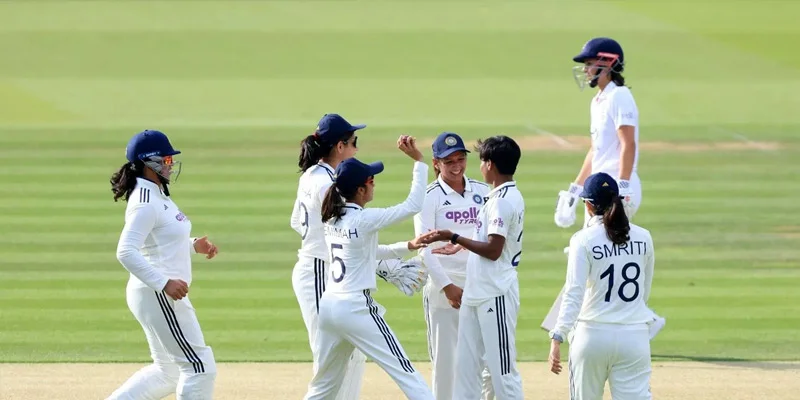
NEW DELHI: Some results announce that a team has arrived. India’s women produced one on their tour of England this month, crushing the hosts by 270 runs in the one-off Test at Lord’s — a commanding, all-round performance on the sport’s most storied ground. Smriti Mandhana anchored the batting with 83 in the first innings and an unbeaten 69 in the second, and the bowlers finished the job in style, with young pacer Kranti Gaud taking five for 37 and Sneh Rana sweeping up the tail. For a side still building its red-ball history, a win of that scale at that venue is a landmark.
The margin matters as much as the win. Test cricket rewards depth, stamina and nerve across four days, and India controlled every phase — a big first-innings total, a disciplined bowling effort that kept England to a modest reply, and the composure to bat the game out of reach. It is the kind of complete display that did not come easily a decade ago, and it reflects how far the women’s game has travelled on the back of a professional domestic league and sustained investment in pathways and facilities.
A landmark at the home of cricket: India’s women beat England by 270 runs in the Lord’s Test — Mandhana 83 and 69 not out, Kranti Gaud five for 37 — a marker of the game’s rise.
A generation of Indian girls now grows up able to name a national women’s XI. That, as much as any scoreboard, is the real victory.
At a Glance
• Result: India beat England by 270 runs in the Lord’s Test
• Top bat: Smriti Mandhana — 83 and 69 not out
• Ball: Kranti Gaud five for 37; Sneh Rana in support
• Next: cricket at the Aichi–Nagoya Asian Games, September 17–22
The win sits within a landmark stretch for Indian cricket, with a busy home and away calendar and a continental prize on the horizon: the sport returns to the Asian Games at Aichi–Nagoya in Japan this September, where an India squad led by Harmanpreet Kaur, with Mandhana as deputy, will chase a medal in the eight-team T20 event. High-visibility fixtures like these are how promising players become household names and how the next cohort of girls, in towns far from the big academies, is pulled toward the game.
The constructive read is that Indian women’s cricket has reached the stage where success is built on structure, not chance. The way forward is to keep widening the base — more matches, stronger domestic pathways and facilities that reach beyond the metros — so that depth keeps deepening. A performance like Lord’s is not a ceiling but a signal: a sport steadily becoming one of the country’s most powerful engines of aspiration for young women.