Blitz Bureau
NEW DELHI: It is the kind of accident that stops a nation and turns its eyes to the people who build it. On Monday afternoon, a landslide sealed the mouth of an under-construction tunnel at the Teesta Stage VI hydroelectric project in Samardung, in south Sikkim, trapping a group of workers underground and touching off a suspected pocket of gas that made the rescue itself perilous. Through Tuesday and Wednesday, teams from the National and State Disaster Response Forces, the police and fire services worked in shifts to reach them — recovering the dead with care and bringing survivors back into the light.
The human toll has been heavy. At least a dozen workers were confirmed dead as bodies were recovered on Wednesday, with the last of those trapped being brought out and the final count still being established — a caution the desk is holding to, because a labourer’s life deserves an accurate number, not a fast one. Chief Minister Prem Singh Tamang announced an ex-gratia of ₹4 lakh for each bereaved family and ₹50,000 for the injured; the Prime Minister added a further ₹2 lakh and ₹50,000 from the national relief fund. Behind those figures are families in hill hamlets and distant states waiting for word.
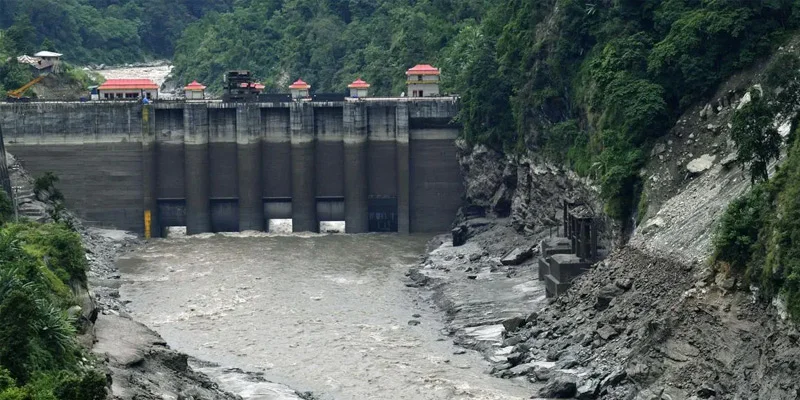
Building in hard country: The Teesta VI tunnel, where a Monday landslide trapped workers underground, sits in the steep, geologically fragile terrain of south Sikkim — where rescuers battled a suspected gas pocket to reach those inside.
A nation is judged not only by what it builds, but by how fiercely it protects the hands that build it. The measure of this tragedy is the safety that follows.
At a Glance
• Incident: Monday landslide sealed a tunnel at the Teesta Stage VI project, Samardung, Sikkim
• Hazard: a suspected gas pocket endangered the trapped workers and rescuers alike
• Toll: at least a dozen confirmed dead as of Wednesday; final count being established
• Relief: ₹4 lakh (state) + ₹2 lakh (national) ex-gratia per bereaved family; ₹50,000 for injured
The immediate task is compassion done competently: complete the recovery, treat the injured, help the families
through the paperwork of grief, and give the country an honest, verified account of what happened underground. The disaster forces are owed real credit — entering a gas-fouled tunnel in the rain to bring strangers home is quiet heroism, and it deserves to be named as such. Care, delivered fast and without fuss, is the first duty a state owes the workers who wager their lives on its infrastructure.
The larger, constructive lesson points to how India tunnels through its young, restless mountains. The Himalaya is among the most geologically fragile terrain on earth, and every hydro and highway project there is a negotiation with unstable rock, seismic stress and a fiercer monsoon. The way forward is not to stop building — the region needs power, roads and jobs — but to build safer: continuous geological and gas monitoring, engineered escape routes and refuge chambers, rehearsed emergency drills, and independent safety audits with real teeth. India has the engineering talent to make its mountain projects a global model of resilience. Turning this sorrow into that standard is how the memory of these workers is best honoured.