Blitz Bureau
NEW DELHI: On a morning when crude crossed $100 and markets flinched, it is worth stepping back from the ticker to a slower, more hopeful number. India’s installed renewable-energy capacity has climbed to about 288.6 gigawatts as of June 2026, led by roughly 162 GW of solar power — and in the first half of this year alone the country added a record 29 GW of new solar and wind. Every one of those gigawatts is electricity India makes for itself, immune to the geopolitics of the Strait of Hormuz. This is the structural story behind the day’s alarming one.
The momentum is real and measurable. India crossed 150 GW of cumulative solar capacity earlier this year, enough to rank third in the world; solar additions in FY2026 hit a record 44.6 GW, comfortably beating the government’s own target and nearly doubling the previous year’s pace. Solar and wind together now make up the overwhelming share of the renewable fleet. Each unit of that home-grown power displaces fuel that would otherwise be bought abroad, in dollars, at whatever price a distant crisis dictates.
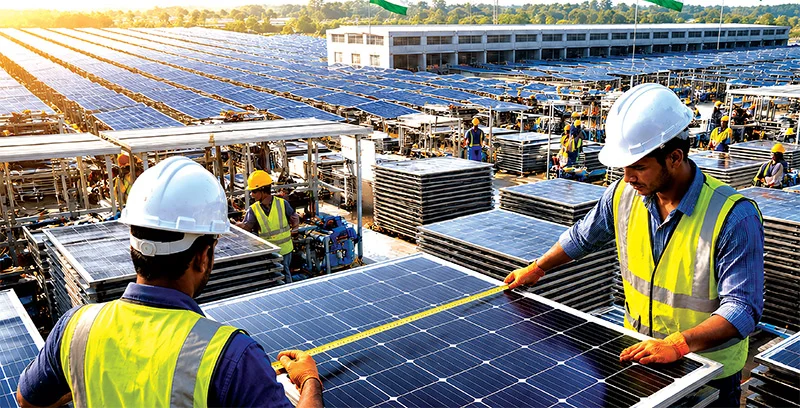
Power that no strait can blockade: India’s renewable capacity reached about 288.6 GW by June 2026, led by ~162 GW of solar, with a record 29 GW of solar and wind added in the first half of the year — a steadily growing hedge against imported-oil shocks.
The cure for an oil shock is not found on the day it strikes. It is built quietly, in gigawatts, over the years when nobody is watching the crude price.
The Long View
• Capacity: ~288.6 GW renewable installed by June 2026; solar ~162 GW
• Momentum: record ~29 GW of solar & wind added in H1 2026
• Standing: crossed 150 GW of solar — third-largest in the world
• Target: 500 GW of non-fossil capacity by 2030 — on track
The honest account is that the transition is a marathon, not a switch. Oil still powers most of India’s transport and much of its industry, and the electricity grid must be strengthened, storage scaled and supply chains for panels and cells deepened before renewables can blunt an oil shock in real time. A record month of installations does not lower the pump price tomorrow. But the direction of travel is unmistakable, and it is the single most powerful lever India holds over its own energy security.
The constructive, long-view conclusion is to treat clean energy as strategic infrastructure and press on with the same urgency an oil scare briefly commands. That means matching generation with grid upgrades and battery storage, localising more of the manufacturing so the value stays at home, and keeping the policy signals steady enough for investors to build a decade ahead. India is on track for 500 GW of non-fossil capacity by 2030. Reach it, and mornings like this one lose their power to unsettle — because the country will increasingly run on a resource no blockade can touch: its own sunlight and wind.