Blitz Bureau
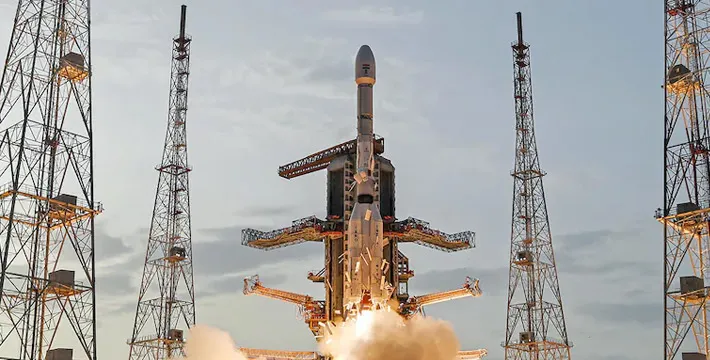
NEW DELHI: The Indian Space Research Organisation has set itself a target of seven missions in the current financial year, with chairman V. Narayanan indicating that the next flight is due within roughly two months. Stated as a number it reads like a schedule. Stated as an engineering ambition it is something harder: cadence. Any capable space agency can fly a spectacular one-off. Flying reliably, on a predictable calendar, is the discipline that separates a programme from a series of achievements — and it is the capability on which every downstream user, from a weather forecaster to a satellite-internet operator, actually depends.
The manifest is deliberately mixed. It includes communication satellites, Earth-observation spacecraft that watch the monsoon, coastlines and farmland, technology-demonstration payloads, and precursor missions tied to Gaganyaan, India’s human spaceflight effort. A 6,500 kg US-built communication satellite is among the payloads ahead — a mass class that puts India’s heavy-lift capability in front of the international commercial market rather than only its own. The year also follows Skyroot Aerospace’s successful Vikram-1 flight, which means the national calendar now sits inside a wider ecosystem in which private Indian launch and satellite capability is a genuine complement rather than an aspiration.
Cadence is the capability: a launch calendar that holds is what allows meteorologists, farmers, fishers and telecom operators to plan around Indian spacecraft rather than hope for them.
A single launch is a headline. Seven launches in twelve months is an industry — and the users downstream can only build on the second kind.
At a Glance
• Target: seven ISRO missions in the current financial year
• Next launch: due within about two months, per chairman V. Narayanan
• Manifest mix: communication satellites, Earth observation, technology demonstration, Gaganyaan precursors
• Heavy payload ahead: a 6,500 kg US-built communication satellite
• Earth observation use: monsoon, coastline and agricultural monitoring
• Private sector: follows Skyroot Aerospace’s successful Vikram-1 mission
What makes cadence difficult is that it is a supply-chain problem dressed as a rocketry problem. Each launch consumes propellant, avionics, composite structures, precision-machined components and, above all, integration-bay time and trained crews. Doubling a launch rate does not double the number of engineers; it requires that vendors deliver flight-qualified hardware on a schedule, that spare capacity exists at the launch complex, and that the review discipline which keeps missions safe does not become the bottleneck that keeps them grounded. India’s second launch pad and the ongoing work on a third are as central to a seven-mission year as any engine test.
The constructive measure of this year will therefore not be seven-out-of-seven. It will be whether the gaps between launches shrink and become predictable, and whether the private ecosystem absorbs an increasing share of routine work — small satellites, rideshares, sub-systems — so that ISRO’s own capacity is reserved for what only a national agency can do: human spaceflight, planetary science and the strategic assets. Publishing a rolling twelve-month launch manifest, updated openly when it slips and explaining why, would do more for India’s standing as a commercial launch destination than any single successful flight. Customers do not buy a record. They buy a date they can rely on.