Blitz Bureau
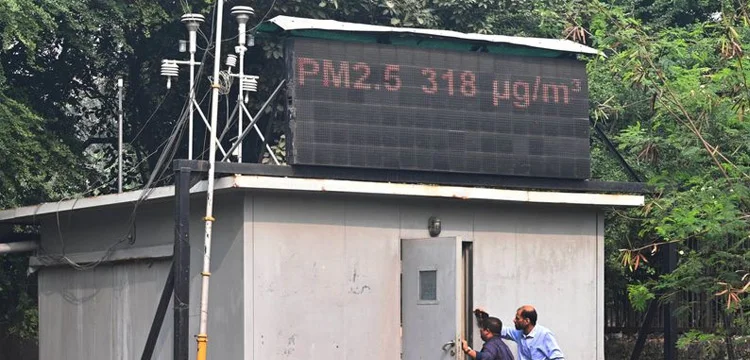
NEW DELHI: The most important thing India has built in air quality over the past seven years is not a filter or a fuel standard. It is a measurement network — and that is a bigger achievement than it sounds. Under the National Clean Air Programme, central funding has increased ambient monitoring capacity three to four times across covered cities, ensuring at least one manual or continuous monitoring station in each. The programme covers 131 non-attainment cities and carries a target of a 40% reduction in particulate concentrations. Of 231 cities with sufficient data coverage, 128 now meet the national ambient standard for fine particulate matter and 103 exceed it.
The results so far are real and uneven, which is what an honest assessment of a programme at this stage should expect. The air quality index recorded in daily bulletins fell about 13% between 2019 and 2023. But in an earlier assessment, only 14 of 43 cities examined had registered a reduction of 10% or more in PM2.5 between 2019 and 2021. And the top of the table remains difficult: Byrnihat in Assam, Delhi and Ghaziabad recorded annual PM2.5 concentrations of about 100, 96 and 93 micrograms per cubic metre respectively — several times the national standard.
Measurement first: monitoring capacity across covered cities has risen three to four times under the National Clean Air Programme — the precondition for any policy that can be evaluated.
Air pollution is the rare public problem where the cause is not in dispute. What is missing is not knowledge but the authority to act at the scale of the airshed.
At a Glance
• Programme coverage: 131 non-attainment cities under the National Clean Air Programme
• Target: a 40% reduction in particulate concentrations in covered cities
• Monitoring capacity: increased three to four times, with at least one station per covered city
• Compliance: of 231 cities with adequate data, 128 meet the PM2.5 standard and 103 exceed it
• Trend: the air quality index from daily bulletins fell about 13% between 2019 and 2023
• Early assessment: 14 of 43 cities examined cut PM2.5 by 10% or more between 2019 and 2021
• Highest annual PM2.5: Byrnihat about 100, Delhi about 96, Ghaziabad about 93 micrograms per cubic metre
• Drivers cited: rapid urbanisation, industrial activity and vehicular emissions.
The single most useful thing the monitoring data has established is that particulate pollution is a regional phenomenon rather than a municipal one. A large share of the fine particulate matter measured inside any Indian city on a bad winter day did not originate inside that city’s boundary; it arrived from surrounding districts, from highways, from brick kilns and industry in the wider region, and from agricultural residue burning across an area far larger than any municipal corporation governs. This is why city-level action plans, however well executed, hit a ceiling: a mayor can regulate construction dust and municipal waste burning within a boundary, and can do nothing at all about an airshed that extends two hundred kilometres in every direction.
That diagnosis points at a specific and achievable next step, and international experience is unusually clear about it. Every country that has substantially cleaned its air — the United Kingdom after the Clean Air Acts, the United States under regional air quality management districts, China across the Beijing–Tianjin–Hebei region — did so by creating an authority whose jurisdiction matched the airshed rather than the city, with the power to set and enforce standards across it. India has already established regional commissions in its most-affected region, and the constructive agenda is to extend that model, fund it properly, and give it enforceable authority over the four sources that dominate the inventory: household and industrial solid fuel, transport emissions, construction and road dust, and agricultural residue. Each of those has a known technical solution and a known cost. The other half of the agenda is publication: hourly, station-level data published openly and in a form that citizens, researchers, courts and state governments can all use, so that progress is visible and attributable. India has spent seven years building the instruments that make air pollution legible. Legibility is what makes a problem governable, and that is exactly the point the country has now reached.