Blitz Bureau
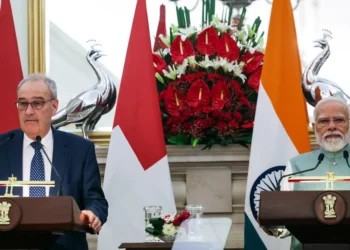
NEW DELHI: India and Rwanda held the first session of their Joint Trade Committee in New Delhi at the end of July. Most of the agenda read like any first meeting between two trade ministries. One item did not: tin, tungsten and tantalum.
Those three metals travel together in the trade literature under an unlovely acronym, and they are among the few materials for which India has almost no domestic answer. Tantalum is what makes the capacitor in a phone small enough to fit in a phone. Tungsten is what lets a cutting tool machine hardened steel, which is to say it is upstream of every engineering exporter India has. Tin is the solder in every circuit board on the subcontinent. India refines, assembles and exports all three categories of finished goods; it mines almost none of the input. Rwanda is among the world’s significant sources of exactly this group, and what the two sides discussed was not a purchase order but something more durable — institutional cooperation between the Geological Survey of India and the Rwanda Mines, Petroleum and Gas Board.
The other end of the corridor: Rwanda has told India it is already the country’s second-largest source of foreign investment. The second session of the Joint Trade Committee will be held in Rwanda next year.
A trade committee that talks about geological surveying rather than shipments is not planning a transaction. It is planning a decade.
At a Glance
• The meeting: first session of the India–Rwanda Joint Trade Committee, New Delhi, July 30–31, 2026
• Led by: Amit Kumar, Joint Secretary, Department of Commerce, for India; Virgile Rwanyagatare, Director General for Asia, Pacific and Middle East Affairs, for Rwanda
• India’s exports to Rwanda: pharmaceutical formulations and biologicals, two- and three-wheelers, industrial and electrical machinery, oil meals, iron and steel
• Rwanda’s exports to India: lead, spices, essential oils, copper, precious and semi-precious stones, processed agricultural products, minerals
• Minerals discussed: tin, tungsten and tantalum — with cooperation proposed between the Geological Survey of India and the Rwanda Mines, Petroleum and Gas Board
• Investment position: Rwanda described India as its second-largest foreign investor as of 2025
• Sectors flagged by Rwanda: mining, agro-processing, affordable housing, ICT, manufacturing, healthcare, tourism, financial services
• Next round: second session in Rwanda in 2027, date through diplomatic channels
For an ordinary reader the connection runs through the price of things that have nothing obviously to do with Africa. A critical mineral is not scarce in the geological sense; it is scarce in the political sense, because processing capacity for most of these metals is concentrated in a very small number of countries. When that concentration is high, a single export restriction anywhere in the chain moves the cost of a capacitor, and therefore of a phone, a car’s control unit and an inverter, everywhere else. India’s exposure here is not theoretical: the electronics assembly base being built at Sanand, Jagiroad and Dholera consumes precisely these inputs, and a factory that cannot source tantalum is a factory that is idle regardless of how good its yield is.
What makes the Rwandan conversation constructive rather than merely diplomatic is that it starts one step further back than a supply agreement. Cooperation between two geological surveys means shared mapping, shared assay standards and shared training — the unglamorous work that determines whether a deposit is bankable a decade from now. India has done this before, with Africa and with Central Asia, and the record is honest about the timelines: exploration partnerships mature slowly, and several yield nothing. The way to read this session is therefore not as a mineral secured but as an option opened, alongside a trade relationship that already runs both ways in medicines, two-wheelers and machinery. The next test is a specific one and it has a date attached: whether the second session, in Rwanda in 2027, arrives with a signed work programme between the two survey bodies or only with a communiqué.