Prabhu Chawla
NEW DELHI: In the long arc of democratic history, the spectacle of the world’s richest democracy systematically hounding the world’s largest and fastest-growing democracy should provoke more than routine diplomatic furore. It should force a reckoning with what power has become when it confuses leverage with leadership.
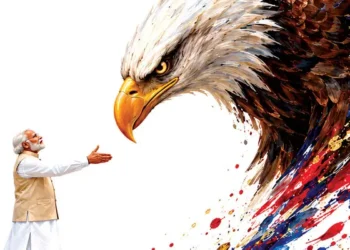
Donald Trump has turned the instruments of diplomacy into tools of coercion and intimidation. That coercion has fixated with particular intensity on India. Trade and commerce have been weaponised. Trump has converted them from a means of building consensus into a blunt instrument for dictating the terms of trade and imposing asymmetrical pressure on any partner that fails to yield at once.
The result is not statecraft, but a sustained campaign of economic destabilisation that undermines the very norms of reciprocity upon which stable international relations are built.
Most provocative act
The latest and most provocative action arrived last week, hours after the funeral of Senator Lindsey Graham at Washington National Cathedral, where Volodymyr Zelenskyy and Benjamin Netanyahu stood among the mourners, when the US Senate voted 86-12 to advance the Graham’s legislation, Sanctioning Russia and Iran Act of 2026.
The legislation authorises secondary tariffs of up to 100 per cent on countries that continue to purchase Russian oil and gas. An earlier draft had explicitly named India, China, Slovakia, Hungary and Azerbaijan as targets. Trump’s fear and favour were clearly reflected in the provisions of the Act. It carefully exempted 15 European nations still importing Russian gas on the grounds that their volumes represented a smaller and declining share of demand.
India buys oil, but then, Europe buys gas. Only one category was judged suitable for maximum pressure. That bipartisan statute – advanced after a colleague’s funeral with more than 60 co-sponsors from both parties – is far harder to reverse than any presidential order. It represents the institutionalisation of coercive diplomacy, transforming a temporary executive preference into enduring legislative mandate.
This vote is the culmination of a campaign that has already altered the duty on Indian goods five times in 15 months. Each one of the penal changes were calibrated to extract further concessions rather than to establish a durable framework.
Recalibration sequence
In April 2025, Washington threatened a 26 per cent tariff. By August, the rate stood at 50 per cent, the additional 25 points imposed solely because India continued to purchase Russian crude. Earlier this year, Trump and Modi announced an interim understanding that lowered the rate to 18 per cent in return for $500 billion in promised Indian purchases of American energy, technology and other goods.
Eighteen days later, the US Supreme Court, in a 6-3 opinion authored by Chief Justice John Roberts, ruled that the International Emergency Economic Powers Act never authorised those tariffs, voiding more than $160 billion already collected and rendering the India understanding moot. Trump absorbed the judicial setback and immediately imposed a flat 10 per cent surcharge under Section 122 of the Trade Act of 1974.
When that temporary authority expired on July 24, Section 301 duties of 10 per cent took effect the same night, justified by findings on forced-labour enforcement. Five successive rates, one country, 15 months – an unbroken sequence of recalibration conveying a sordid saga of undiplomatic conduct. It’s for the first time in America’s 250-year-old history that its Head of State has acquired the image of a bully with scant regards for conviction and consistency.
China, which imports comparable volumes of Russian oil, has faced no such revolving door of punishment and has been offered something closer to a negotiated truce. India, the more cooperative partner, has been the more frequently punished. Keeping in view the importance of strategic partnership, India has been making significant concessions. The US goods trade deficit with India stood at around $58 billion in 2025, 27 per cent higher than the year before.
Narrowing surplus
However, India’s own surplus with the US narrowed to $34.4 billion in 2025-26 from $40.9 billion the previous year. India reduced the share of its crude imports drawn from Russia, increased purchases of American energy and kept the negotiating channels open while Indian firms committed substantial new investment on American soil. More than a dozen rounds of high-level negotiations followed by visits of senior officials to both Washington and New Delhi have taken place. But they have been turned into either photo albums, TV bytes, or been dismissed by Trump as irrelevant for now.
None of these adjustments has produced a stable rate, a durable exemption, or even a settled legal basis for the duties currently applied. Cooperativeness has been interpreted not as leverage to be reciprocated but as elasticity to be tested repeatedly.
Funnily, Trump continues to describe Modi as a friend while deploying every available statute and legislative opportunity to damage his prestige at home. The Trumpian presidency has been transformed from an institution that seeks to forge global consensus into one that thrives on confrontation. Leaders like Netanyahu and Zelenskyy, who postpone or avoid fresh electoral mandates, receive public support and diplomatic latitude. But the fastest-growing large democracy is treated as a problem to be managed through successive layers of tariffs.
Policies that generate worldwide economic instability fall with particular force on brown democracies that lack China’s strategic weight or Europe’s alliance insulation. Modi has so far kept his counsel and refused to escalate, preserving India’s strategic autonomy and room for manoeuvre. Yet, the longer this campaign of coercive diplomacy continues, the clearer it becomes that the damage will rebound upon Trump’s own political base and upon the American economy.
Policies that generate worldwide economic instability fall with particular force on brown democracies that lack China’s strategic weight or Europe’s alliance insulation. Modi has so far kept his counsel and refused to escalate
Eroding commercial ties
As India expands its manufacturing base, deepens partnerships across the Global South, and positions itself as a credible counterweight to Chinese influence in South Asia, it will emerge stronger, not weaker. By targeting that rising power, Washington is not protecting Americans. It is eroding the commercial relationships and strategic partnership that once promised to balance Asia and advance shared interests.
A superpower that mistakes harassment for statecraft will eventually discover that the countries it seeks to discipline possess alternatives, and that the voters who once cheered confrontation will tire of higher prices, disrupted supply chains and diminished alliances.
India has already demonstrated the patience of a rising power that knows time is on its side. America would do well to remember that patience is not the same as permanent forbearance, and that the weaponisation of diplomacy ultimately weakens the hand that wields it.
More than a dozen rounds of high-level negotiations followed by visits of senior officials have taken place. But they have been turned into either photo albums, TV bytes, or been dismissed by Trump as irrelevant for now