Blitz Bureau
NEW DELHI:India’s senior health cover does not means-test. Anyone aged 70 or above qualifies, whatever the household earns. Roughly 1.2 crore have enrolled — which, against the size of the eligible population, means the largest remaining obstacle is that people do not know.
The Ayushman Bharat Vay Vandana extension of the Pradhan Mantri Jan Arogya Yojana was approved to cover every Indian aged 70 and above, irrespective of income, with a family cover of ₹5 lakh a year. That last clause is the one most often missed. The parent scheme is targeted at economically vulnerable households and has an eligibility test; the senior extension does not. A retired schoolteacher with a pension and a farm labourer with none are both entitled on the same terms, and a household already enrolled under the parent scheme gets a separate top-up for its senior members rather than sharing one pot. As of June 5, 2026, about 1.20 crore senior citizens had enrolled, and they had taken more than 13.84 lakh treatments worth roughly ₹3,000 crore.
36,218 doors: the number of empanelled hospitals matters less than whether the nearest one to a 70-year-old is on the list — which the scheme’s own hospital finder will answer.
An entitlement nobody claims is indistinguishable, at the kitchen table, from an entitlement that does not exist.
At a Glance
• Who qualifies: every Indian aged 70 and above, regardless of income
• Cover: ₹5 lakh a year, on a family basis, for eligible seniors
• Seniors enrolled: about 1.20 crore as on June 5, 2026
• Treatments availed by seniors: more than 13.84 lakh
• Value of those treatments: about ₹3,000 crore
• Hospitals empanelled under the scheme: 36,218
• Of which public: 19,659. Private: 16,559
• Whole scheme, treatment value: about ₹1,80,435 crore as on June 5, 2026
• Needed to enrol: proof of age, and a visit to a hospital help desk or the official app
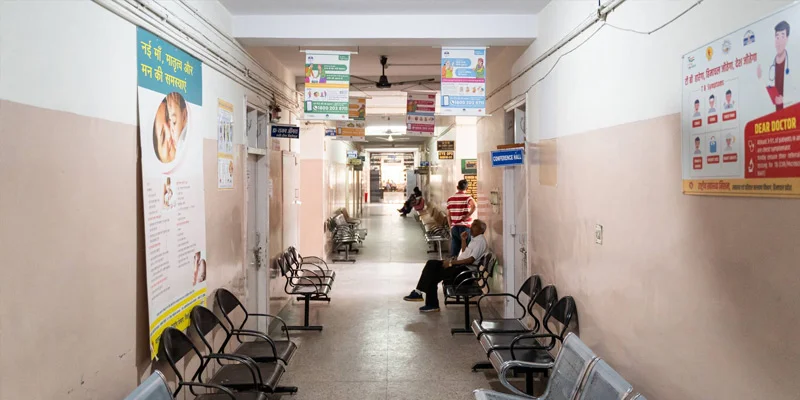
The practical mechanics are simpler than the acronyms suggest. Enrolment produces a card; the card is generated against proof of age, through the official app, the scheme’s website, a common service centre, or the Ayushman help desk that empanelled hospitals are required to run. There is no premium and no waiting period for the senior cover. Treatment is cashless at any empanelled hospital, of which there are 36,218 — 19,659 public and 16,559 private — and the useful step before an emergency, rather than during one, is to check which hospitals near home are on that list, because the answer varies sharply between districts. Across the whole scheme, treatment worth about ₹1,80,435 crore had been provided as of June 5.
What the numbers suggest is a distribution problem rather than a design one. India has considerably more than 1.2 crore people aged 70 and above, so enrolment has room to run, and the households least likely to have heard about a no-means-test entitlement tend to be exactly the ones for whom a ₹5 lakh cover changes the most — families where a single cardiac admission would otherwise be paid for by selling land or borrowing at rates nobody should pay. The remedy is not complicated and is largely already in motion: camps at panchayat level, enrolment at pension disbursement points, and hospitals prompting the question at the registration counter. For any reader with a parent or grandparent over 70, the action is small and worth taking this week. Check whether the card exists. If it does not, make it before it is needed.