Blitz Bureau
NEW DELHI: Every energy crisis produces the same national conversation about sourcing, shipping lanes and strategic reserves. The permanent question is quieter and much harder: how many barrels does India simply never need to buy? On that question the answer has been changing faster than the headlines suggest.
Start with the one number in Indian energy policy that has moved ahead of schedule. Ethanol blending in petrol reached 20 per cent by June 2026 — a target originally set for 2030 and hit five years early, from a base of 10 per cent in 2021-22. Blending has done more than displace a share of the fuel tank. Between the 2014-15 ethanol supply year and June 2026 the programme is credited with cumulative foreign-exchange savings of more than ₹1.97 lakh crore, the replacement of roughly 316 lakh tonnes of crude, and the avoidance of some 952 lakh tonnes of carbon dioxide. The Petroleum Ministry’s estimate is that blending at this level can save the country in the region of ₹38,000 crore a year. Set that against a $49.8 billion quarterly crude bill and the proportion is honest: this is a discount, not an escape. But it is a discount that compounds, and one that pays a sugarcane farmer rather than a shipping lane.
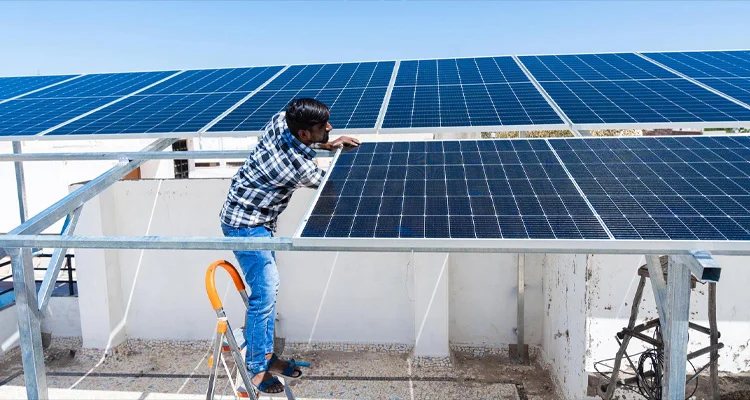
The barrels never bought: India added a record 29 GW of solar and wind in the first six months of 2026, and its renewable fleet passed 288 GW in June.
A strategic reserve buys India weeks. A kilowatt-hour that never needed a barrel buys it decades.
At a Glance
• Ethanol blending: 20 per cent reached June 2026, five years early, from 10 per cent in 2021-22
• Cumulative forex saved: more than ₹1.97 lakh crore since 2014-15
• Crude replaced: about 316 lakh tonnes
• Carbon avoided: about 952 lakh tonnes
• Annual saving potential: around ₹38,000 crore
• Renewable capacity, June 2026: 288.58 GW — solar 162.15, wind 57.44, large hydro 57.24
• Added in FY26: 55.29 GW of non-fossil capacity, the highest in any single year
• Added in H1 2026: a record 29 GW of solar and wind
• Target: 500 GW of non-fossil capacity by 2030
The electricity side of the ledger is moving faster still. India’s renewable capacity stood at 288.58 GW at the end of June — 162.15 GW of solar, 57.44 GW of wind and 57.24 GW of large hydro — and non-fossil additions in 2025-26 came to 55.29 GW, the largest in any year on record. The first six months of 2026 alone added about 29 GW of solar and wind, with solar additions up 43 per cent and rooftop systems under PM Surya Ghar contributing an unusually large share. Rooftop matters disproportionately here for a reason that has nothing to do with megawatts: a household that generates its own afternoon load learns what electricity costs, and that is the beginning of demand-side behaviour no tariff order can legislate. On present trajectory the 500 GW non-fossil goal for 2030 is a schedule question rather than a feasibility question.
Where the honest gap lies is in the join between the two ledgers. Renewables displace coal in the power system; they do not, by themselves, displace crude, because crude in India is overwhelmingly a transport and petrochemical fuel rather than a power fuel. The bridge between them is electrification of transport — which is exactly why July’s record of 3,27,901 electric vehicle registrations belongs in an energy story rather than an automobile one. The three permanent tasks that follow are unglamorous and long: storage, so that solar generated at noon can move a vehicle at nine in the evening; transmission, so that Rajasthan’s surplus reaches Bihar’s demand; and domestic cell manufacturing, so that reducing an oil import does not simply create a battery import in its place. None of the three is finished. All three are underway. The measure of success will not be a headline capacity figure but a boring one — the year in which India’s crude import volume falls while its economy grows. This quarter the volume did fall, by 4.5 per cent, for reasons of disruption rather than design. The work described here is the attempt to make that decline permanent, and chosen.