Blitz Bureau
NEW DELHI: The Prime Minister promised AI training for ten million young Indians within a year, and free online coaching for those who cannot afford the private kind. Do the division and the promise becomes a logistics problem.
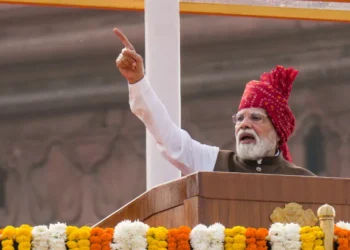
Two announcements from the Red Fort this morning were addressed directly to the young. The first is a national network through which students can receive coaching online without paying fees — aimed at the aspirant who currently pays for a private institute, and often for a room and a bus ticket to a distant city on top of it. The second is a commitment that one crore young Indians will be trained in artificial intelligence skills over the next year. “We have decided that in the next one year, one crore youth will be given training in AI skills,” the Prime Minister said, adding that the country must focus on three things: cost, quality and skill.
The second promise is the one worth doing arithmetic on. One crore is ten million. Spread evenly across 365 days, that is roughly 27,400 people beginning training every single day for a year, weekends and festivals included. Spread across India’s 28 states and eight Union Territories, it is close to 2.8 lakh trainees per state on average — more, obviously, in the populous ones. No conventional classroom network in the country runs at that rate. The pledge is therefore, by construction, a digital-delivery pledge, and it stands or falls on the same infrastructure the free coaching network will run on.
What the training is for: the AI-skilling pledge is aimed at employability across manufacturing, finance, health, education and services — the sectors already rewriting job descriptions around the technology.
One crore in a year is about twenty-seven thousand people a day. That is not a course. That is a delivery system.
At a Glance
• Announced: Red Fort, 15 August 2026
• Pledge one: free online coaching network, no fees
• Pledge two: one crore youth trained in AI skills within a year
• Daily run-rate implied: roughly 27,400 trainees a day
• Average per state/UT: close to 2.8 lakh
• Stated priorities: cost, quality and skill
• The cost being removed: institute fees, plus travel and lodging in coaching towns
• Still to be published: launch date, partner institutions, courses, eligibility, certification
• The dependency: reliable connectivity in remote and low-income districts
What makes the coaching announcement substantive rather than symbolic is the cost it targets. The expense of competitive-exam preparation in India is only partly the fee. A student from a small town who moves to a coaching hub pays rent, food and transport for a year or two, and the family often borrows to fund it. Removing the fee alone does not remove the migration; delivering the teaching online is what removes the migration. That is the mechanism by which the announcement, if it works, changes a household budget rather than a headline.
The government has not yet published the operating detail — the launch date, the participating institutions, the syllabus, eligibility rules, certification, or the platforms through which a student enrols. Those are the things that will decide whether one crore is a number trained or a number registered, and the distinction matters, because an AI certificate that employers do not recognise helps nobody. The constructive path is visible enough: publish the curriculum and the assessment standard early, let employers vet them, and report completion rather than enrolment. India has built digital delivery at national scale before. The question this year is whether it can also build the quality assurance to go with it.