Blitz Bureau
NEW DELHI: India keeps 98.5 out of every 100 children in the foundational years and 51.9 in the secondary years. Almost everything that matters about Indian education sits in the distance between those two numbers.
The UDISE+ report for 2025-26, summarised by the government today, covers 14.67 lakh schools, 1.03 crore teachers and more than 24.72 crore enrolled students — an averaged seven teachers and 169 students per school, at an overall pupil-teacher ratio of 24:1, comfortably inside the 30:1 the National Education Policy recommends. Stage by stage the ratios are better still: 10:1 at the foundational stage, 12:1 preparatory, 17:1 middle and 21:1 secondary. On access and staffing, the system is in better shape than the popular conversation about it assumes.
The retention series is where the structure shows. Retention runs at 98.5 per cent at the foundational stage, 91.1 per cent preparatory, 83.7 per cent middle — and 51.9 per cent secondary. Transition rates are strong throughout: 99.2 per cent from foundational to preparatory, 93.8 per cent to middle, 88.3 per cent to secondary. Read the two series together and the mechanism becomes clear. Children are not failing to move up a stage; they are moving up and then, at the secondary stage, leaving. Dropout is 1.8 per cent at preparatory, 3.6 per cent at middle — slightly up on the previous year — and 7.0 per cent at secondary. This is not a story about enrolment. It is a story about the last four years of school.
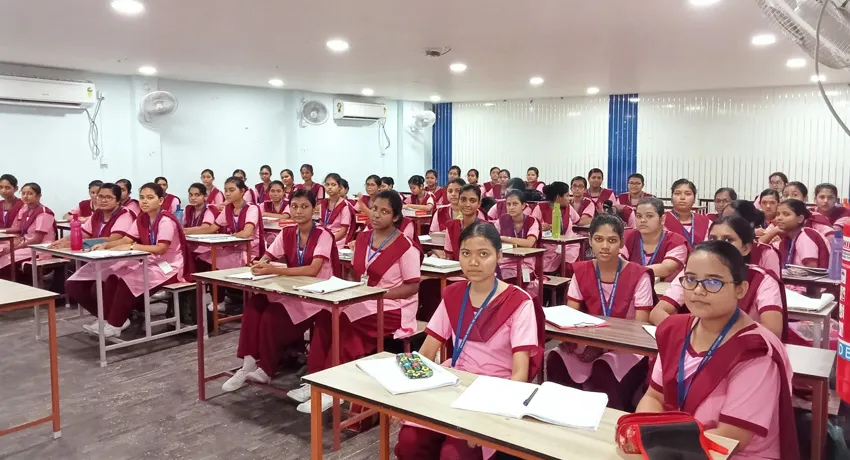
The last four years: a school classroom in India. Retention falls from 83.7 per cent at the middle stage to 51.9 per cent at the secondary stage — the single largest structural gap in the UDISE+ 2025-26 data.
Children are not failing to move up a stage. They move up, and then they leave. The gap is not in enrolment. It is in the last four years of school.
At a Glance
• Report: UDISE+ 2025-26, Department of School Education and Literacy
• Coverage: 14.67 lakh schools, 1.03 crore teachers, 24.72 crore students
• Averages: 7 teachers and 169 students per school
• Overall pupil-teacher ratio: 24:1, against an NEP norm of 30:1
• Stage-wise PTR: 10:1, 12:1, 17:1, 21:1
• Retention: 98.5, 91.1, 83.7 and 51.9 per cent by stage
• Transition: 99.2, 93.8 and 88.3 per cent
• Dropout: 1.8 preparatory, 3.6 middle, 7.0 secondary
• Gross enrolment ratio: 89.6 per cent middle, 71.7 per cent secondary
• Single-teacher schools: down about 3 per cent to 1,00,843
• Zero-enrolment schools: down 29 per cent to 5,663
• Girls: 48.4 per cent of enrolment · Women teachers: 54.9 per cent
• Computers: 69.9 per cent of schools · Internet: 67.4 per cent
Two numbers in the same report show that the system knows how to fix structural problems when it identifies them. Schools running on a single teacher fell about 3 per cent to 1,00,843, and zero-enrolment schools — institutions on the register with no students on the roll — fell 29 per cent in one year to 5,663. A 29 per cent reduction is not drift; it is deliberate rationalisation, teachers redeployed and non-functioning schools consolidated or closed. The same instrument that measured the problem produced the correction, which is the practical argument for a national school database in the first place. Infrastructure has moved the same way: 95 per cent of schools have electricity, 99.5 per cent drinking water, 98.5 per cent girls’ toilets, 90.5 per cent a library, 69.9 per cent computers and 67.4 per cent internet.
The secondary retention gap is a permanent feature of Indian schooling rather than this year’s news, and that is precisely why it deserves a structural answer rather than an annual scheme. The causes are well documented and mostly economic: at fifteen a child’s labour has market value, the nearest secondary school is often further than the nearest middle school, and girls face an additional distance-and-safety constraint. The levers that follow are equally well identified — secondary school provision within reasonable travel distance, residential and transport support where it is not, vocational streams that make the last four years look like a route to work rather than a detour from it, and early-warning tracking so a school knows which child stopped attending in week two rather than in term three. India has 71.7 per cent gross enrolment at the secondary stage and 89.6 per cent at middle. Closing that eighteen-point gap is the single highest-return investment available in Indian education, and the data system to monitor it already exists.