Blitz Bureau
NEW DELHI: Washington and Delhi both want the relationship at $500 billion by 2030. They do not currently count the same way — and for anyone tracking the target, knowing which number is being quoted matters more than the number itself.
The United States Trade Representative’s country data puts American goods imports from India at $103.8 billion in calendar 2025, up 18.9 per cent on 2024, against American goods exports to India of $45.6 billion, up 9.8 per cent. That leaves a United States goods deficit with India of $58.2 billion, 27.1 per cent wider than a year earlier. Indian official reporting works to a financial year, counts services alongside goods, and produces a different-looking series — bilateral trade of $132.2 billion in 2024-25 on that basis. Neither set is wrong. They are answering different questions, and the gap between them is where a good deal of loose commentary lives.
What both capitals do agree on is the destination. When India’s External Affairs Minister met the United States Secretary of State on 13 January 2026, the two sides reaffirmed the aim of more than doubling bilateral trade to $500 billion by 2030 — the target first framed as Mission 500. Bilateral trade talks have run since February 2025, and a trade agreement announced in February 2026 lowered American tariffs on a range of Indian goods after the punitive rates imposed through 2025. India’s Commerce and Industry Minister Piyush Goyal said on 11 August that reports of India stalling further talks were “baseless and misleading”.
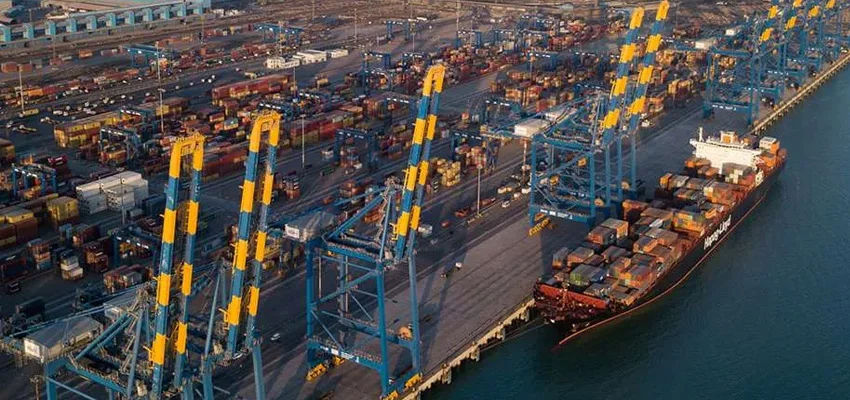
Where the target is settled: at the quayside. Getting to $500 billion by 2030 from roughly $150 billion of two-way goods trade in 2025 implies compound growth few large corridors have sustained.
Two-way goods trade of about $149 billion in calendar 2025 has to reach $500 billion by 2030 — and services, which Indian data counts and the goods series does not, are the only realistic way there.
At a Glance
• US goods imports from India, 2025: $103.8 bn, up 18.9 per cent
• US goods exports to India, 2025: $45.6 bn, up 9.8 per cent
• US goods deficit with India, 2025: $58.2 bn, 27.1 per cent wider
• Two-way goods trade, 2025: about $149.4 bn
• Indian series, 2024-25: bilateral trade $132.2 bn (financial year, goods and services)
• Shared target: $500 bn by 2030, reaffirmed 13 January 2026
• Talks began: February 2025 · trade agreement announced February 2026
• Tariff history: 25 per cent imposed in 2025, later raised to 50 per cent, since eased
For an Indian reader the practical question is not the accounting but the exposure. The United States is the single largest destination for Indian merchandise exports, and the sectors that carry it — engineering goods, gems and jewellery, textiles and garments, pharmaceuticals, electronics assembly — are exactly the labour-intensive lines where a tariff line moving two points changes hiring plans in Tiruppur, Surat and Noida. The 2025 tariff episode was felt first by exporters with thin margins and short order books, and the February 2026 agreement is being read in those clusters as breathing room rather than a settlement.
The arithmetic of the target is worth stating plainly, because it is demanding rather than impossible. Roughly $149 billion of two-way goods trade in 2025 must become $500 billion of total trade by 2030 — achievable only if services, digital delivery and the global capability centres now hiring across Bengaluru, Hyderabad and Pune are counted in and grow fast. That is the constructive reading: the corridor’s fastest-growing component is the one Indian data already captures and the American goods series does not. The way forward is a common statistical frame the two governments publish together, so that progress towards $500 billion can be measured rather than argued about. Until then, readers should check which book a number came out of.