

Blitz Bureau
NEW DELHI: The Finance Minister told public sector bankers a high-powered reform committee is on the way. The more revealing document is the conference agenda — six themes that show where the government wants bank credit to go next.
The Department of Financial Services convened its PSB Confluence in New Delhi on 17 and 18 August, bringing together roughly 125 chairmen, managing directors and executive directors from public sector banks and from the public financial institutions that sit alongside them — NABARD, EXIM Bank, SIDBI, the National Housing Bank, IIFCL, IFCI and NaBFID. Union Finance Minister Nirmala Sitharaman and Minister of State for Finance Pankaj Chaudhary addressed the gathering. Sitharaman said the government would shortly announce a high-powered committee on public sector bank reform, and that the conference’s recommendations and outcomes would be placed before it.
That sequencing is the part worth noticing. A committee that receives an agreed industry document on day one starts from a different place than one that begins by commissioning consultations. It also means the six themes chosen for the two days are not decoration; they are the draft terms of reference in all but name.
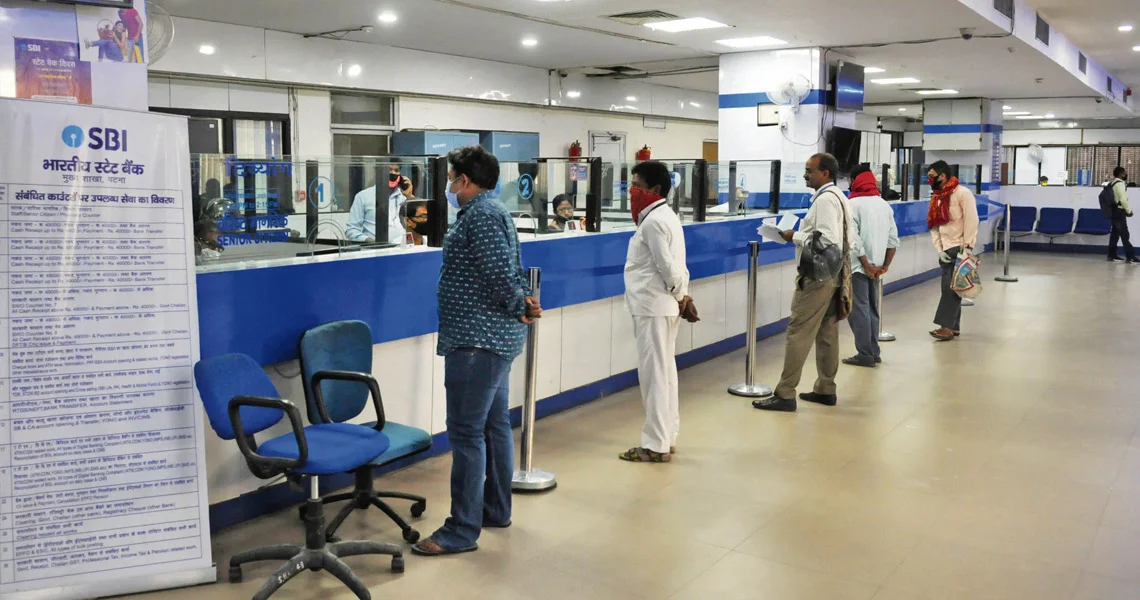
The last mile: whatever a reform committee recommends is finally delivered at a branch counter. Six themes shaped the two days at the confluence, from youth banking to the credit card business.
Global capability centres and horticulture value chains sat on the same agenda. That is an unusual pairing, and it is the point — both are credit gaps the existing product set does not reach.
At a Glance
• Event: PSB Confluence, Department of Financial Services, New Delhi
• Dates: 17–18 August 2026, two days
• Addressed by: Union Finance Minister Nirmala Sitharaman; MoS Finance Pankaj Chaudhary
• Participation: about 125 chairmen, MDs and executive directors
• Institutions: public sector banks plus NABARD, EXIM Bank, SIDBI, NHB, IIFCL, IFCI, NaBFID
• Themes: banking for youth · supporting the investment cycle · global capability centres
• agriculture and horticulture value chain infrastructure · priority sector lending · reimagining the credit card business
• Announced: a high-powered committee on PSB reform, to be named shortly
• Mechanism: conference outcomes to be placed before the committee
Take the six in turn and a pattern shows. “Banking for youth” and “reimagining the credit card business” are both about a customer under thirty who has a digital payments history but no credit file. “Supporting the investment cycle” and “global capability centres” are about lending to capital formation that increasingly takes the form of a leased floor and 2,000 engineers rather than a factory with collateral. “Agriculture and horticulture value chain infrastructure” is about cold chain, grading and pack-houses — the segment where India loses produce between farm and market. And priority sector lending is the frame that governs how much of a bank’s book has to reach all of them.
The common thread is that each is a lending gap the existing product set does not comfortably serve, either because the borrower lacks conventional collateral or because the asset being financed is intangible. That is a solvable design problem rather than a capital problem: Indian public sector banks are better capitalised and cleaner on asset quality than at any point in the past decade, which is precisely why the conversation has moved from repair to allocation. The constructive test for the coming committee will be whether it produces measurable products — a cash-flow-based lending template for young borrowers, a defined credit line for pack-house and cold-chain construction — rather than another set of targets. The banks have been asked to write the brief. It will be worth reading what they submit.