Blitz Bureau
NEW DELHI: Kharif sowing is down 20.95 lakh hectares this year. Karnataka alone accounts for roughly 14.5 lakh of that. Uttar Pradesh, meanwhile, is up on almost everything it plants.
Agriculture Ministry data as on 14 August puts total kharif area at 1,016.57 lakh hectares against 1,037.52 lakh hectares on the same date last year — a fall of 20.95 lakh hectares, or 2.02 per cent. Rice explains most of it: 379.07 lakh hectares against 393.44, a drop of 14.37 lakh hectares, which is 68.6 per cent of the entire national shortfall. Pulses are almost flat, oilseeds down 0.89 lakh hectares, sugarcane down 0.31, cotton down 0.96, and jute and mesta marginally up.
National aggregates of this kind conceal more than they show. Add up Karnataka’s declines across rice, pulses, coarse cereals and oilseeds and the state is down roughly 14.5 lakh hectares — close to 69 per cent of the national shortfall, from one state. Add up Uttar Pradesh’s gains and the state is up 4.25 lakh hectares in pulses, 3.89 in oilseeds, 0.62 in coarse cereals and 0.36 in sugarcane, against a rice decline of just 0.58. On net, UP has planted about 8.5 lakh hectares more than last year.
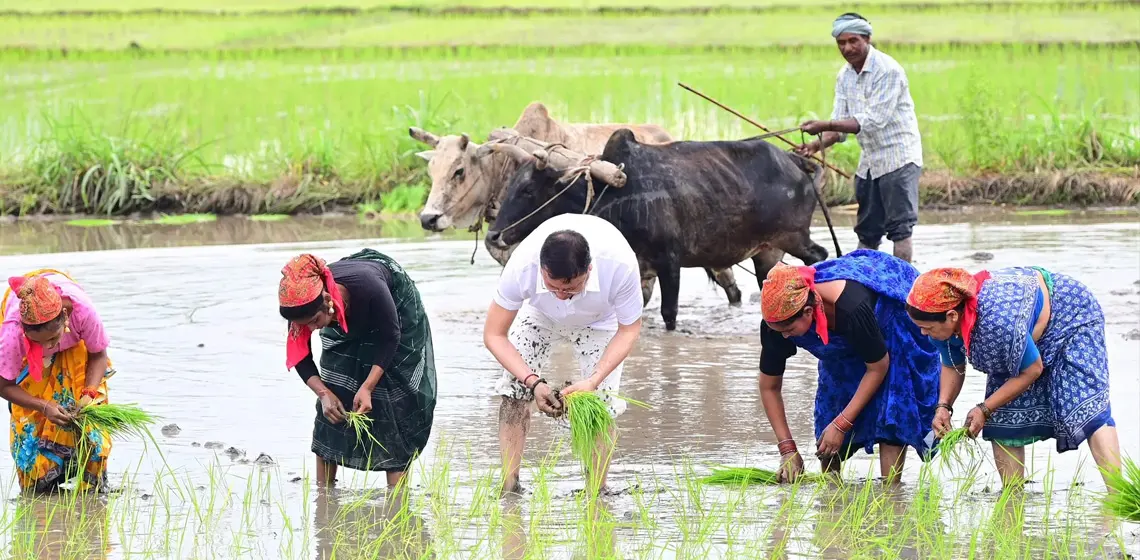
Where the decision is made: ploughing a paddy field in Umaria district, Madhya Pradesh. A sowing decision is taken field by field in the first fortnight of the monsoon, and it is effectively irreversible for the season.
The largest single rice gain in the country this year is Assam’s, at 3.93 lakh hectares. The largest single loss is Karnataka’s, at 2.86 lakh hectares in rice alone. India’s rice map is being redrawn by rainfall, not by policy.
At a Glance
• Data as on: 14 August 2026, Ministry of Agriculture & Farmers Welfare
• Total kharif area: 1,016.57 lakh ha vs 1,037.52 lakh ha — down 2.02 per cent
• Rice: 379.07 lakh ha, down 14.37 — 68.6 per cent of the total decline
• Karnataka: down about 14.5 lakh ha across four crop groups
• Uttar Pradesh: up about 8.5 lakh ha on net
• Largest rice gain: Assam, up 3.93 lakh ha
• For context: 2025’s final kharif area was 1,134.27 lakh ha
The permanent question underneath the seasonal number is where India should be growing its most water-hungry crop. Rice in the peninsular states is grown substantially on stored and pumped water; rice in the eastern and north-eastern states is grown substantially on rain that arrives anyway. When a deficit year pushes area out of Karnataka and a surplus year pulls it into Assam, the map is moving in the direction that hydrology would choose if anyone were choosing deliberately. The difficulty is that it moves by accident, one bad season at a time, and the farmer absorbs the cost of the transition rather than being paid for it.
There is a constructive version of the same shift. Uttar Pradesh’s figures show what it looks like when a state substitutes rather than simply loses: pulses and oilseeds up sharply, rice down only marginally, total area higher. Both are crops India imports in quantity, and both use a fraction of the water. Procurement and crop-insurance signals are the instruments that decide whether the rest of the country follows that pattern or merely fallows the land. Publishing district-level water-use alongside the sowing bulletin — the same table, one more column — would let states see which of their own districts are trading scarce water for a crop the market is not short of. The season’s number is disappointing. The direction inside it is not.