Blitz Bureau
NEW DELHI: India grows about four-fifths of the world’s makhana, almost all of it in nine districts of one state. The Centre’s answer is a six-year scheme worth ₹476.03 crore — and the interesting part is not the money, but where it is being spent.
The Government’s own backgrounder on the makhana sector, issued on 19 August, sets out a position most agricultural commodities in India would envy: the country is the world’s largest producer of makhana, with a share of the global crop put at close to 80 per cent, and Bihar is the nerve centre of it. Production is concentrated in Madhubani, Darbhanga, Sitamarhi, Saharsa, Katihar, Purnea, Supaul, Kishanganj and Araria. Nine districts, one crop, and a dominant share of a world market — that combination is rare enough to be worth reading carefully.
The institutional architecture around it is new. The National Makhana Board was announced in the Union Budget for 2025-26, constituted by gazette notification on 14 September 2025, and launched by the Prime Minister in Bihar the following day. Alongside it the Centre approved a Central Sector Scheme for the Development of Makhana with an outlay of ₹476.03 crore running from 2025-26 to 2030-31 — six financial years, which works out to an average of ₹79.34 crore a year.
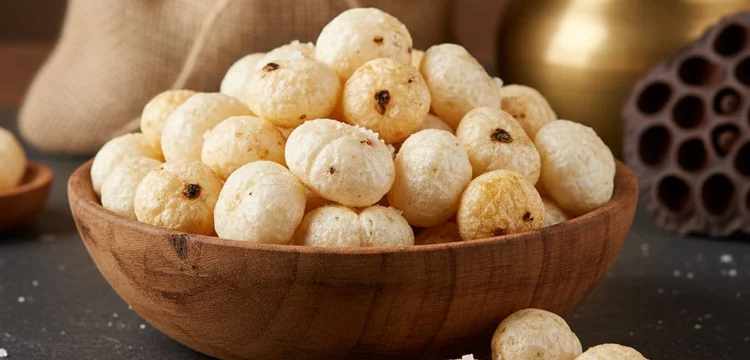
The crop after popping: Makhana — the seed of Euryale ferox, harvested from ponds and wetlands and sold in this popped form. The Central Sector Scheme names grading, drying, popping and packaging as the infrastructure it intends to fund, which is a precise statement of where value currently leaks out of the chain.
₹79.34 crore a year is not a subsidy programme — it is too small to be one. It is the price of fixing seed supply and post-harvest processing in a sector that already owns its world market. That is a leverage bet, not a support bet.
At a Glance
• Scheme: Central Sector Scheme for Development of Makhana
• Outlay: ₹476.03 crore, 2025-26 to 2030-31 (six years)
• Average a year: about ₹79.34 crore
• Board notified: 14 September 2025; launched in Bihar 15 September 2025
• India’s share of world output: about 80 per cent
• Core districts: Madhubani, Darbhanga, Sitamarhi, Saharsa, Katihar, Purnea, Supaul, Kishanganj, Araria
• Seed supply: SAU Sabour and CAU Samastipur, Bihar
• Research anchor: National Research Centre for Makhana, Darbhanga
Read the Board’s own first meeting and the strategy becomes legible. When the Board convened for the first time at Krishi Bhawan in New Delhi on 12 December 2025, chaired by the Secretary of the Department of Agriculture and Farmers Welfare, Dr Devesh Chaturvedi, it did not begin with prices or procurement. It began with seed. The meeting recorded the need to consolidate the seed requirement of the states, to be supplied by the State Agricultural University at Sabour and the Central Agricultural University at Samastipur. It then turned to training the trainers — the National Research Centre for Makhana at Darbhanga and the two universities teaching state officials the technology of the value chain, so that cultivation can spread into what the Board calls non-traditional makhana areas.
The third item on that list is the one that decides farmer income: infrastructure for grading, drying, popping and packaging. Makhana leaves the pond as a hard seed and reaches the shelf as a light, popped kernel, and almost all of the value is added in between. A scheme that spends its money on seed quality and on the processing step is aiming at the two points where a smallholder currently loses the most — poor germination at one end, and selling raw seed to a processor at the other.
The honest caveat is that ₹79 crore a year cannot, on its own, industrialise nine districts. The scheme’s success will depend on whether the state annual action plans the Board has cleared translate into working grading and popping units close to the ponds rather than in distant towns, and whether the Sabour and Samastipur seed pipeline can actually meet consolidated state demand year after year. Those are administrative questions, and they are answerable. The constructive next step is disclosure: publishing, district by district, how many processing units are commissioned, how much certified seed is distributed, and what a farmer’s realised price per quintal has done since 2025-26. A sector with 80 per cent of a world market can afford to be measured in public.