Blitz Bureau
NEW DELHI: Kharif sowing is running 2.02 per cent behind last year. That headline understates what is actually happening, because the decline is not spread across the crop basket — it is concentrated in the single most water-intensive crop India grows.
As of 14 August, the total kharif area stood at 1,016.57 lakh hectares against 1,037.52 lakh hectares on the same date a year earlier — a fall of 20.95 lakh hectares, or 2.02 per cent. Decompose that figure by crop and the picture changes. Rice accounts for 379.07 lakh hectares this year against 393.44 lakh hectares last year: a fall of 14.37 lakh hectares. That single crop is 68.6 per cent of the entire national shortfall.
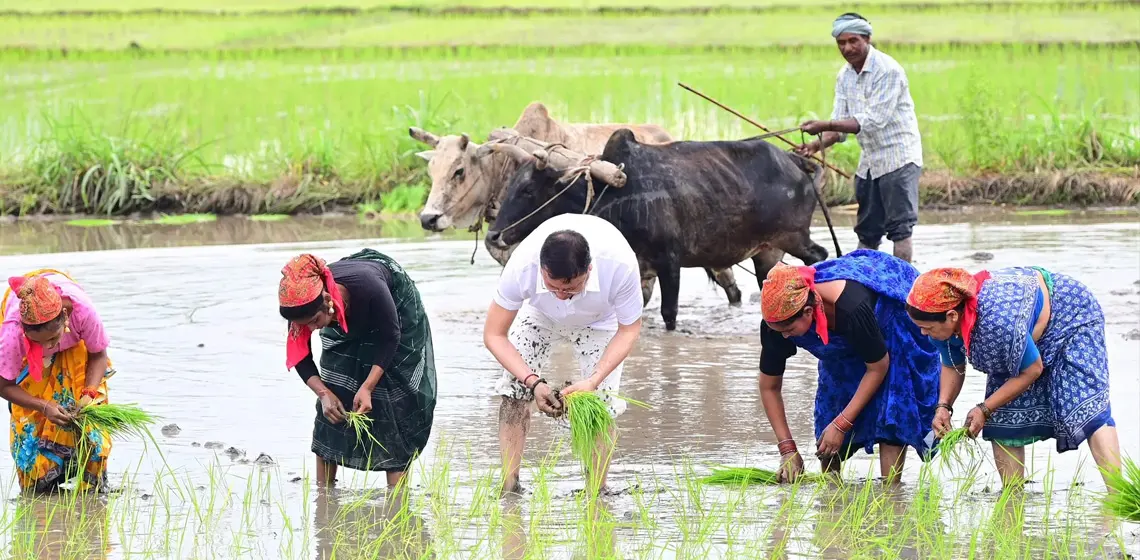
The water-heaviest hectare: Ploughing a paddy field in Umaria district, Madhya Pradesh. Transplanted paddy is the most water-intensive of India’s major kharif crops, which makes the composition of a sowing shortfall as important as its size.
Two-thirds of a 2.02 per cent shortfall sitting in one crop is not a bad monsoon story. It is a cropping-pattern story, and those move slowly in both directions.
At a Glance
• Total kharif area, 14 August: 1,016.57 lakh hectares
• Same date last year: 1,037.52 lakh hectares
• Shortfall: 20.95 lakh hectares, or 2.02%
• Rice: 379.07 lakh ha against 393.44 — down 14.37 lakh ha, or 3.65%
• Rice share of the total shortfall: 68.6%
• Pulses: 108.14 lakh ha against 108.49 — effectively flat, down 0.32%
• Coarse cereals / millets: 172.96 lakh hectares
• Cotton: 107.30 lakh ha against 108.26 — down 0.89%
• Source of series: Ministry of Agriculture & Farmers Welfare weekly sowing data
Pulses and cotton barely moved. Pulses are down 0.32 per cent — a rounding error on a 108 lakh hectare base — and cotton is down 0.89 per cent. Coarse cereals and millets stand at 172.96 lakh hectares. In a season where rainfall was genuinely poor across the board, one would expect the shortfall to be distributed across every crop roughly in proportion to area. It is not. It sits in paddy.
That concentration is worth reading constructively, because a smaller paddy area is not automatically bad news. Transplanted paddy is the most water-intensive of India’s major kharif crops, and the states that grow the most of it are also the states where groundwater tables have fallen fastest. Every hectare that moves from paddy to pulses, millets, maize or oilseeds reduces the water drawn per hectare, improves soil nitrogen, and shortens the crop cycle. India’s own policy documents have argued for exactly that shift for two decades.
The structural case is arithmetic rather than ideological. India will need to feed a larger population from a water table that is falling in its most productive basins. There are only two ways to do that: grow the same crops with less water per hectare, or grow different crops. Direct-seeded rice, alternate wetting and drying, micro-irrigation and laser land levelling do the first. Crop diversification does the second. A country serious about water security does both, and the second is the harder one because it requires procurement, price signals and market access to move together.
The way forward is therefore procurement and market design rather than exhortation. A farmer switches out of paddy when the alternative crop has an assured buyer at an assured price — which is why pulses and oilseeds procurement, millet inclusion in the public distribution system, and processing capacity near the growing districts matter more to the water table than any advisory ever will. The final kharif estimate is still weeks away and the season is not yet closed; but a shortfall concentrated in the thirstiest crop is the least worrying kind of shortfall to have.