Blitz Bureau
NEW DELHI: The e-Shram portal turns five today with 31.89 crore workers on its rolls. Read the age table and the occupation table together, and the next five years write themselves.
The e-Shram portal was launched on 26 August 2021 and completes five years today. The headline the Ministry of Labour and Employment offers is the size of the register: 31.89 crore registrations, each worker carrying a 12-digit Universal Account Number, on what is India’s first Aadhaar-authenticated National Database of Unorganised Workers. That is a database larger than the population of every country on earth except China and India itself.
Two figures inside the register are more interesting than the total. The first is that women are 54.28 per cent of everyone registered and men 45.72 per cent — roughly 17.31 crore women against 14.58 crore men. No other large employment record in India leans that way. It is a reminder that when work is counted rather than assumed, the informal economy turns out to be substantially a women’s economy: domestic and household work is the second-largest occupational category on the portal, behind only agriculture.
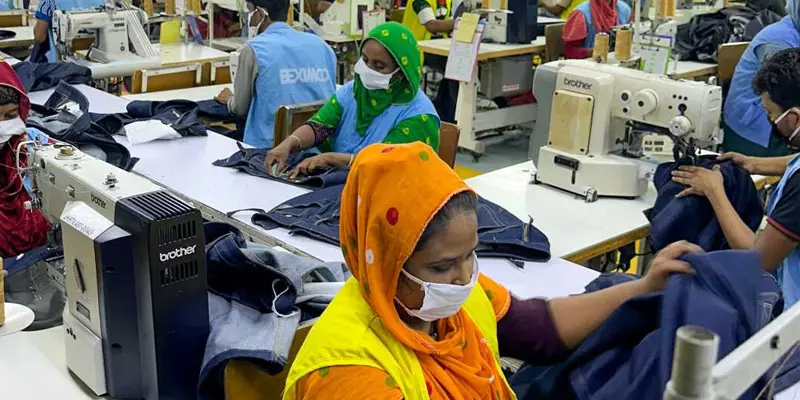
The four columns that carry the register. Agriculture, domestic and household work, construction and apparel account for the largest share of e-Shram registrations. Apparel workers, above; the portal’s value is that it turns each of them from an assumption into a record.
A database is not a benefit. What e-Shram has built in five years is the address list. The next five years are about what actually arrives at those addresses.
At a Glance
• Launched: 26 August 2021; five years today
• Registrations: 31.89 crore (as on 18 August 2026)
• Women: 54.28 per cent · Men: 45.72 per cent
• Aged above 50: 20.53 per cent — about 6.55 crore workers
• Gig and platform workers: about 11.5 lakh registered
• Top states: Uttar Pradesh, Bihar, West Bengal, Madhya Pradesh, Maharashtra
The second figure is the one that should set the agenda. Around 11.5 lakh gig and platform workers have registered — delivery riders, cab drivers, the people whose work is dispatched by an application. Against a register of 31.89 crore that is 0.36 per cent, or roughly one worker in 277. Gig work is the fastest-growing category of informal employment in urban India and the thinnest column on the country’s main informal-work database. Everything a policymaker might want to do for platform workers — contribution-linked insurance, a portable benefit account, a bargaining framework — needs that column to be full first. It is the single most fixable gap in the system, because unlike a farm labourer in a remote block, every gig worker already holds a smartphone and is already onboarded to a digital platform.
The age table points the same way. 20.53 per cent of those registered are above 50 — about 6.55 crore people who will reach 60 within this decade. For them the relevant instrument is the Pradhan Mantri Shram Yogi Maan-Dhan scheme, which pays a minimum assured pension of ₹3,000 a month from the age of 60, and which a worker can now enrol in through e-Shram itself. Enrolment is voluntary and contributory; the register tells the government exactly whom to approach, and when.
What e-Shram gives a worker today is concrete and worth stating plainly, because a great many eligible people still do not know it. Registration is free, one-time, and open to any worker aged 16 or above in the unorganised sector who is not an income-tax payer and not a member of the EPFO or ESIC. It needs an Aadhaar number and a mobile number, and can be done at register.eshram.gov.in or at a Common Service Centre. Since the e-Shram One-Stop Solution was launched on 21 October 2024, the portal has carried 15 social security and welfare schemes in one place, and a registered worker can enrol directly in Pradhan Mantri Suraksha Bima Yojana — ₹2 lakh for accidental death or permanent disability, ₹1 lakh for partial disability — and Pradhan Mantri Jeevan Jyoti Bima Yojana, which carries ₹2 lakh of life cover. Since 2025 the portal has spoken 22 languages through Bhashini.
The way forward is not a new scheme; it is completion. Three things would convert the register into delivery. Fill the gig column, using the platforms themselves as the registration counter. Turn the address list into an outbound one — the database knows which 6.55 crore workers are approaching 60 and can be told, in their own language, what PM-SYM would pay them. And close the loop with the states, so that the construction-worker records e-Shram shares actually end in registration with a BOCW Board, where the welfare cess money already sits. India spent five years learning who its informal workers are. That was the hard part, and it is done.