Blitz Bureau
NEW DELHI: Read once, the Joint Statement issued at Tashkent on 30 August 2026 looks like the customary inventory of goodwill. Read twice, and something harder shows through it. Almost every paragraph names a body that must now meet, a study that must now be converted into a negotiation, or a market that must now be opened to a certificate. India and Uzbekistan did not merely elevate their relationship to a Comprehensive Strategic Partnership on the second day of the Prime Minister’s State Visit. They wrote themselves an order book.
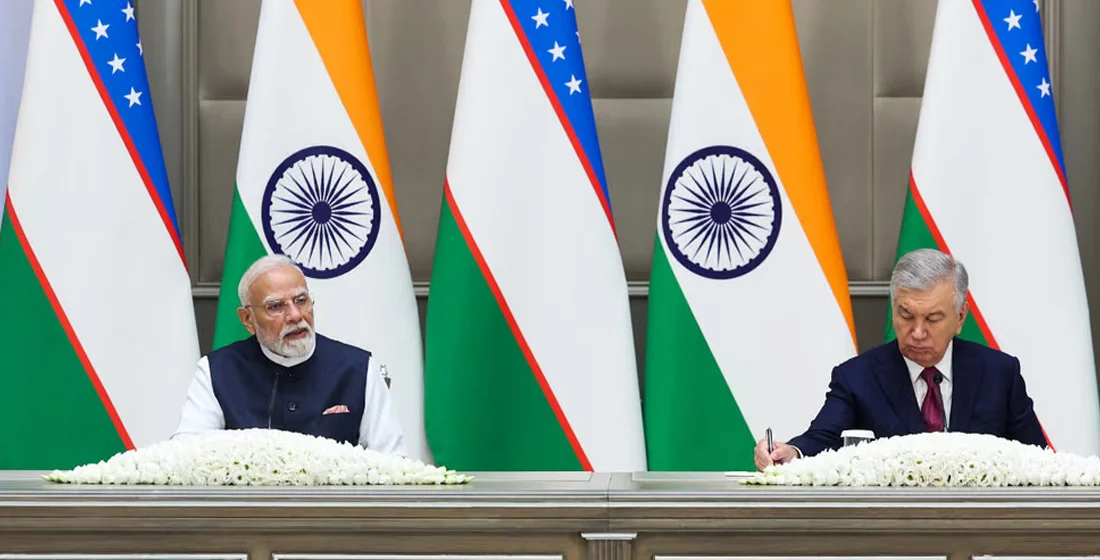
The Prime Minister of India paid a State Visit to the Republic of Uzbekistan from 29 to 30 August 2026 at the invitation of President Shavkat Mirziyoyev. The two leaders reviewed the relationship in full, exchanged views on regional and international questions, and identified the areas where practical cooperation should now go. That much is the language of communiqués everywhere. What distinguishes this one is the number of times it stops describing and starts instructing.
Machinery before ceremony
The first instruction concerns the two countries’ own habits. A mechanism led by the Foreign Ministers of both sides is to be established, and its stated purpose is not dialogue but oversight — high-level coordination of the implementation of the agreements and arrangements already reached, and the timely realisation of priority initiatives and projects. Anyone who has followed bilateral relationships across a decade will recognise what is being addressed. Instruments are signed at summits and then wait. Putting the two Foreign Ministers in charge of the waiting list is a small change of design with a large consequence.
The same instinct runs through the treaty framework itself. The leaders emphasised the need for a comprehensive review of the existing bilateral legal instruments, so that they reflect the current priorities of the engagement, and agreed to work jointly on modernising that framework in line with present-day realities. It is an unusual thing for two governments to say aloud: that some of what they have already signed has aged.
The commercial spine
The trade section is where the order book is thickest. The Joint Feasibility Study on a Preferential Trade Agreement has been concluded, and the ministries have been directed to explore the next steps on a time-bound basis. A Joint Working Group is to be created for non-tariff issues and investment barriers, with a particular focus on the sectors that carry most of the trade. Both sides agreed to promote dialogue among regulators and to explore mutual recognition arrangements — the unglamorous plumbing through which an Indian pharmaceutical approval or an engineering certification stops being re-tested at the far end.
The Tashkent Order Book : What the Joint Statement instructs, not merely notes
| Parameter / Metric | Details |
|---|---|
| Foreign Ministers’ mechanism for implementation oversight | To be set up |
| Preferential Trade Agreement — feasibility study | Concluded |
| Next steps on the PTA | Time-bound |
| Joint Working Group on non-tariff and investment barriers | To be created |
| Bilateral trade target | US$5 bn by 2030 |
| Uzbek nationals trained under ITEC, cumulative | 2,700+ |
| Uzbek students selected under ICCR scholarships | 400+ |
| Aral Sea ecological rehabilitation, Indian grant-in-aid | US$1 mn |
| Cultural Exchange Programme signed | 2026–2030 |
Source: Joint Statement during the State Visit of Prime Minister Narendra Modi to Uzbekistan, pmindia.gov.in, 30 August 2026. The US$5 billion trade target was stated by the Prime Minister at Tashkent on the same day.
Behind the machinery sits a reading of both economies. The two sides named electrical items, engineering products, automobiles and pharmaceuticals as the sectors of greatest untapped potential, and agreed to closer business-to-business tie-ups in each. They agreed to explore cooperation between Uzbekistan’s Investment Promotion Agency and Invest India through joint forums, roadshows and investment seminars. India, for its part, was thanked for supporting Uzbekistan’s accession to the World Trade Organization, and both sides committed themselves to preserving a multilateral trading system with the WTO at its core, particularly in the interests of developing countries.
The leaders directed the relevant Ministries to explore the next steps on a time bound basis.
What the elevation means
• Ties raised to a Comprehensive Strategic Partnership at Tashkent, 30 August 2026.
• Cooperation spans trade, transport connectivity, digital transformation, energy transition, critical minerals, food security, healthcare, pharmaceuticals and education.
• A framework is to be established for the long-term supply of uranium from Uzbekistan to India, alongside cooperation in the peaceful uses of nuclear energy.
• Uzbekistan chairs the Non-Aligned Movement for 2027–2030; India chairs BRICS in 2026.
Rock, root and reactor
The resources chapter is the one that will be quoted longest. The two sides agreed to expand cooperation in critical minerals through joint projects in geological exploration, mining, mineral processing and the development of integrated value chains — not extraction alone, but the steps that follow it, including the production of value-added goods and recycling. Indian companies are to be encouraged to take part in developing prospective mineral deposits in Uzbekistan, and Uzbek enterprises invited to collaborate inside India. Separately, the leaders expressed interest in extended cooperation in the peaceful uses of nuclear energy.
Agriculture is treated with the same seriousness, and with an eye on what the two countries can teach each other rather than merely sell. The leaders agreed to cooperate in developing agricultural value chains, strengthening export capability and raising the technical capacity of the agriculture and livestock sectors, with a stated focus on innovation and resource-efficient technologies. Research institutions and enterprises are to work together on productivity and on the conservation and sustainable use of plant genetic resources — a quiet commitment, and among the most consequential in the document for a region where water is the binding constraint.
The human column
The passages on people carry the numbers that matter most to a reader. More than 2,700 Uzbek nationals have passed through the Indian Technical and Economic Cooperation programme over the years, and more than 400 Uzbek students have been selected under scholarships of the Indian Council for Cultural Relations, including under AYUSH.
Uzbekistan welcomed the announcement of a Lal Bahadur Shastri Scholarship for the Hindi language. India’s Ek Ped Maa Ke Naam and Uzbekistan’s Yashil Makon were set side by side, and out of that pairing comes an Indian grant-in-aid of US$1 million, with technical support, for the greening and ecological rehabilitation of the Aral Sea region.
The first information technology park in Tashkent, established in 2019 on the Indian model with the support of the Software Technology Parks of India, was cited as the template for what should follow: wider partnerships among technology parks, companies, startups and educational institutions. The two sides agreed to cooperate on safe, secure and trustworthy artificial intelligence systems, building on understandings reached in February 2026 on the margins of the India AI Impact Summit in New Delhi, and to expand practical cooperation in the peaceful uses of outer space.
What Blitz would add
The document’s strength is that it names the bodies. Its risk is the one every such document carries: a working group is only as good as the calendar it keeps. Two suggestions, offered to speed the work rather than to fault it.
First, the Foreign Ministers’ mechanism would gain from publishing a short annual statement of what has been implemented and what has not — a public scoreboard is the cheapest form of pressure. Second, since the Preferential Trade Agreement has been given a time-bound instruction, the instruction would be sharper for carrying a date. The Tashkent order book is a good one. What it now needs is a delivery schedule.