Blitz Bureau
NEW DELHI: Two of India’s stubborn problems have never been thought of as the same problem. One is the smoke that rises off the fields of the north-west when the rice straw is burned. The other is the bitumen India buys from abroad to surface the roads it is building faster than almost any country on earth. Three laboratories of the Council of Scientific and Industrial Research have spent years arguing that these are one problem, and on 5 August 2026 they put the argument on a table in Dehradun with the product beside it.
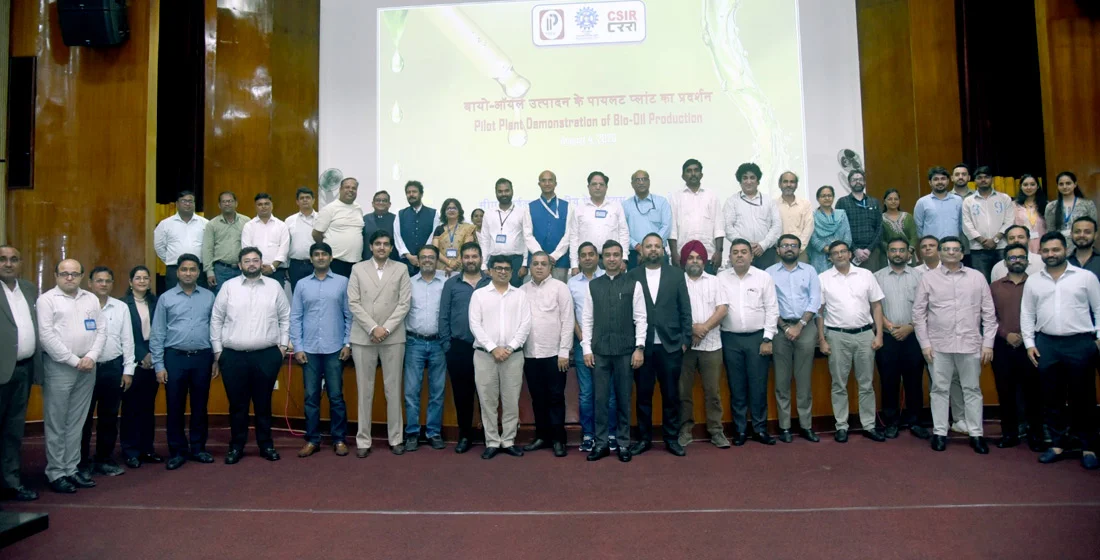
The CSIR-Indian Institute of Petroleum at Dehradun, working with the CSIR-Central Road Research Institute and the CSIR-Advanced Materials and Processes Research Institute, showcased what the three call Bio-Binder Technology: a route that takes agricultural and biomass waste and returns a substitute for petroleum-derived bitumen. The demonstration was attended by the directors of all three laboratories — Dr Harender Singh Bisht of CSIR-IIP, Dr C. Ravi Sekhar of CSIR-CRRI and Dr Thallada Bhaskar of CSIR-AMPRI — along with Dr V. C. S. Palla’s team at CSIR-IIP, Dr G. Bharath’s team at CSIR-CRRI, and the industry partners who would have to build it at scale.
What the chemistry actually does
The process is pyrolysis: biomass, principally rice straw, is heated in the absence of oxygen until it breaks into fractions. Dr Ravi Sekhar explained that the run yields bio-oil, bio-binder, biochar and biogas. The heavy organic fraction becomes the binder, and that binder can replace or supplement conventional bitumen in flexible pavement — the ordinary layered road surface on which most Indian traffic runs. India’s road programme, he noted, continues to lean heavily on imported bitumen; this is an indigenous alternative to it.
What lifts the work above a laboratory curiosity is Dr Bhaskar’s insistence that nothing in the barrel be wasted. He described the design as an integrated biorefinery, in which every process stream must find a commercially valuable end. The aqueous fraction — the part a narrower project would have discarded — has been converted into a patented biological pesticide formulation, and then into a stable powder to make storage, transport and handling practical. That powdered formulation has been put through evaluation by national laboratories for possible commercialisation in agriculture. Laboratory-scale research, Dr Bhaskar observed, is comparatively straightforward; commercialisation demands products that meet a real market, substitute for imports and return money.
Laboratory to Highway : From the laboratory towards the highway
| Parameter / Metric | Details |
|---|---|
| Test section laid and evaluated, National Highway-40 near Shillong | 100 m |
| Long-term evaluation of that section | Completed |
| Evaluation programme initiated by Government of Andhra Pradesh | 5 km |
| National Bio-Binder Testing Laboratory at CSIR-CRRI, approved by MoRTH | By March 2027 |
| Laboratories involved | CSIR-IIP, CSIR-CRRI, CSIR-AMPRI |
| Standards work under way with | MoRTH, NHAI, IRC |
Source: Press Information Bureau, Ministry of Science and Technology, release of 5 August 2026 (Release ID 2294669), reporting the CSIR-IIP technology demonstration programme at Dehradun.
The evidence on the ground
The claim rests on a road, not a slide. CSIR-CRRI has completed the long-term evaluation of a 100-metre Bio-Binder test section built on National Highway-40 near Shillong — a stretch chosen in a wet, hilly, punishing part of the country. On the strength of that trial the Government of Andhra Pradesh has begun a five-kilometre evaluation programme for Bio-Binder road construction, which is the first order of magnitude by which a laboratory result becomes an engineering one. CSIR-CRRI is working with the Ministry of Road Transport and Highways, the National Highways Authority of India and the Indian Roads Congress on the standardised technical specifications and implementation guidelines without which no Indian road agency can lawfully write the material into a tender.
The Ministry of Road Transport and Highways has approved a dedicated National Bio-Binder Testing Laboratory at CSIR-CRRI, expected to be operational by March 2027, to test, validate, certify and assure the quality of commercially manufactured bio-binders. That is the sentence a chemist finds dull and an economist finds decisive: a certification facility is the thing that lets a dozen private manufacturers enter a market without a buyer having to trust any of them on faith.
Why it matters for India
Three national accounts are touched at once. The import bill, because bitumen is bought abroad. The farm income of the rice belt, because straw acquires a buyer instead of a match. And the winter air of the northern plains, for the same reason. The programme was coordinated by Dr Jyoti Porwal, with Dr O. P. Khatri, Dr Atul Ranjan and Dr Ajay Kumar of CSIR-IIP.
Two cautions belong in the same breath, and the desk states them rather than leaving them to be discovered. The release records a completed evaluation of one 100-metre section and a five-kilometre programme that has been initiated, not concluded; no peer-reviewed durability figure across a full monsoon-to-summer cycle at highway scale has been published with it. And no price per tonne against imported bitumen has been placed in the public record. Neither point weakens the science. Both are simply what is still to be shown.
What Blitz would add
The testing laboratory arrives in March 2027; the standards should not wait for it. If the Indian Roads Congress can publish an interim specification, even a provisional one, State public works departments could begin writing bio-binder into small contracts this construction season rather than the next. And since the straw is the input, the scheme deserves to be joined to the existing crop-residue management effort in Punjab, Haryana and western Uttar Pradesh, so that the farmer sees one buyer and not two schemes.
Photograph: issued by the Press Information Bureau with the release of 5 August 2026, Ministry of Science and Technology, Government of India — the event itself, on its own date. No agency photograph has been used.