Blitz Bureau
NEW DELHI: The Indian Space Research Organisation put up a mission page on 29 August 2026 for GSLV-F17, which will carry the earth observation satellite EOS-05. In four short paragraphs the page records something India has not done before: EOS-05 is described by ISRO as the country’s first ever imaging satellite from geosynchronous orbit.
What ISRO’s own page states
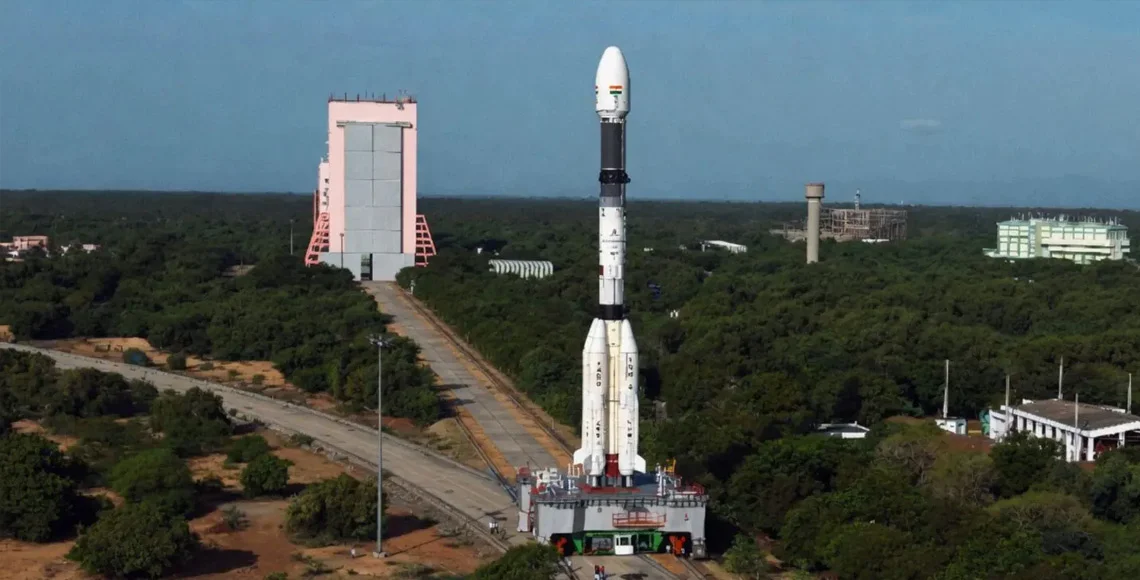
GSLV-F17 is the nineteenth flight of India’s Geosynchronous Satellite Launch Vehicle. Its payload fairing is the four-metre-diameter ogive composite version. The vehicle will place EOS-05 into a sub-geosynchronous transfer orbit, and the launch is planned from the Second Launch Pad at the Satish Dhawan Space Centre, SHAR. ISRO describes EOS-05 as a state-of-the-art earth observation spacecraft. A mission brochure dated 29 August 2026 accompanies the page.
That is the whole of what the primary document says, and this newspaper carries no more than that. Reports in circulation give the satellite a second designation and place the launch on the early morning of 4 September 2026; neither the alternative name nor the date appears on ISRO’s mission page as read by this desk, and both are therefore reported here as what secondary accounts state, not as what the agency has said.
Why a high orbit is a different instrument
Almost every earth observation satellite India has flown works from a low, near-polar orbit. It circles the earth roughly every hour and a half, the planet turns beneath it, and over days it builds up coverage strip by strip. The pictures are sharp, because the spacecraft is close. But it sees any one place only when it happens to be passing over it.
A satellite working from geosynchronous altitude does the opposite. It keeps pace with the earth’s rotation, so it stays over the same longitude and can look at the same region continuously. It is much further away, so for the same optics the ground detail is coarser. What it buys instead is persistence — the ability to look again in minutes rather than days.
For a country of India’s geography that trade is a serious one. A cyclone forming in the Bay of Bengal, a flood front moving down a river system, a cloud band arriving with the monsoon, a fire, a spill: these are events where knowing what changed in the last twenty minutes is worth more than knowing precisely what a field looked like last Thursday. Low-orbit satellites answer the second question well and the first one badly.
A low-orbit satellite tells you what a place looked like when it passed. A geosynchronous one tells you what is happening there now.
From ISRO’s mission page, 29 August 2026
• Launch vehicle: GSLV-F17, the 19th GSLV flight.
• Payload fairing: 4 m diameter ogive, composite.
• Target orbit: sub-geosynchronous transfer orbit.
• Launch site: Second Launch Pad, SDSC SHAR.
• Satellite: EOS-05, earth observation.
• ISRO’s description: India’s first ever imaging satellite from geosynchronous orbit.
The vehicle, and why this flight matters
The GSLV is the launcher India built to reach geosynchronous transfer orbits with an indigenous cryogenic upper stage, and its early record was the hardest-won in the Indian programme. A nineteenth flight carrying a first-of-its-kind national asset is a statement about where that vehicle now sits in ISRO’s planning: no longer the launcher being proven, but the launcher chosen when the payload matters.
The sub-geosynchronous transfer orbit in the mission description is worth a word too. The launcher does not place the spacecraft at its final altitude; it places it on a transfer path, and the satellite’s own propulsion raises and circularises the orbit over the following days. A launch is therefore the beginning of the mission, not the end of it, and the operational orbit is reached some time after the vehicle’s work is done.
What this desk is not saying
No resolution figure, no revisit interval, no instrument list and no operational-service date appears here, because none appears on the primary document read. When the mission brochure and the post-launch releases are on the record, those numbers can be reported; until then, a satellite’s capabilities are not a thing to be estimated in print.
Offered only as corrective advice, to help the work move faster: ISRO’s mission pages are among the cleanest primary documents any Indian institution publishes, and the practice of putting one up ahead of the launch with a dated brochure is exactly right. Adding the planned launch date and window to the mission page itself — it presently appears only in secondary reporting — would let every newspaper in the country take the date from the agency rather than from each other.