Blitz Bureau
Sriharikota · The rocket will not put EOS-05 where it is meant to live. That is the plan, and it is the most interesting thing about the mission.
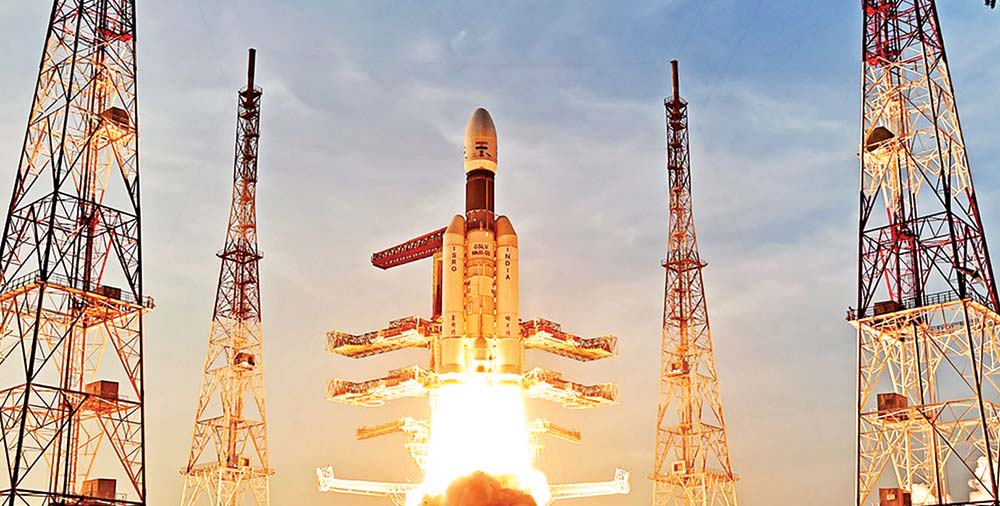
At 02:55 in the morning of 4 September 2026, the nineteenth flight of India’s Geosynchronous Satellite Launch Vehicle will leave the Second Launch Pad at the Satish Dhawan Space Centre, Sriharikota, carrying a spacecraft called EOS-05. ISRO describes it, on its own mission page, as India’s first imaging satellite from geosynchronous orbit. The description is doing more work than it looks.
Almost every Earth-observation satellite India has flown lives in a low polar orbit, a few hundred kilometres up, going round the planet in about ninety minutes. Such a satellite sees any given field, coastline or river with superb resolution — and then leaves, and does not come back for days. It is a camera that takes one very good photograph a week.
A satellite in geosynchronous orbit, roughly thirty-six thousand kilometres out, goes round the Earth once in a day, which is to say at the same rate the Earth turns. From the ground it appears to hang still. It sees a whole face of the planet at once and it never looks away. It is not a camera that takes a photograph; it is a camera that never stops recording.
The bit most reports will leave out
Here is the detail on ISRO’s page that repays reading twice. The GSLV-F17 will place EOS-05 into a Sub-Geosynchronous Transfer Orbit — a stretched ellipse that is not the working orbit at all. The spacecraft has to finish the journey itself, firing its own engine over days to round that ellipse out into the circle where it will live and stay.
This is standard practice and it is not a shortfall; it is how the mass budget is made to work, and how a vehicle of this class delivers a spacecraft of this class to that altitude. But it means the launch is not the end of the mission. It is the first of several manoeuvres, and the weeks after the flight are when the mission is actually won.
Blitz Data Card · Sriharikota, 3 September 2026
GSLV-F17 / EOS-05: What Is Being Flown, And Where To
| Parameter / Metric | Details |
|---|---|
| Scheduled lift-off | 4 Sept 2026, 02:55 IST |
| Launch vehicle — flight number of the GSLV | 19th |
| Payload fairing | 4 m Ogive, composite |
| Orbit the vehicle delivers | Sub-GTO |
| Orbit the spacecraft works from | Geosynchronous |
| Launch site | Second Launch Pad, SDSC SHAR |
THE COMPARISON — DRAWN TO SCALE
Time to circle the Earth — geosynchronous satellite: 24 hours
Time to circle the Earth — low polar orbit: about 1.5 hours
THE DIFFERENCE — A low polar orbit closes its circuit 93.75 per cent faster — sixteen turns to the geosynchronous satellite’s one. Difference derived here from the two periods.
WHAT INDIA GAINS
The ability to keep an unbroken eye on its own territory and its own seas from an Indian satellite on an Indian rocket — and to sell that continuity as a service, which is a capability only a handful of countries hold.
What it is for
ISRO’s Chairman, V. Narayanan, speaking to reporters at Tirumala on 2 September after placing models of the rocket at the temple, called EOS-05 a state-of-the-art spacecraft that will strengthen India’s Earth-observation capabilities and improve the delivery of Earth-observation services. That last phrase is the operational one.
Services are what a continuous watch makes possible and a weekly pass does not: a flood front tracked as it moves rather than photographed after it has passed; a cyclone followed hour by hour off the eastern coast; a crop stress signal caught in the week it appears rather than the week after.