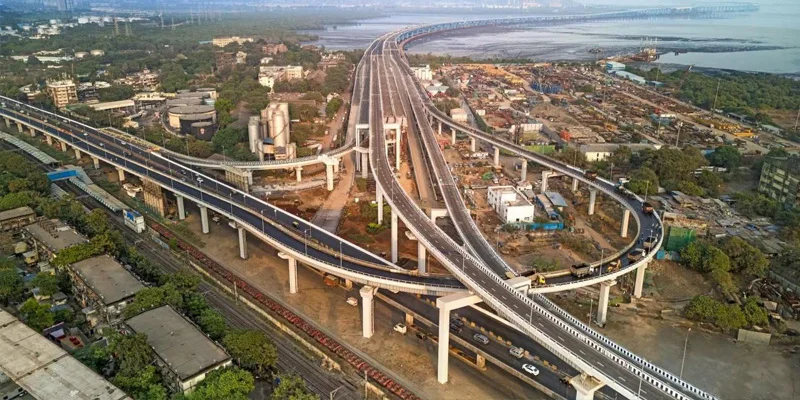
With Mumbai expanding at a rapid rate Maharashtra is looking at a new urban centre beyond Navi Mumbai. Called Mumbai 3.0, the KarnalaSai-Chirner (KSC) New Town will bring 124 villages across Uran, Panvel and Pen talukas of Raigad district into a planned urban development spread over 323.44 sq km.
The Mumbai Metropolitan Region Development Authority (MMRDA) has been appointed as the New Town Development Authority for the region, according to a report by NDTV.
The proposed city sits close to the Atal Setu and Navi Mumbai International Airport, putting it at the centre of one of India’s fastest-growing infrastructure corridors. Mumbai has already expanded far beyond its original island city. Navi Mumbai became the next major urban centre. But even Navi Mumbai is seeing increasing pressure for land.
Hence, the need for KSC New Town. The project is being planned as a new economic and residential centre rather than simply another housing suburb.
The vision includes commercial districts, technology hubs, logistics, data centres, healthcare, education and residential areas.
According to the plan, around 104 sq km will have townships and industrial corridors, while other areas will retain green zones, forests and rural settlements.
The biggest advantage for Mumbai 3.0 is connectivity. The Atal Bihari Vajpayee Sewri-Nhava Sheva Atal Setu has dramatically reduced travel time between Mumbai and the Navi Mumbai-Raigad side.
The proposed city will also benefit from the Navi Mumbai International Airport, Panvel-Karjat railway corridor, Virar-Alibaug multimodal corridor and the Mumbai-Pune Expressway.
Investment commitment
The MMRDA has also secured a proposed $12 billion investment commitment from Brookfield covering areas such as real estate, transit-oriented development, logistics parks, data centres and GCCs.
The project is also getting a significant push from the MMRDA. For 2026-27, MMRDA has earmarked Rs 4,000 crore for the KarnalaSai-Chirner New Town as part of its infrastructure-focused budget.
Land acquisition is also moving ahead. MMRDA has offered landowners in the 124 villages different compensation routes, including monetary compensation, development rights and land pooling. This will be one of the most important parts of the project.