Blitz Bureau
NEW DELHI: India opens an airport every forty-five days. It does not, for the most part, own the aircraft that land on them. More than eighty-five per cent of the fleet flown by Indian carriers is leased, and the first meeting of the High-Level Committee on Aircraft Leasing and Financing, held in New Delhi on 2 September, was the government sitting down to work out what that dependence costs and how much of it can be brought home.
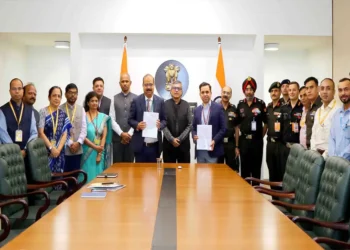
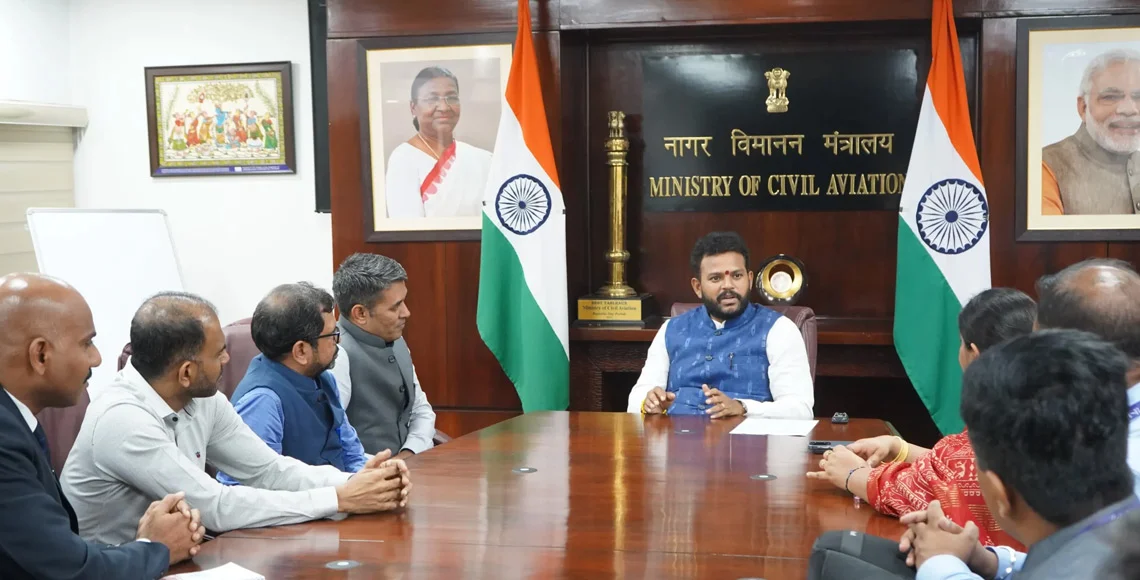
The first meeting of the High-Level Committee on Aircraft Leasing and Financing, New Delhi, 2 September 2026. Photograph from the Ministry of Civil Aviation’s own release, static.pib.gov.in.
The Committee was chaired by the Union Minister of Civil Aviation, Shri Ram Mohan Naidu, and the room was assembled for a reason. Besides the Ministry’s Secretary, Shri Samir Kumar Sinha, and Additional Secretary, Shri Puneet Kansal, it held officials of the Ministry of Finance and the Department of Commerce, the Directorate General of Civil Aviation, the Reserve Bank of India, the International Financial Services Centres Authority, and industry associations. Aircraft leasing is not an aviation problem. It is a tax, banking and treaty problem that happens to be about aeroplanes.
What the ledger already shows
The Minister put the working figures on the table. Four hundred and twenty-two assets, including 250 aircraft and 87 engines, have been leased through the International Financial Services Centre, and 474 leasing agreements have been signed.
What Has Actually Been Leased Through The IFSC
| Parameter / Metric | Details |
|---|---|
| Assets leased through IFSC (cumulative, to 2 September 2026) | 422 |
| — of which aircraft | 250 |
| — of which engines | 87 |
| Leasing agreements signed (cumulative) | 474 |
| Share of Indian carriers’ fleet on lease | more than 85% |
| New airport operationalised | one every 45 days |
THE COMPARISON. Aircraft 250 ▮▮▮▮▮▮▮▮▮▮▮▮▮▮▮▮▮▮▮▮▮▮▮▮▮ · Engines 87 ▮▮▮▮▮▮▮▮▯ · Everything else 85 ▮▮▮▮▮▮▮▮▯ (one bar block = ten assets). Aircraft outnumber engines by 163 assets, a difference of 187.4 per cent, derived at this desk as (250−87)÷87.
BLITZ CALCULATION. 250 aircraft + 87 engines = 337. Against a total of 422, that leaves 85 assets — one in five — that are neither aircraft nor engine. The release does not say what they are and this desk does not guess: NOT STATED. Second derivation: 474 agreements ÷ 422 assets = 1.12 agreements per asset, which means some assets have already been leased more than once inside the Centre. That is the difference between a booking window and a market. Third: 365 ÷ 45 = about 8.1 new airports a year at the stated rate.
WHAT INDIA GAINS. Every lease written in an Indian financial centre rather than a foreign one keeps the fee, the tax and the legal work in India, and gives an Indian airline a lessor whose currency is its own.
The road from Cape Town to GIFT City
The Minister traced the sequence himself. The first Aircraft Leasing Summit was held at GIFT City. Out of it came the industry’s demand for ratification of the Cape Town Convention, which the government met by enacting the Protection of Interests in Aircraft Objects Act. At the second summit, the industry asked for a standing committee. That committee met for the first time on 2 September.
This is worth saying plainly because it is the part that is usually invisible. A lessor’s whole risk is repossession: if an airline fails, how quickly and how certainly can the aeroplane be taken back? The Cape Town Convention is an international answer to that question, and a country that has legislated it is a country where the lease rate falls. The Minister’s own observation was that the risks of the sector are being progressively addressed through legal and regulatory measures — which is another way of saying that the price of an Indian lease is a function of Indian law.
“While India has been expanding its airport infrastructure at a rapid pace, with an airport being operationalized every 45 days, the availability of aircraft remains a key bottleneck.”
On the table at the first meeting
• Rupee-denominated financing for aircraft
• Greater clarity on the applicability of the General Anti-Avoidance Rule
• The possibility of renegotiating the Double Taxation Avoidance Agreement framework with Ireland
• Greater allocation of bank credit to the aircraft sector
• Joint ventures for technical and skill development in leasing
The four questions now on the table
Rupee-denominated financing is the largest of them. A lease priced in dollars puts the currency risk on the airline and, through the airline, on the fare. A lease priced in rupees moves that risk to a party better placed to carry it. Clarity on the General Anti-Avoidance Rule matters for a different reason: a lessor deciding where to book an aircraft wants to know, in advance, that a structure will not be reopened years later. The Ireland question is the most quietly consequential. Ireland has been the world’s aircraft-leasing centre for four decades, and the treaty framework between the two countries is part of the reason a lease is cheaper to write there than here.
The Minister’s closing point was procedural and, for that reason, the most testable thing in the release: a coordinated and time-bound approach, with the identified regulatory, financing and taxation issues examined in consultation with the Ministries, Departments and stakeholders concerned, towards a predictable policy framework.
What this gives an Indian passenger
Cheaper and more certain access to aircraft is the difference between an airport that has been inaugurated and an airport that has flights. India’s constraint is no longer runways; it is metal. The Ministry’s own formulation is that greater availability of aircraft will translate into better connectivity, more choice and greater ease of flying. Behind that lies a harder gain: a domestic leasing industry is a financial-services export in its own right, and the country that writes the lease keeps the margin.
The Committee now has a cumulative count of assets and agreements. A cumulative total can only rise, and so it cannot show whether the pace is quickening. If the International Financial Services Centres Authority were to publish that count quarterly — assets added, agreements written, aircraft re-leased — the market would be able to see the curve rather than the sum, and the Committee’s own time-bound approach would have a public clock against which to measure itself.