PM Matsya Sampada: six years of Blue Revolution
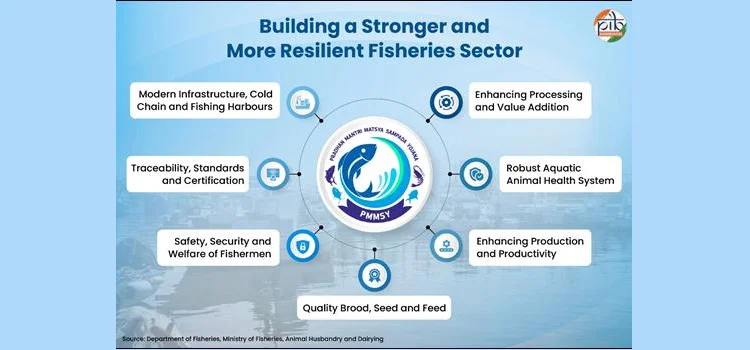
New Delhi, 10 September In Porbandar, a fisherman who had spent two decades in the trade could see exactly what his business needed and exactly why he could not have it. An ice plant costs more than a boat owner earns. Mr Pravinbhai Babulal Masani got a ₹48 lakh subsidy in 2021-22 under the Pradhan Mantri Matsya Sampada Yojana, built a plant making 30 tonnes of ice a day, and the boats leaving his harbour now carry enough ice to bring the catch back unspoiled.
That is the scheme in one man. The Pradhan Mantri Matsya Sampada Yojana completes six years on 10 September 2026, and the Press Information Bureau backgrounder issued that day sets out what the six years bought.
Fish production rose from 141.64 lakh tonnes in 2019-20 to a record 197.75 lakh tonnes in 2024-25. Exports rose from ₹46,663 crore in 2019-20 to ₹73,890 crore in 2025-26. The scheme records employment opportunities for 58 lakh people in fisheries and aquaculture work, in a sector the same document says sustains nearly three crore livelihoods, most of them in coastal and marginalised communities.
Blitz has done the arithmetic the backgrounder leaves undone. Production is up 56.11 lakh tonnes, a rise of 39.6 per cent over five years — a compound rate of about 6.9 per cent a year. Exports are up ₹27,227 crore, or 58.3 per cent. And the 58 lakh people the scheme records amount to roughly a fifth of all the livelihoods the sector carries.
The money has an interesting shape. The scheme’s total outlay since 2020-21 is ₹20,750 crore. But the projects actually approved between 2020-21 and 2025-26 come to ₹21,394.88 crore as of 11 August 2026, of which the Central share is ₹9,510.89 crore. Two things follow that the document does not say: the Central share is 44.45 per cent of the approved cost, so States, Union Territories, implementing agencies and beneficiaries are putting in the remaining ₹11,883.99 crore; and the approved project cost has already passed the scheme’s own outlay, standing at 103.11 per cent of it. A scheme whose approvals exceed its outlay is one that is pulling money in behind it rather than merely spending money out.
The rest of the record: ₹2,500 crore allocated in the Budget Estimates for 2026-27, a record for the scheme; ₹2,797 crore approved for cold-chain and marketing infrastructure; and 2,195 Fish Farmer Producer Organisations supported through projects worth ₹544.86 crore — which works out at about ₹24.8 lakh for each producer organisation.
What India gains is protein, foreign exchange and a coastline that earns. Fish is the cheapest animal protein available to a coastal household, and an ice plant in Porbandar is the difference between selling a catch and losing it.
BLITZ DATA CARD : THE RECORD
- Scheme outlay since 2020-21: ₹20,750 crore
- Budget Estimate 2026-27: ₹2,500 crore
- Projects approved to 11 August 2026: ₹21,394.88 crore
- Central share: ₹9,510.89 crore
- Production 2019-20: 141.64 lakh tonnes
- Production 2024-25: 197.75 lakh tonnes
- Exports 2019-20: ₹46,663 crore
- Exports 2025-26: ₹73,890 crore
- Employment: 58 lakh
- Cold chain approved: ₹2,797 crore
- FFPOs: 2,195 through ₹544.86 crore
THE COMPARISON
Exports 2019-20 — ₹46,663 crore
Exports 2025-26 — ₹73,890 crore
Difference: 58.3 per cent higher.
WHAT INDIA GAINS
The cheapest animal protein a coastal household can buy, and ₹73,890 crore of export earnings from a resource that renews itself.
BRICS: Turning Economic Weight into Trade
New Delhi, 10 September India hosts the 18th BRICS Summit in New Delhi on 12 and 13 September 2026. Its the fourth turn in the chair since the grouping was formed, according to the PIB backgrounder. The chairship runs under the theme “Building for Resilience, Innovation, Cooperation and Sustainability”.
The grouping now has eleven members — Brazil, China, Egypt, Ethiopia, India, Indonesia, Iran, Russia, Saudi Arabia, South Africa and the United Arab Emirates. Between them, the backgrounder records, they hold 49.5 per cent of the world’s population, 40 per cent of global gross domestic product and 26 per cent of global trade.
Set those three figures side by side and the summit’s real subject appears, though the document never spells it out. BRICS produces two-fifths of what the world makes but conducts only a quarter of what the world trades: its share of trade is 0.65 of its share of output, and barely half its share of population. Fourteen percentage points separate what these economies produce from what they exchange. That gap is not a weakness so much as an unworked seam — trade that these countries could be doing with each other and are not.
The history is worth the paragraph. The acronym was coined in 2001 by an investment bank’s economics paper, which projected on econometric grounds that Brazil, Russia, India and China would be among the world’s largest economies within five decades. South Africa joined in 2010, turning BRIC into BRICS; later waves brought in oil producers, African economies and South-East Asian partners. A label invented to describe a market has become a forum that meets.
What India gains from the chair is agenda-setting. The backgrounder places development, sustainability, innovation and the aspirations of the Global South at the centre of India’s presidency — and a country that writes the agenda decides which questions get asked in the room.

25-Day LPG refill rule for all
New Delhi, 10 September The Ministry of Petroleum and Natural Gas has set a uniform inter-refill booking gap of 25 days for all domestic LPG consumers, including those in rural areas, with effect immediately, according to its release of 10 September 2026.
What it replaces matters more than what it sets. In February 2026, the Ministry records, it prescribed booking timelines of 25 days in urban areas and 45 days in rural areas as a temporary demand-management measure, in view of the outbreak of conflict in West Asia. A rural household therefore waited twenty days longer than an urban one for the right to book the next cylinder.
The Ministry says the revision follows from the present LPG supply position and a considerable reduction in refill backlogs compared with the situation when the measure was introduced. The stated purpose is to streamline bookings and manage demand and supply.
The twenty days that disappear are not an abstraction. A rural kitchen that runs out mid-cycle has no piped alternative; it goes back to firewood or dung, and the cost of that is paid in the lungs of whoever does the cooking. Restoring parity means a village household can now book on the same calendar as a city household.
What Indians gain is the removal of a distinction that had opened between rural and urban households — and the demonstration that a temporary measure was in fact treated as temporary.
AIIMS Guwahati makes cardiac history
Guwahati, 10 September For a family in Assam whose child needs a hole in the heart closed, the operation has until now meant a journey — to Delhi, to Chennai, to Vellore, with the cost of the travel often exceeding the cost of the surgery. On 8 September 2026 that changed at home.
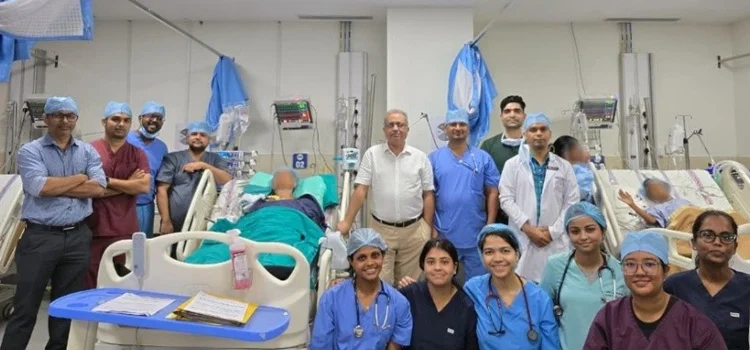
The All India Institute of Medical Sciences, Guwahati, performed two open-heart surgeries in a single day, on a seven-year-old child and a 47-year-old woman from Assam, both with congenital heart defects, according to the Ministry of Health and Family Welfare release of 10 September 2026. It was the start of the institute’s Cardiac Surgery Programme.
The surgeries were conducted under the leadership of Professor Colonel Dr Ashok Puranik, Executive Director of AIIMS Guwahati, by the Department of Cardiothoracic and Vascular Surgery led by Prof. Vineet Mahajan, working with the departments of anaesthesia and cardiology, cardiac perfusionists, and the paramedical, technical and nursing teams. Open-heart surgery requires a heart-lung machine to take over the work of both organs while the heart is stopped; the machine used for these two operations was donated through the corporate social responsibility programme of the ICICI Foundation.
The institute plans to extend the programme to coronary artery bypass surgery and other advanced cardiac procedures.
What the North East gains is distance removed. A cardiac surgery programme in Guwahati serves Assam and the adjoining States, and every kilometre a patient does not have to travel is a day of wages not lost by the family travelling with them.
Global Dryland Congress 2026 opens in Delhi
New Delhi, 10 September
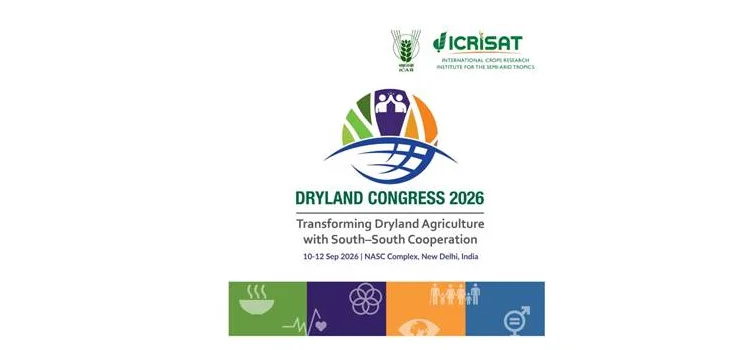
The Global Dryland Congress 2026, themed “Transforming Dryland Agriculture with South–South Cooperation”, runs at the National Agricultural Science Complex in New Delhi from 10 to 12 September 2026, according to the Ministry of Agriculture and Farmers’ Welfare release of 9 September 2026.
It is jointly organised by the Indian Council of Agricultural Research and the International Crops Research Institute for the Semi-Arid Tropics, and doubles as the fiftieth anniversary of the ICAR–ICRISAT partnership. More than 800 scientists, policymakers, farmer representatives and development partners from Asia, Africa and the Americas will work through six themes: breeding, climate resilience, nutrition and markets, farming systems, seed systems, and gender and youth inclusion.
The scale of the subject is in one sentence of the release. Drylands cover about 45 per cent of the world’s land surface and are home to over two billion people, a great many of them smallholders facing climate variability, land degradation, water scarcity and shifting markets. Dryland agriculture is not a specialist corner of farming; it is how a quarter of humanity eats.
Proceedings are to end with the adoption of the Delhi Declaration on Dryland, alongside new partnerships, memoranda and awards. The final day also marks the United Nations Day for South–South Cooperation, with sessions on South–South and Triangular Cooperation in agricultural research convened with CGIAR. Shri Shivraj Singh Chouhan, Union Minister of Agriculture and Farmers’ Welfare and of Rural Development, is Chief Guest, with Dr Himanshu Pathak, Director General of ICRISAT, Ms Cathy Reade, ICRISAT Board Chair, and Dr M. L. Jat, Secretary of the Department of Agricultural Research and Education and Director General of ICAR, among those addressing it.
What India gains is the convening role. A declaration named after Delhi, adopted by the countries that farm the world’s dry land, is a standard India helped write rather than one it received.
NIELIT Digital University expands Global learning
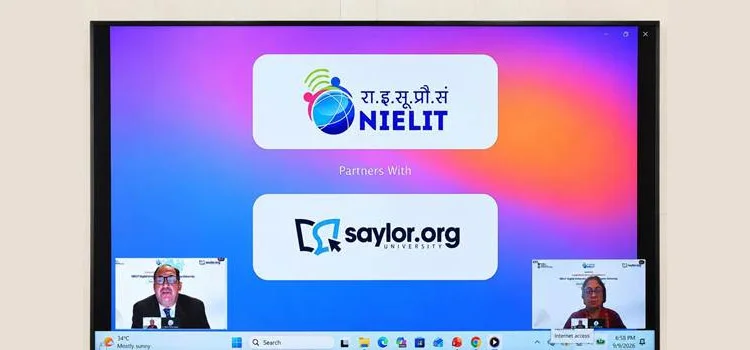
New Delhi, 10 September The National Institute of Electronics and Information Technology has integrated the digital learning resources of Saylor University of the United States into its NIELIT Digital University platform, according to the Ministry of Electronics and Information Technology release of 10 September 2026. Shri S. Krishnan, Secretary of the Ministry, inaugurated the partnership at the Ministry in New Delhi.
The practical effect is that a learner already on the Indian platform reaches a wider library of self-paced, globally relevant courses without leaving it. The point is the platform, not the courses: a single national ecosystem that carries both Indian and international material is worth more to a learner in a small town than a list of foreign links they must find for themselves.
The same event saw memoranda exchanged with eight organisations — the Confederation of Indian Industry, NASSCOM, the Electronics Sector Skills Council of India, Pearson India Education Services, Stemlore Innovators, Dassault Systèmes, ABES Engineering College, and Kavayitri Bahinabai Chaudhari North Maharashtra University at Jalgaon. Two industry bodies, one sector skills council, two companies, one engineering college and one State university is a deliberately mixed list; it is what an industry–academia linkage looks like when it is being built rather than announced.
Krishnan described the collaborations as steps towards strengthening India’s digital skilling ecosystem and expanding access to technology-enabled, industry-relevant learning.
What Indians gain is optionality at no cost. A diploma-holder in Jalgaon can now take a course written for a global audience on the same platform that issues their Indian certification.
Bhashini pushes citizen-friendly AI
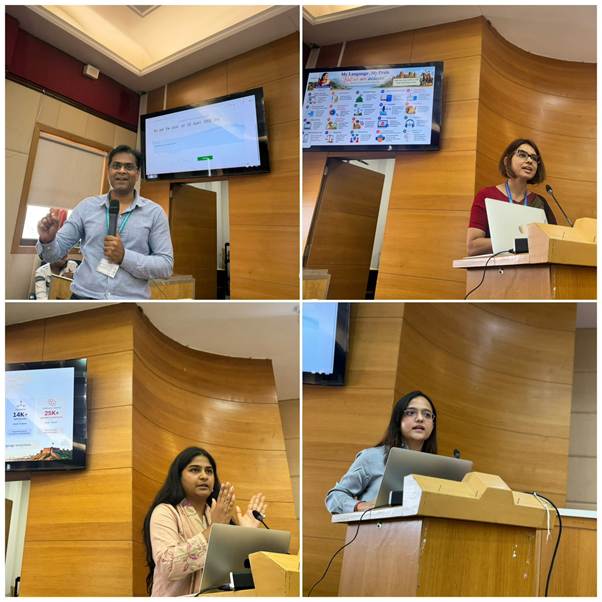
New Delhi, 10 September The Digital India BHASHINI Division held a workshop at Maharashtra Mantralaya with the State’s Language Department on multilingual and voice-enabled artificial intelligence in public services, according to the Ministry of Electronics and Information Technology release of 10 September 2026.
The team demonstrated speech recognition, speech-to-text, text-to-speech, translation and voice-enabled interaction, and the discussion turned on where these fit into citizen-facing systems in Marathi and other Indian languages. A citizen who can speak to a government system rather than type at it is a citizen for whom literacy has stopped being a gate.
The workshop’s substantive theme was data. Locally relevant language AI needs high-quality, representative language data, and the release records discussion of how language experts, government institutions, academia and communities can strengthen those datasets — with BhashaDaan, BHASHINI’s crowdsourcing platform, as the route for citizens to contribute. The other thread was department-specific language AI: government departments carry specialised terminology, and a translation engine that does not know a revenue department’s vocabulary will not survive contact with a revenue department’s forms.
The workshop also explored a Maharashtra-focused multilingual ecosystem under the proposed MahaBHASHINI concept, with tourism and transport named as candidate services, and identified priority use cases for collaboration between the State government and BHASHINI.
What Indians gain is a public service that answers in the language the question was asked in. That is a small sentence and a very large change.
New Basmati export centre in Pilibhit
Pilibhit, 10 September Jitin Prasada, Union Minister of State for Commerce and Industry and for Electronics and Information Technology, laid the foundation stone of the BEDF Basmati and Organic Training Centre cum Demonstration Farm at Tanda Bijeshi in Pilibhit, Uttar Pradesh, according to the Ministry of Commerce and Industry release of 9 September 2026. It is a joint project of the Agricultural and Processed Food Products Export Development Authority and the Basmati Export Development Foundation.
The design is worth reading closely, because it answers a specific failure. Farmers lose basmati export consignments not on price but on compliance — a pesticide residue above a buyer’s limit, a variety not on the notified list, a certificate that does not match the consignment. The centre is to demonstrate notified basmati varieties and production technologies, insect-pest and disease management, organic cultivation and inputs, and integrated pest and nutrient management. Shri Abhishek Dev, Chairman of the export authority, said it would give farmers access to improved seeds, quality standards, testing facilities, packaging and export procedures.
Shri Prasada said Pilibhit has significant potential as a major basmati-producing region, and that the centre would give farmers better access to training, quality seeds and organic inputs while building stronger links to export markets.
Uttar Pradesh is a prominent basmati-producing State and a key contributor to basmati exports. The release records it as seventh in the country in organic production and eighth in area under organic cultivation — figures that place the State’s organic sector behind its basmati sector, and suggest where the headroom is.
What Indian farmers gain is the testing laboratory brought to the district instead of the district being sent to the laboratory.
NITI Aayog backs deregulation drive
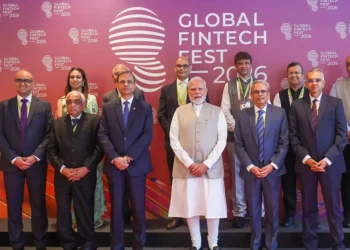
New Delhi, 10 September Rajiv Gauba, Member of NITI Aayog, said the next-generation reform architecture should be defined by deregulation, speaking at a fireside chat titled “From Regulation to Transformation: Building India’s Next-Generation Reform Architecture” at the Global Fintech Fest 2026, according to the NITI Aayog release of 10 September 2026.
The formulation was specific rather than rhetorical. The focus, he said, should be on “nuts-and-bolts” reform — doing away with the licence, approval and permission regime and its frequent renewals, which persists in different avatars — and on systematically reviewing laws, regulations and administrative processes. That work, he said, is being carried out by a High-Level Committee, guided by the philosophy of trust-based governance.
Reflecting on the past decade, Shri Gauba noted that the Goods and Services Tax, the Insolvency and Bankruptcy Code and a liberalised foreign investment regime had reshaped the economy and opened sectors once closed to private enterprise, including defence, space and now nuclear energy.
The part of the argument that reaches furthest is about who holds the rules. Many important reforms, he noted, lie with States and municipal governments, and a Deregulation Task Force is carrying trust-based governance principles down to the State and city level. Citing the scheme for Special Assistance to States for Capital Investment and the Urban Challenge Fund, he described the approach as “cooperative federalism with a competitive edge” — scheme incentives linked to reform milestones, and projects selected in challenge mode. A renewal a shopkeeper files is usually a municipal rule, not a Union one, which is why a reform that stops at Delhi is not felt.
On fintech, he cited India’s digital public infrastructure — Aadhaar, UPI, DigiLocker and the account aggregator framework — as a model others can replicate, in which government lays open, secure and interoperable rails and private enterprise builds on them. Regulation in technology-driven sectors, he said, should be principles-based, technology-neutral and proportionate to risk, while promoting competition, ensuring non-discriminatory access to underlying infrastructure and improving information symmetry. He called for greater coordination among financial regulators and simpler, more predictable compliance.
What India gains, if the review lands, is time. Every renewal a firm does not file is a week its staff spend on the business instead of on the file.

Kochi hosts deep-sea taxonomy school
Kochi, 10 September Before anyone can regulate mining on the deep seabed, somebody has to be able to say what lives there. That is a taxonomy problem, and taxonomy is a skill that has to be taught animal by animal.
The Centre for Marine Living Resources and Ecology, under the Ministry of Earth Sciences, is running a five-day school in Kochi from 7 to 11 September 2026 titled “Deep-sea Macrofauna Taxonomy School: Standardizing Methodologies for Biodiversity Assessments”, according to the Ministry of Earth Sciences release of 9 September 2026. It is held under the Sustainable Seabed Knowledge Initiative of the International Seabed Authority, with the Indian Ocean Rim Association and the National Marine Biodiversity Institute of Korea.
The word doing the work in that title is “standardizing”. If two countries survey the same stretch of seabed and count differently, the two surveys cannot be compared, and a body regulating the seabed cannot use either. A school that teaches one method to researchers from many countries is building the measuring instrument, not the measurement.
About 30 early-career researchers from International Seabed Authority member states in the Indian Ocean region are taking part, from South Africa, Kenya, Bangladesh, Mauritius, Malaysia, Indonesia, Singapore and Sri Lanka among others. Ms Leticia Carvalho, Secretary-General of the International Seabed Authority, was Chief Guest at the inaugural session and spoke on strengthening scientific and taxonomic expertise to underpin environmental management of the deep seabed. Dr R. Maheskumar, Head of the Centre, delivered the welcome address; Dr Senthil, Scientist-E, presented the Centre’s marine biodiversity research; Dr G. Dharani, Scientist-G and Head of the Marine Biotechnology Division at the National Institute of Ocean Technology, Chennai, gave a special lecture on biodiversity work under the Deep Ocean Mission; and Dr Baban Ingole, formerly of the National Institute of Oceanography, Goa, delivered a keynote on benthic studies in the Indian Ocean.
What India gains is position. The country that trains the region’s seabed taxonomists shapes the method the region uses — and India is doing it inside the International Seabed Authority’s own programme rather than alongside it.
CAG Finds Huge Gaps in Green Mission
New Delhi, 10 September The Comptroller and Auditor General’s Performance Audit Report No. 4 of 2026 on the Green India Mission was tabled in Parliament on 12 August 2026, and the auditor’s own press release of 13 August 2026 sets out what it examined: the planning, implementation and monitoring of Mission work in the 16 States and Union Territories for which the Ministry of Environment, Forest and Climate Change approved physical and financial targets between 2015-16 and 2024-25.
Most of that document is an account of shortfall, and the auditor states it plainly: against a target of 1.4 million hectares, improvement in forest-cover quality was recorded on 0.11384 million hectares, a shortfall of 91.87 per cent, and an increase in forest cover on 0.03409 million hectares, a shortfall of 97.57 per cent. The report is before Parliament, where the Ministry’s response forms part of the process, and Blitz does not present any finding in it as settled.
But one sentence in the auditor’s release points the other way, and it is the one worth carrying. No State except Madhya Pradesh and Chhattisgarh conducted any assessment of carbon sequestration between 2015 and 2025. Two of sixteen — 12.5 per cent, a figure the release does not compute — actually measured what the trees were absorbing.
That matters more than it sounds. Carbon sequestration is the whole justification for planting at national scale; without measurement, an afforestation programme knows how many saplings went into the ground and nothing about what they achieved. Flux towers are the instrument that closes that gap, measuring the exchange of carbon dioxide between a forest and the air above it. The auditor records that the towers installed in those two States were left idle for want of maintenance and upkeep planning by the Indian Council of Forestry Research and Education, after an outlay of ₹3.50 crore — which is the constructive point exactly: the instrument exists, the two States were willing, and what is missing is a maintenance contract.
On the money, the auditor records that against ₹2,000 crore approved by the Cabinet Committee on Economic Affairs from the 12th Plan for the scheme’s first four years, together with ₹400 crore from 13th Finance Commission grants towards the States’ share, ₹1,149.14 crore was received through budgetary support over ten years of implementation — which the release puts at 47.88 per cent. Blitz has checked that arithmetic against the two components: ₹1,149.14 crore of ₹2,400 crore is 47.88 per cent exactly, and the legs sum to the published total.
What India gains from the report is a working example. Two States showed that measuring carbon under the Mission is possible; the remaining fourteen now have a method to copy and a maintenance lesson to avoid.
THE RECORD
- Report No. 4 of 2026, Green India Mission, Performance Audit — Union Government
- Tabled: 12 August 2026
- Auditor’s press release: 13 August 2026
- Period examined: 2015-16 to 2024-25
- States and UTs covered: 16
- States assessing carbon sequestration: 2 (Madhya Pradesh, Chhattisgarh)
- Flux tower outlay: ₹3.50 crore
- Budgetary support received: ₹1,149.14 crore of ₹2,400 crore
THE COMPARISON
Approved for the first four years — ₹2,400 crore
Received over ten years — ₹1,149.14 crore
Difference: 52.12 per cent less than approved.
WHAT INDIA GAINS
Proof that carbon sequestration under the Mission can be measured by a State, and a named reason — upkeep of the flux towers — why fourteen others have nothing to show.