Punjab farmers turn carbon into cash
LUDHIANA, 17 September Harinderjeet Gill farms at Noorpur Bet, outside Ludhiana. For seven years he has sown his paddy directly into the ground instead of transplanting it, and he has not set fire to what the combine leaves behind. A payment has now landed in his account for the carbon that decision put into his soil.
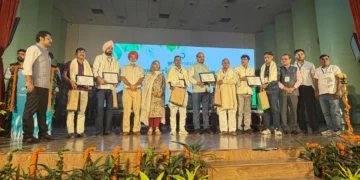
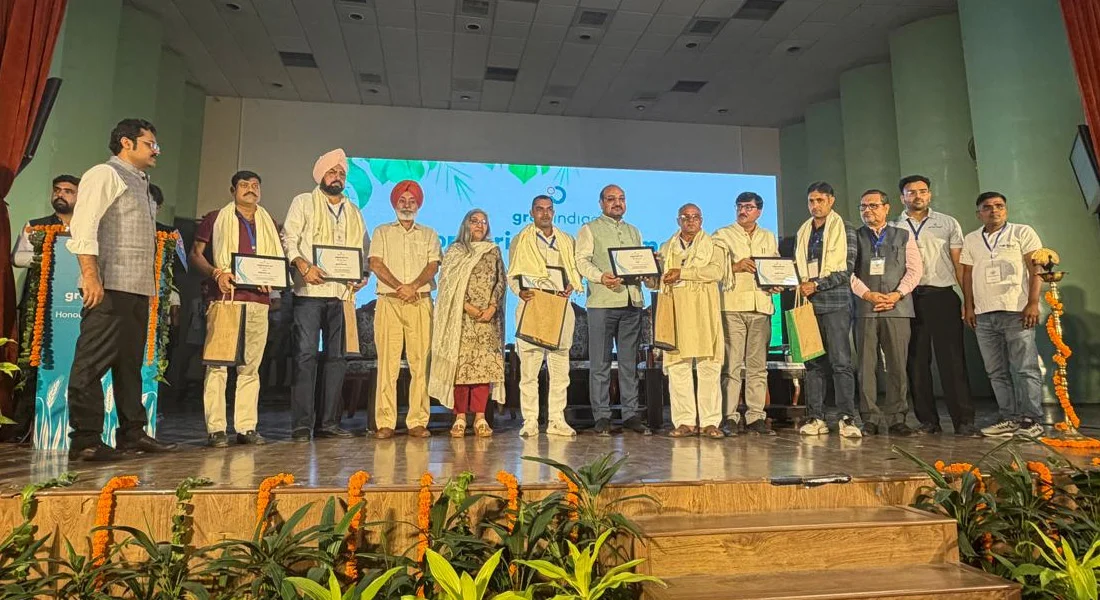
He is one of 2,550 farmers in Punjab and Haryana who will receive more than Rs 2.9 crore between them, according to the Ministry of Agriculture and Farmers Welfare press release of 17 September 2026, release ID 2311218. Secretary of the Department of Agricultural Research and Education and Director General of the Indian Council of Agricultural Research M L Jat released the transfers at Punjab Agricultural University. It is the first time in India that a farmer has been paid for what his land stores rather than for what it grows.
What the payment is for
The money comes out of Grow Indigo’s carbon programme for farmers, called Aadi, which began in 2019 with technical support from the ICAR. Between 2019 and 2022 the farmers in this tranche took up direct-seeded rice, reduced tillage and residue management. The reduction in greenhouse gases and the gain in soil carbon were measured, then independently verified, before any credit was issued — under the Verra VM0042 methodology, which is the agricultural soil-carbon standard.
The first tranche covers about 30,000 acres and more than 50,000 credits. Individual farmers received between Rs 3,000 and Rs 15,000. Two options were offered: an assured payment up front, or 75% of net carbon revenue once the credits sell. Grow Indigo paid from its own funds before the credits were fully sold, so nobody waited on a buyer.
The figures behind it
Work the numbers and the shape becomes clearer. Rs 2.9 crore across 2,550 farmers averages Rs 11,373 — derived here, and consistent with the Rs 3,000 to Rs 15,000 band the release gives. Divide the same sum by the credits and a credit is worth about Rs 580 to the farmer who made it.
The more useful figure is the one the release does not set out. The programme runs across seven states, more than 20 lakh acres and over one lakh farmers. The 30,000 acres paid for in this tranche are 1.5% of that area, and the 2,550 farmers are about 2.4% of those enrolled. This is a first instalment on a system, not a settlement of it.
The environmental accounting is equally checkable. For the farms enrolled between 2019 and 2022 the programme estimates 45 billion litres of water saved and more than two lakh tonnes of residue kept out of the fire, preventing an estimated 1,000 tonnes of PM2.5. That works out at five kilograms of PM2.5 for every tonne of straw not burnt — a conversion the desk has made, and a number worth carrying, because it is the exchange rate between a farmer’s decision in October and the air over north India in November.
What has changed in the fields
Punjab recorded 5,114 farm fires in the 2025 paddy harvest, the lowest since monitoring began under the present system — 93% below 2021 and 90% below 2022, on government figures cited in the release. Ransingh Kalan in Moga has held 1,310 acres to a zero-burning record for six consecutive years.
Amandeep Kaur farms in Sangrur. She and Gill both spoke at Ludhiana about carrying on with the practices, and about what not burning has been worth to them in money as well as in air. Grow Indigo’s executive director Usha Barwale Zehr called the payment the first instance in India of farmers being paid for carbon held in their own soil, and acknowledged the patience it had taken them to sit through several seasons of measurement.
Blitz Data Card
Ludhiana: At a glance
Farmers being paid: 2,550, in Punjab and Haryana Total being paid: over Rs 2.9 crore
Land in the first tranche: about 30,000 acres
Carbon credits in the first tranche: over 50,000
Received per farmer: Rs 3,000 to Rs 15,000
Methodology: Verra VM0042
What India gains
A second income for a small farmer from land he already owns, cleaner air for everyone downwind of it, and a verification method India is now exporting through BRICS rather than buying in.
India bets big on component power

NEW DELHI, 17 September India makes the phone. It has been buying the board inside it.
That is the gap the Electronics Components Manufacturing Scheme was aiming to close, and on the day SEMICON India 2026 opened at Yashobhoomi the PIB published a backgrounder on where the scheme has reached. Till August, 106 projects stand approved across 15 states, covering 30 electronic domain products and carrying Rs 69,548 crore of approved investment. Thirty-eight of those plants are already producing; another 16 are in advanced construction or machinery installation.
The scheme was notified on 8 April 2025 with an outlay of Rs 22,919 crore. The Union Budget for 2026-27 raised that to Rs 40,000 crore. It runs six years, with an optional one-year gestation period, and capital expenditure incentives available for five.
The imports it targets are specific: printed circuit boards, camera and display modules, connectors, capacitors, lithium-ion cells and rare-earth magnets. Approved projects are projected to produce Rs 5.34 lakh crore of output and 74,628 direct jobs, with 2.5 lakh indirect.
Set the money against itself and the pull it exerts shows. Rs 69,548 crore of investment against a Rs 40,000 crore outlay is Rs 1.74 of private capital for each rupee of state support — derived here. The projected output is Rs 7.68 for every rupee invested, and the investment works out at Rs 93.2 lakh a direct job, which is simply what a components plant costs. Half the approved projects, 50.9%, are either producing or nearly so.
Medicine sales face 24×7 surveillance
NEW DELHI, 17 September The Ministry of Health and Family Welfare has proposed amending the Drugs Rules, 1945 to tighten oversight of Schedule H, H1 and X medicines — the ones a chemist may sell only against a valid prescription. The proposal came through draft gazette notification G.S.R. 791(E), issued on 8 September 2026, according to the ministry’s press release of 17 September 2026, release ID 2311184.
The central measure is mandatory CCTV surveillance at chemist shops, proposed as an additional regulatory safeguard against unauthorised access and sale. The Drugs Consultative Committee considered the proposal first; it then went to the members of the Drugs Technical Advisory Board, which recommended approval.
Objections and suggestions have been invited, and may be sent to the Under Secretary (Drugs) at the Ministry of Health and Family Welfare, Kartavya Bhawan-1, New Delhi, or by email to the drugs division. The draft is on the e-Gazette.
Schedule X covers the narcotic and psychotropic preparations; H1 was created to slow the counter sale of antibiotics that resistance was running ahead of. A camera does not write a prescription. What it does is make the absence of one visible after the fact, which is the part the present rules cannot reach.
ICAR built the carbon trust chain
NEW DELHI, 17 September A carbon credit is a promise that something did not happen. Nobody pays for a promise unless somebody can check it, and checking a gas that was never emitted from a field that was never burnt is harder than it sounds.
That is the problem the Indian Council of Agricultural Research spent seven years on, and it is why the Ludhiana payment could be made at all. The council’s contribution, as set out in the Ministry of Agriculture and Farmers Welfare press release of 17 September 2026, release ID 2311218, is a chain of six pieces: greenhouse gas accounting, crop-simulation modelling, soil sampling methods, device validation, field-team training, and satellite and remote-sensing work.
Why each link matters
Take them in order and the logic holds. Greenhouse gas accounting sets what counts as a reduction. Crop simulation models what the same field would have emitted under the old practice, which is the counterfactual the whole credit rests on. Soil sampling establishes carbon actually held, not carbon modelled. Device validation makes sure the instrument taking the sample reads true. Field-team training makes the sampling repeatable by someone other than a scientist. Remote sensing scales it from a plot to a district.
ICAR-Indian Agricultural Research Institute, New Delhi, contributed to these procedures. On the extension side Grow Indigo works with ICAR-Agricultural Technology Application Research Institute, Zone 1, which is the arm that reaches the krishi vigyan kendras and, through them, the farmer.
What it is worth beyond India
The measurement work is the exportable part. In June 2026, at the 16th BRICS agriculture ministers’ meeting at Indore held under India’s chairship, the members agreed to establish a BRICS Network of Centres of Excellence on agro-ecology and regenerative agriculture for climate resilience and productivity. Initial oversight sits with ICAR-Indian Institute of Farming Systems Research at Modipuram. The BRICS New Delhi Declaration adopted in September 2026 welcomed cooperation through that network.
The honest limit should be stated. The release describes the protocols and names the institutes; it does not publish the sampling density, the model parameters or the uncertainty bounds, and a soil-carbon credit is only as good as those three. That is not a criticism of the work. It is the next document the field will want.
Earth sciences cleans up its backlog
NEW DELHI, 17 September The Ministry of Earth Sciences has reported its results under the fifth Special Campaign for Disposal of Pending Matters, in a press release of 17 September 2026, release ID 2311177. Between December 2025 and August 2026 the ministry and its institutions ran 20 cleanliness drives across 10 offices.
The measurable outcomes: 54,815 square feet of office space cleared for productive use, and Rs 1.57 crore in cumulative revenue to the exchequer from disposal of scrap and waste. In records management, 750 physical files and 177 e-files were closed after review.
On the redress side the ministry reports one parliamentary assurance, 17 references from the Prime Minister’s Office and 37 from Members of Parliament, and 304 public grievances disposed of. All inter-ministerial committee proposals and all public grievance appeals were resolved, giving a 100% disposal rate on those two heads.
Two derived figures put it in scale. The scrap revenue is Rs 286 for every square foot freed — not a return on the space, but a useful measure of how much value sat in a store room nobody had opened. And of the 927 files closed, 177, or 19.1%, were electronic, which is the number to watch year on year: a campaign that closes only paper is clearing a backlog, while one that closes e-files is managing a live system.
The campaign is a self-report, and it should be read as one. The ministry states what it achieved against heads it set; there is no external audit in this document. The figures are nonetheless specific, dated and attributable, which is more than most administrative reporting offers.