
India wins 100% duty-free access in FTA with New Zealand
New Delhi, 22 September A leather cutter in Kanpur, a knitwear unit in Tiruppur and an engineering shop in Rajkot will all find the same thing waiting on 20 October. The duty their New Zealand buyer has been paying vanishes. Not tapered over seven years, not held back for a review. Gone, from the first consignment.
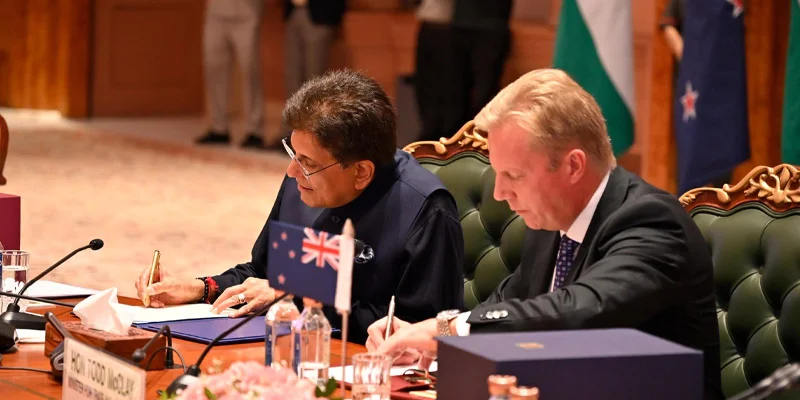
The India–New Zealand Free Trade Agreement enters into force on 20 October 2026, the two governments announced on 21 September 2026 in a joint statement issued by the Ministry of Commerce and Industry. The agreement was signed on 27 April 2026 at Bharat Mandapam in New Delhi by Commerce and Industry Minister Piyush Goyal and New Zealand’s Minister for Trade and Investment Todd McClay. New Zealand’s Parliament passed the enabling legislation on 16 September 2026, and the entry-into-force date was fixed by the two ministers in a virtual conference the following week.
Between signature and effect: 176 days. That is the number worth holding on to. Trade agreements of this size commonly wait a year or more between the signing photograph and the day an exporter can actually use them; this one waited under six months, and 34 days of that was the gap between New Zealand’s legislation and the chosen date.
What falls away on day one
Every single tariff line covering 100% of India’s exports to New Zealand becomes duty-free on entry into force, according to the Ministry of Commerce and Industry’s statement of 21 September 2026. New Zealand’s peak tariffs, which run up to 10%, are eliminated. The sectors named in the statement are the ones that employ the most hands: textiles and apparel, leather and footwear, gems and jewellery, engineering goods and processed foods.
The traffic runs both ways in a manner Indian manufacturers will notice. Wooden logs, coking coal and metal scrap — inputs India buys to make things it sells elsewhere — come in tariff-free. A cheaper input is a quieter benefit than a cheaper export, and usually a larger one.
Where the line was drawn
Dairy, animal meat other than sheep, key agricultural commodities, sugar and edible oils are excluded from tariff concessions altogether. Apples, kiwifruit and Manuka honey come in through Tariff Rate Quotas carrying a Minimum Import Price and seasonal import windows, so the fruit arrives when Indian orchards are not selling.
Alongside the quotas sits an Agriculture Productivity Partnership with dedicated Action Plans for kiwifruit, apples and honey, and Centres of Excellence for orchard management, post-harvest practice, supply chains, food safety and sustainable beekeeping. A Joint Agriculture Productivity Council will check that the market access New Zealand received is matched by the cooperation it promised. That is an unusual clause, and an instructive one: access granted, with an obligation attached and a body to watch it.
At a glance
Entry into force: 20 October 2026
Signed: 27 April 2026, Bharat Mandapam, New Delhi
India’s export lines going duty-free on day one: 100%
New Zealand peak tariff eliminated: up to 10%
Merchandise trade, 2025-26: about USD 1.1 billion
Investment New Zealand commits to facilitate: USD 20 billion
Two-way trade goal by 2030: NZ$7 billion, about ₹35,000 crore
Work and holiday visas a year for Indians: 6,000
What India gains
Indian exporters get the same terms in New Zealand as its other trading partners, from the first day rather than the seventh year, while dairy, sugar and edible oils stay outside the deal.
Kevadia, a new home for national film awards
Ekta Nagar, 22 September The 72nd National Film Awards will be presented today at Ekta Nagar, Kevadia, by President Droupadi Murmu, according to the President’s Secretariat announcement of 20 September 2026. The President reached Gujarat on 21 September and is on a three-day visit to the State.
The venue is the news inside the news. India’s film awards have been handed out in Delhi for most of their seven decades. Moving the ceremony to Ekta Nagar — the township built around the Statue of Unity in the Narmada district — puts the country’s oldest cinema honour in a place most of its winners have never worked in.
The awards for 2024 were announced earlier this month; Anant Nag was named for the Dadasaheb Phalke Award for 2024 for his contribution to Indian cinema, and the Prime Minister congratulated him on 16 September 2026.
On 23 September the President attends the 75th annual convocation of the Maharaja Sayajirao University of Baroda at Vadodara, launches the Brahma Kumaris campaign ‘Spiritual Awakening for World Renewal’, inaugurates the ‘Global Spiritual Palace’ Retreat Centre, and virtually launches ‘Youth for Viksit Bharat: Awakening Inner Strength for Nation Building’.
What India gains
A national honour moves out of the capital and into a district town, which is where most of the country’s film work and film audience actually live.
EPFO wage ceiling raised to 51 lakh more workers
New Delhi, 22 September Take a shop supervisor drawing ₹22,000 a month. Until this decision she could be hired, work for years and retire with no provident fund account, no pension claim and no insurance cover attached to her job, because her salary sat above the threshold at which cover becomes compulsory. She is the person this decision is about.
The Union Cabinet approved raising the wage ceiling for mandatory coverage under the Employees’ Provident Fund Organisation from ₹15,000 to ₹25,000 a month on 16 September 2026, on a proposal of the Ministry of Labour and Employment. More than 51 lakh additional employees are expected to come within mandatory coverage.
The size of the step
The ceiling rises by 66.67%. It was last revised in September 2014, and before that it had not moved through the decade from 2004. Twelve years is a long time for a threshold expressed in rupees to stand still while wages do not.
EPFO currently has about 7.98 crore contributing members across about 7.68 lakh contributing establishments, and the Employees’ Pension Scheme pays about 82 lakh pensioners. Measured against the existing contributing base, the 51 lakh new members are an addition of 6.4%.
What it costs, and per whom
The annual government outgo is estimated at about ₹11,339 crore against existing annual budgetary support of about ₹10,250 crore. The increase is therefore about ₹1,089 crore a year — which, spread across 51 lakh newly covered workers, is roughly ₹2,135 per worker per year of additional public money.
The five-year figure in the Cabinet note is about ₹56,696 crore. Five years at ₹11,339 crore comes to ₹56,695 crore, so the arithmetic in the note holds to within a crore of rounding. A leg-sum check that passes is worth saying out loud.
The proposal was recommended by the Expenditure Finance Committee at its meeting of 16 June 2026. The Ministry of Labour and Employment and EPFO will now take the statutory and administrative steps to put it into effect.
No photograph.
At a glance
Old wage ceiling: ₹15,000 a month, set September 2014
New wage ceiling: ₹25,000 a month, approved 16 September 2026
Additional employees expected to be covered: more than 51 lakh
Contributing members now: about 7.98 crore
Contributing establishments: about 7.68 lakh
EPS pensioners: about 82 lakh
Annual outgo: about ₹11,339 crore
Existing annual budgetary support: about ₹10,250 crore
Five-year expenditure: about ₹56,696 crore
What India gains
A worker earning between ₹15,000 and ₹25,000 a month now carries provident fund savings, a pension claim and insurance cover with the job rather than depending on the employer’s goodwill.
India’s young guns hit the podium again
New Delhi, 22 September Rudrankksh Balasaheb Patil, Himanshu Dhillon and Parth Rakesh Mane took the silver in the 10m Air Rifle Men’s Team event at the Asian Games 2026, the Prime Minister’s Office said on 21 September 2026. Patil also won a bronze, and Dhillon a silver, in the individual events, while Sonam Uttam Maskar, Elavenil Valarivan and Vidarsa K Vinod took a silver in the women’s team event on 20 September.
India added four medals on the second day of competition, Doordarshan News reported on 22 September 2026, and Suchika Tariyal took the country’s first mixed martial arts medal at the Games.
The kabaddi team beat South Korea 63–31 on 22 September for a second straight win, according to Doordarshan News. P V Sindhu’s badminton team, the women’s cricketers and the shooters lead India’s card for the day.
Congratulating the rifle team, the Prime Minister said their “focus, consistency and teamwork have made India proud”.
At a glance
10m Air Rifle Men’s Team: silver — Rudrankksh Balasaheb Patil, Himanshu Dhillon, Parth Rakesh Mane
10m Air Rifle Women’s Team: silver — Sonam Uttam Maskar, Elavenil Valarivan, Vidarsa K Vinod
Individual shooting: silver, Himanshu Dhillon; bronze, Rudrankksh Balasaheb Patil
Mixed martial arts: India’s first medal at the Games, Suchika Tariyal
Kabaddi, second pool match: India 63, South Korea 31
What India gains
Four shooting medals in two days from a squad in which no shooter is carrying the team alone is what a deep bench looks like, and depth is what turns one good Games into several.
Ayush begins Sowa-Rigpa standards drive
Ghaziabad, 22 September Sowa-Rigpa is practised across Ladakh, Himachal Pradesh, Sikkim, Arunachal Pradesh and the Darjeeling hills. Until now its medicines have been made and dispensed without a national book of standards saying what each one must contain and how it is to be tested. That is the gap the Ministry of Ayush has begun to close.
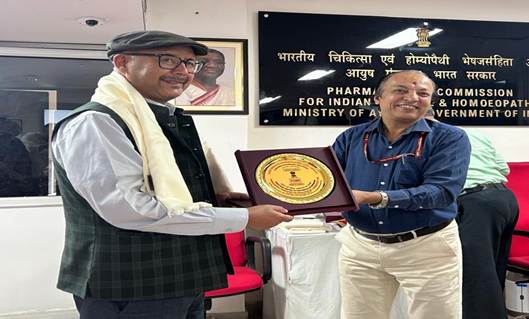
The first meeting of the Sowa-Rigpa Working Group, constituted under the Pharmacopoeia Commission for Indian Medicine and Homoeopathy, was held on 18 September 2026 at PCIM&H in Ghaziabad, Uttar Pradesh, the Ministry of Ayush said on 21 September 2026. It was chaired by Kousthubha Upadhyaya, Director of PCIM&H, with four experts from Sowa-Rigpa institutions including Padma Gurmet, Director of the National Institute of Sowa-Rigpa at Leh.
The group will work through a step-wise plan to produce Formularies, Pharmacopoeias and the other statutory and non-statutory documents that quality assurance of Sowa-Rigpa drugs requires, within the Drugs and Cosmetics Act, 1940 and the Rules made under it.
What a pharmacopoeia does is unglamorous and decisive. It fixes identity, purity and strength, and it gives a drug inspector something to test against. Without one, a regulator can act only on obvious adulteration; with one, a batch either meets the monograph or it does not. PCIM&H is also the Central Drug Testing-cum-Appellate Laboratory for Indian systems of medicine, so the body writing the standard is the body that will run the appeal.
A first meeting is a first meeting. No monograph has been published, no timetable has been announced, and the number of formulations to be covered has not been stated. Those are the figures to ask for next.
At a glance
Body: Sowa-Rigpa Working Group under PCIM&H, Ministry of Ayush
First meeting: 18 September 2026, Ghaziabad, Uttar Pradesh
Chair: Kousthubha Upadhyaya, Director, PCIM&H
Sowa-Rigpa experts present: four, including Padma Gurmet, Director, National Institute of Sowa-Rigpa, Leh
Governing law: Drugs and Cosmetics Act, 1940, and the Rules thereunder
Number of formulations to be covered: not stated
Timetable for the first monograph: not stated
Audit trail goes public across India
New Delhi, 22 September Four audit reports reached State legislatures in the first week of September 2026, and all four are on the Comptroller and Auditor General’s public register, read on 22 September 2026 at cag.gov.in.
Manipur received two on 2 September 2026: the report on State Finances for 2024-25, and the report on General, Social, Economic and Revenue Sectors for the year ended 31 March 2024. Both are submitted to the Governor under Article 151 of the Constitution.
Nagaland received two on 3 September 2026. Report No. 2 of 2026 is the State Finances report for 2024-25, an independent assessment of the State’s fiscal position, its revenue and its expenditure trends. Report No. 1 of 2026 covers the Social including Local Governments Audit, Economic, General and Revenue Sectors for the year ended 31 March 2024, and the sectors it names are Local Bodies, Finance, Social Infrastructure, Education, Health and Family Welfare, and Power and Energy.
Himachal Pradesh also received two on 3 September 2026: Report No. 2 of 2026 on State Finances for 2024-25, and Report No. 1 of 2026, a Composite Audit Report for the period ended March 2023 which carries the results of an Information Technology Audit alongside performance and compliance audit of receipts and expenditure.
The register itself now lists 2,827 audit reports in the public domain. That number is the point. An audit that is tabled and then filed away changes nothing; an audit that sits on a public register, numbered and searchable, can be opened by a citizen in Kohima or Shimla as easily as by a committee in Delhi. The Information Technology Audit in the Himachal Pradesh composite report is the sort of work that has grown quietly inside the institution — the auditor following public money into the systems that now move it.
Each of these reports is with its legislature. What the departments say in reply, and what the Public Accounts Committee of each State makes of the replies, is the next stage and is not yet on record.
What India gains
A citizen can read the audit of the State they live in without asking anyone’s permission, which is the difference between an audit that is done and an audit that is used.