India goes global on water
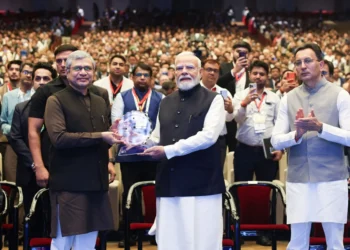
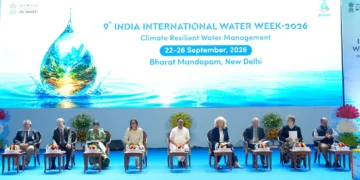
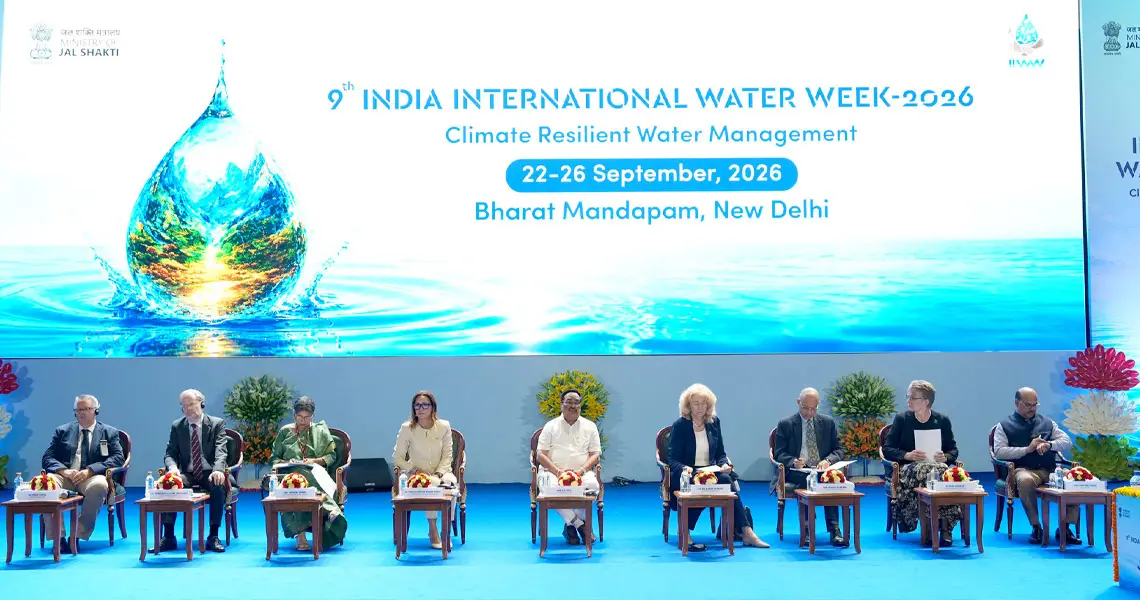
New Delhi, 23 September For eight editions it was called India Water Week. The ninth, which Vice-President C P. Radhakrishnan opened at Bharat Mandapam on 22 September, is called the India International Water Week — and the Ministry of Jal Shakti’s release of that date is unusually direct about why. The earlier editions, it says, were held as India Water Week, and the event has now evolved into its international form, a change that reflects growing global participation and the rising importance of international cooperation on shared water challenges.
A renaming is a small thing. What sits behind this one is not. The Netherlands and Germany are taking part as partner countries. Fourteen States are partner States and two central ministries are partner ministries. The event runs from 22 to 26 September on the theme Climate Resilient Water Management.
What was released
The Vice-President released two publications: the Sustainable Urban River Management Framework, and AI and ML Driven Integrated Reservoir Sediment Management. The second is the more technical and the less understood. Silt carried down a river settles behind a dam, and the live storage a reservoir was designed to hold shrinks year by year. A reservoir built to deliver a certain quantity of water and power therefore delivers less each decade than the design promised, without anything visibly failing. Measuring that loss accurately across a large stock of dams is the problem the publication addresses.
Five urban river management plans were launched at the plenary on the Global River Cities Alliance, which took up how cities and the rivers running through them are planned together rather than separately.
A number from Jharkhand
Recalling his term as Governor of Jharkhand, the Vice-President said rural tap water access in the State under the Jal Jeevan Mission rose from about 7% to 37%. That is a rise of 30 percentage points, and the later figure is 5.29 times the earlier one.
The release does not date either end of that range. A reader who wants to judge the pace of the work — rather than its extent — cannot do so from the figure as given, and Blitz has not worked out a rate per year for that reason.
At a glance
Edition: 9th India International Water Week, 22 to 26 September 2026, Bharat Mandapam, New Delhi
Theme: Climate Resilient Water Management
Partner countries: 2 — the Netherlands and Germany
Partner States: 14
Partner ministries: 2
Publications released: 2
Urban river management plans launched: 5
What India gains
An annual international water market and negotiating table on Indian soil, on a subject where the scale of India’s own operation is the credential.
UDAN takes flight again
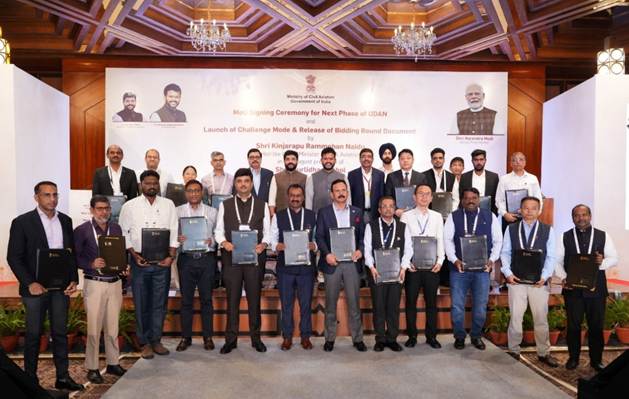
New Delhi, 23 September The Ministry of Civil Aviation signed 21 memoranda of understanding with States and Union Territories on 22 September at The Ashok in Chanakyapuri, and launched a Challenge Mode portal through which State governments and Union Territory administrations can themselves nominate airstrips and helipads for development under the next phase of the regional connectivity scheme UDAN.
According to the ministry’s release of that date, UDAN has since inception put 687 routes and 95 aerodromes into operation and carried about 1.71 crore passengers on more than 3.66 lakh flights. That works out at 46.7 passengers a flight and 7.2 routes an aerodrome — both figures derived by Blitz from the ministry’s own totals, neither stated in the release.
Civil Aviation Minister Ram Mohan Naidu Kinjarapu named a second set of numbers as the ones that matter to him: employment in the aviation sector, he said, has risen from about 30 lakh in 2014 to about 77 lakh, and is expected to reach 2.5 crore by 2040. He named Tezu in Arunachal Pradesh and Purnea in Bihar as airports that were once hundreds of kilometres from any air link.
Minister of State Murlidhar Mohol said the revised scheme is working towards 120 new destinations and 4 crore additional passengers over the next ten years. Spread evenly that is 40 lakh passengers a year, and 2.34 times everything UDAN has carried in its life so far — which is the measure of how much of this scheme is still ahead of it.
The ministry also released the scheme document for the route bidding process, under which airlines will bid for identified routes.
Nagpur hosts Ayurveda’s next leap
Nagpur, 23 September The Ministry of Ayush hosts the 11th Ayurveda Day in Nagpur on 23 September under the theme Ayurveda for a Healthy Future, with observances across India and abroad.
The item on the programme with the longest reach is a report on the Ayush service sector prepared by the Research and Information System for Developing Countries, which the ministry’s release of 22 September describes as the first such assessment. A sector that has been discussed for years largely in terms of belief and tradition acquires, with it, a set of numbers about its size and shape.
Also being released are safety dossiers on two plants in common use — Gokshura, Tribulus terrestris, and Chandrasur, Lepidium sativum — standard treatment guidelines for skin disorders, a report titled From Traditional Knowledge to Global Leadership: Ayush Vision 2030, and a status report on Ayush-related inventions in India. The Central Council for Research in Ayurvedic Sciences is launching a web portal for its AGNI assessment scale, the Ayurveda Gyan Naipunya Initiative.
Two scientific sessions are listed, one on Ayurveda’s path towards 2047 and one on integrating treatments to reduce the burden of non-communicable diseases.
Film awards leave Delhi for Gujarat
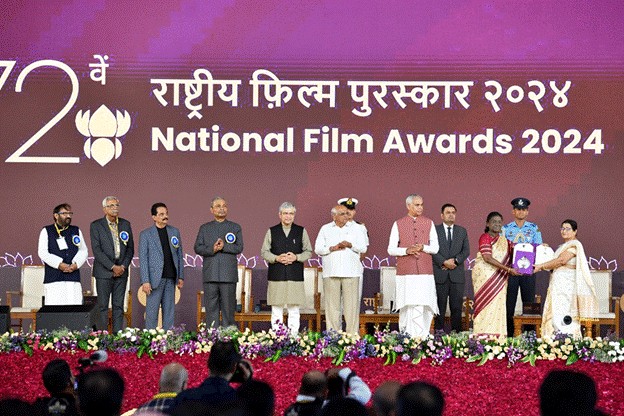
Ekta Nagar, 23 September President Droupadi Murmu conferred the 72nd National Film Awards at Ekta Nagar in Gujarat on 22 September, the first time the ceremony has been held outside Delhi. Veteran actor Anant Nag received the Dadasaheb Phalke Award for 2024.
Information and Broadcasting Secretary Chanchal Kumar said the awards drew entries of 400 feature films in 34 languages and 161 non-feature films in 24 languages, and that awards were given in 22 feature and 23 non-feature categories. That is 561 entries competing for 45 categories, and an average of close to 12 feature entries for every language represented.
Article 370 was named Best Feature Film and won Yami Gautam the award for Best Actress in a Leading Role. Mammootty for Bramayugam and Kartik Aaryan for Chandu Champion shared Best Actor in a Leading Role. Rajkumar Periasamy took Best Direction for Amaran, Kalki 2898 AD was named Best Popular Film providing wholesome entertainment, and Captain Miller the Best Feature Film promoting national, social and environmental values.
Beyond the languages of the Eighth Schedule, Garhwali and Tulu cinema were recognised — Dholi as Best Garhwali Film and Imbu as Best Tulu Film — and the Santhali film Aangen, directed by Ravi Raj Murmu, took Best Debut Film of a Director.
Information and Broadcasting Minister Ashwini Vaishnaw said the intention is to take the ceremony to leading tourist destinations in the States, and invited States and Union Territories to propose venues. He said the Indian Institute of Creative Technologies has about 380 students enrolled across 13 industry-aligned courses, that the Prime Minister has approved 15,000 creative labs across the country, and that the next edition of WAVES will be held in October 2027.
Highways, canals end the toll war
Gandhinagar, 23 September
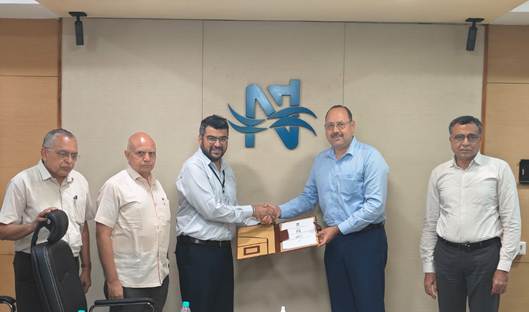
The National Highways Authority of India and Sardar Sarovar Narmada Nigam Limited have signed a memorandum of understanding at Gandhinagar to set a simplified, time-bound process for approving national highway, canal and pipeline crossings in Gujarat, according to the Ministry of Road Transport and Highways release of 22 September.
The provision in it that will show up in project accounts is the mutual waiver: the various fees, charges and other levies the two bodies would ordinarily raise on each other at such crossings are waived on both sides. Where a highway crosses a canal, each authority has until now been billing the other out of the same public purse. The memorandum also provides for early exchange of project information, standardised engineering practices and a defined allocation of responsibility for building and maintaining the crossings.
It was signed by NHAI’s Regional Officer and SSNNL’s Chief Engineer for quality control, technical, monitoring and control, in the presence of the corporation’s directors.
Ayush gets its first report card
New Delhi, 23 September Four of the documents being released at Nagpur on 23 September belong to research rather than to ceremony, and the Research Desk has separated them out.
The assessment of the Ayush service sector has been prepared by the Research and Information System for Developing Countries, an autonomous policy research body, and the Ministry of Ayush describes it as the first of its kind. Its value will lie in whether it establishes a denominator — how many practitioners, how many establishments, what volume of service — because almost every claim made about this sector currently rests on estimates that no published assessment supports.
The two safety dossiers cover Gokshura, Tribulus terrestris, and Chandrasur, Lepidium sativum. A safety dossier is not an efficacy claim. It assembles what is known about toxicity, dose and interaction for a single plant, and its usefulness is to a regulator and a prescriber rather than to a patient.
The standard treatment guidelines for skin disorders address a different gap: variation between practitioners treating the same presentation. The CCRAS AGNI portal, for the Ayurveda Gyan Naipunya Initiative assessment scale, is an instrument for grading competence.
The Research Desk has not seen any of these four documents, which are to be released on the day of publication of this edition. Nothing about their contents is asserted here; what is set out is what each document is for.
Audit Files Await Parliamentary Scrutiny
New Delhi, 23 September The Comptroller and Auditor General’s own press-release register, read on 23 September, records nine releases between 12 and 17 August 2026. Eight of them announce reports presented to Parliament.
Presented on 13 August 2026 were a performance audit on the Project Imports Scheme under the Union Government’s customs accounts, a report on compliance with the Fiscal Responsibility and Budget Management Act, an audit report on customs, an audit report on government, scientific and environmental ministries and departments, a performance audit on BharatNet, an audit report on the Green India Mission, and two reports on the Union Government’s railway accounts. The audit report on the goods and services tax was presented on 12 August 2026.
No report has been presented since. The Oversight Desk records that position rather than reporting findings: this desk has not yet read the tabled volumes themselves, and under the Blitz standard a finding is not carried until the report that contains it has been read here, with the ministry’s reply beside it.
What can be said about status is this. A report presented to Parliament goes in the ordinary course to the Public Accounts Committee or, for public sector undertakings, to the Committee on Public Undertakings, and departmental standing committees may take up matters within their subjects. The Action Taken Report is where the account is settled, and it is the stage least often reported.
On 17 August 2026 the Comptroller and Auditor General addressed the annual meeting of the INTOSAI Working Group on Follow-up Audit — the international body concerned with precisely that last stage, what happens after an audit finding is made.