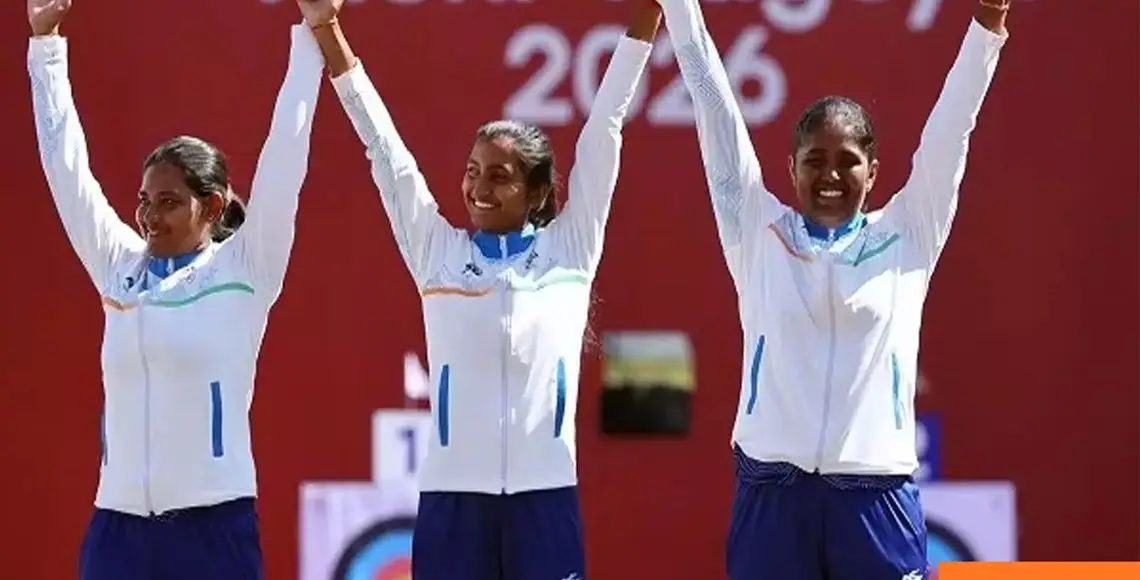
Ankita, Kumkum and Kirti script historic gold at Asian Games
NEW DELHI, 2 October: Ankita Bhakat, Kumkum Anil Mohod and Kirti beat South Korea 5-3 in the women’s recurve team final at the Asian Games in Aichi-Nagoya, Japan. The Prime Minister’s Office, in its release of 2 October 2026, called it India’s first-ever gold medal in the event. The trio had reached the final by beating China 5-1.
.
South Korea’s women have won every Olympic team recurve title since the event entered the Games in 1988, ten in a row up to Paris 2024. Beating them in a final is the hardest thing a recurve team can be asked to do.
At the previous Asian Games, held in Hangzhou in 2023, India’s women’s recurve team of Ankita Bhakat, Bhajan Kaur and Simranjeet Kaur won bronze, as All India Radio reported at the time. She is part of this one, which is the shortest way of describing what three years of a programme look like: one archer carrying the experience forward, two newer ones bringing the form.
The Prime Minister said the team’s “composure and precision in a closely fought final were remarkable” and that the win would inspire young archers across the country.
At a glance
Event: women’s recurve team, Asian Games, Aichi-Nagoya
Final: India 5, South Korea 3
Semi-final: India 5, China 1
Team: Ankita Bhakat, Kumkum Anil Mohod, Kirti
India’s previous Asian Games result in the event: bronze, Hangzhou 2023
What India gains
A first Asian Games title in the Olympic form of team archery, won against the world’s benchmark side — evidence that Indian recurve can now close out a final rather than merely reach one.
Buxa’s Tiger comeback begins with T138
BUXA (BENGAL), 2 October — A tigress numbered T138, moved from Valmiki Tiger Reserve in Bihar, was released into Buxa Tiger Reserve on 2 October 2026 in the presence of the Union Minister for Environment, Forest and Climate Change, Bhupender Yadav, and the Chief Minister of West Bengal, Suvendu Adhikari. According to the ministry’s release of the same day, it is the first phase of a planned tiger reintroduction programme, and it opens Wildlife Week 2026.
Buxa was declared a tiger reserve in 1983, 43 years ago. The ministry is plain about what happened next: habitat degradation, fragmentation, changes in land use and a falling prey base left the reserve without a stable resident tiger population for a prolonged period. Releasing a tiger into a forest that cannot feed it would simply move the problem.
T138 will be followed by telemetry, camera traps and field teams. Further releases, the ministry says, will depend on habitat and prey, protection, population viability and expert advice. Sixty-four eco-development and joint forest management committees are part of the programme, because a tiger that strays into a village is a conservation problem only if nobody there was consulted.
What is not yet known is the one number that will decide the project: whether T138 stays, and breeds.
At a glance
Tigress released: T138, from Valmiki Tiger Reserve, Bihar
Buxa declared a tiger reserve: 1983
Recovery project under way since: 2018
Grassland restored or converted: about 380 hectares over eight years
Chital released to rebuild prey: more than 800
Community committees engaged: 64
Tigers recorded on camera traps: 2021, 2023 and 2026
What India gains
A tiger landscape linked to Assam and Bhutan brought back into use, and a reintroduction built on habitat first — a method that can be repeated in other reserves that have lost their tigers.
Goyal defends WTO consensus
MILWAUKEE, 2 October — Solutions to distortions in world trade must be found inside the rules of the World Trade Organization, not around them, Commerce and Industry Minister Piyush Goyal told the concluding session of the G20 trade ministers’ meeting in Milwaukee, United States, according to the Ministry of Commerce and Industry’s release of 2 October 2026.
His sharpest point was on what trade negotiators call structural excess capacity. Industrial capacity in itself is not the difficulty, he argued; the distortion comes from hidden subsidies that concentrate production in one geography. India, he said, is “the fastest-growing large economy in the world, with a domestic-demand-driven economy serving 1.4 billion people” — a country building capacity to meet its own demand, which is a different thing from building it to flood someone else’s market.
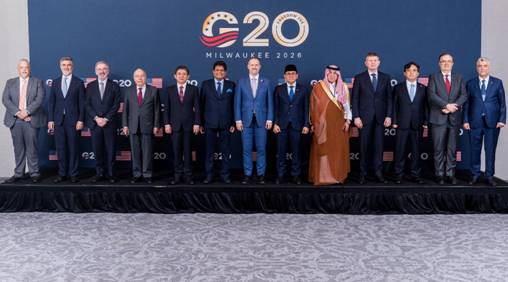
He defended the most-favoured-nation principle — equal treatment for every trading partner — and said consensus remains central to the WTO. On forced labour, India’s commitment was described as “absolute and unconditional”, resting on the Constitution and on India’s ratification of International Labour Organization Conventions 29 and 105.
Bihar’s makhana takes the export route
NEW DELHI, 2 October — One tonne of popped makhana is on its way from Purnea in Bihar to Piraeus in Greece, and 24 tonnes of frozen vegetables and snacks from a farmer producer company in Sonipat, Haryana, are on their way to Canada. Both shipments were facilitated by the Agricultural and Processed Food Products Export Development Authority, APEDA, according to two Ministry of Commerce and Industry releases of 2 October 2026.
Bihar grows around 80-85% of India’s makhana, across more than 35,000 hectares in 10 districts. The State’s Agriculture Minister, Vijay Kumar Sinha, who chaired the flag-off, put India’s makhana exports in 2025-26 at more than 7,000 tonnes, worth 22 million dollars, to more than 20 destinations. Divide one by the other and the country earned at most about 3.1 dollars a kilogram on average across raw and value-added product. The Purnea consignment, the ministry says, fetched a better price than the domestic market was paying. That gap is the whole case for exporting.
At a glance
Purnea to Greece: 1 tonne popped makhana, via Mundra to Piraeus
India’s makhana exports, 2025-26: more than 7,000 tonnes, 22 million dollars
Bihar’s share of production: around 80-85%
Sonipat to Canada: 24 tonnes, 2,295 boxes, 35,140 Canadian dollars
What India gains
Farm producers selling abroad in their own name, and Bihar’s makhana reaching a European market beyond its traditional buyers.
Odisha’s rural tap coverage hits 73pc
BHUBANESWAR, 2 October: By March 2024, 64.71 lakh of Odisha’s 88.68 lakh rural households had a functional household tap connection under the Jal Jeevan Mission, according to the Comptroller and Auditor General’s Report No. 5 of 2026 on the Government of Odisha, a performance and compliance audit for the period ended March 2024, placed on the CAG’s website on 28 September 2026. That is 73.0% of rural homes, and 23.97 lakh still to go.
The Government of Odisha, the report records, acknowledged the issues and assured remedial action.
At a glance
Rural households with a tap, March 2024: 64.71 lakh of 88.68 lakh
Funds available under JJM, 2019-24: ₹14,534.59 crore
Funds used: ₹13,568.78 crore
Water quality monitoring spend: 0.38% of allotted funds, limit 2%
Laboratories NABL-accredited or recognised: 43 of 77
What India gains
A State-level map of exactly where the last rural taps are missing, and a monitoring gap named while there is still time to close it.
PM Modi calls for khadi purchase on Gandhi Jayanti
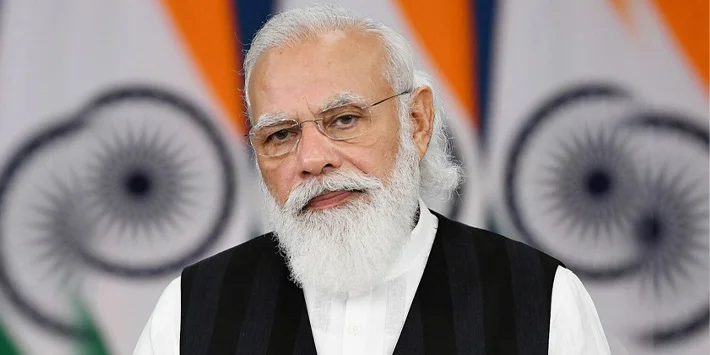
NEW DELHI, 2 October — Prime Minister Narendra Modi paid tribute to Mahatma Gandhi on his Jayanti and urged people to buy at least one Khadi product on 2 October and take pride in calling it Swadeshi, according to the Prime Minister’s Office release of the same day. Mahatma Gandhi’s thoughts, he said, remain relevant “as long as their flow remains connected with humanity.” He also paid homage to former Prime Minister Lal Bahadur Shastri, born on the same date. A single purchase, multiplied across a country, is the most direct support a spinner or weaver in a Khadi institution can receive.
NITI Aayog pushes SDG-linked budgets
KOLKATA, 2 October: Representatives of 32 States and Union Territories met in Kolkata on 29 September at a NITI Aayog workshop. It was conducted on tagging State budgets to the Sustainable Development Goals, held with the Government of West Bengal and the UNDP, NITI Aayog said in its release of 2 October 2026. Haryana, Odisha, Meghalaya and West Bengal shared how they do it, and a jointly developed guide for mapping State budgets to the goals was discussed. R. Balasubramaniam put the purpose in one line: “money spent can be shown to be money spent wisely.”