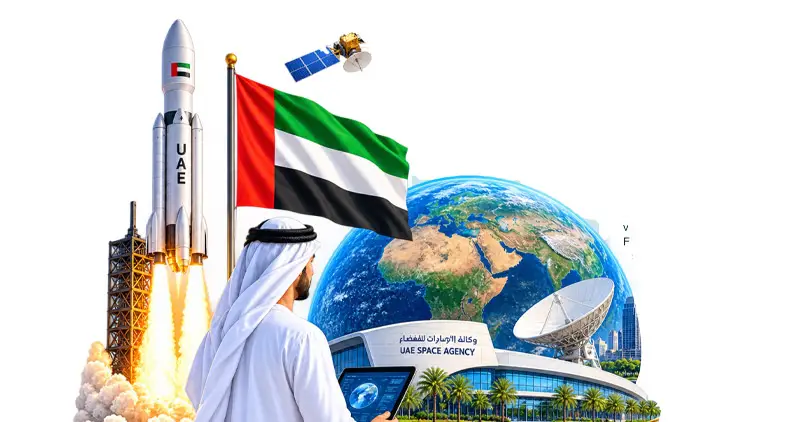
The UAE’s space sector has evolved beyond scientific and exploration missions and satellite launches into an integrated economic ecosystem spanning infrastructure, manufacturing, data, artificial intelligence, research and development, investment, international partnerships and talent development, reported WAM.
The developments point to a marked shift from building space capabilities to expanding their use and translating them into economic, technological, and knowledge value.
This transformation is being driven by a national vision aimed at doubling space economy revenues, increasing the sector’s economic added value by 60 per cent, doubling the number of national c o m p a n i e s and start-ups, i n c r e a s i n g investment in space assets and infrastructure, and expanding UAE space exports in global markets.
The National Space Strategy 2031, approved by the UAE Cabinet on March 29, 2026, places the economy at the heart of the sector’s next phase. It seeks to build a resilient, investment-attractive space ecosystem, strengthen global leadership in space partnerships and market access, and develop competitive space infrastructure and facilities. These targets build on an established ecosystem. Results from the previous strategy included the development of 30 satellites, while the number of entities operating in the UAE space economy has exceeded 170.
Space42 illustrates the shift in value creation from satellites themselves to the data and services they generate. In June, Foresight-3, Foresight-4 and Foresight-5 entered full operation, expanding the Foresight Earth Observation constellation to five satellites providing highresolution geospatial intelligence. Critical integration and testing processes were completed in Abu Dhabi, while cooperation with ICEYE supports technology transfer and supplychain localisation.