India’s chip mission moves from plans to production
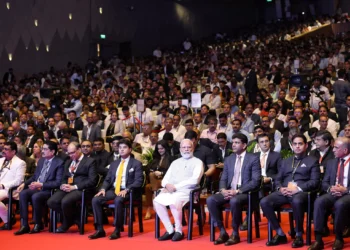
NEW DELHI, 8 October — “Commercial production has already begun at five locations,” the Prime Minister told the 10th India Mobile Congress at Yashobhoomi on 8 October. Later on the same day, he outlined five sites where India’s semiconductor mission has moved from approval to output. He paired it with a demand: that mobile phones and telecom hardware be made in India, not merely assembled here.

At a glance
Semiconductor sites in commercial production: 5 (PM’s address, text released 8 October 2026)
DIKSHA, to July 2022: more than 500 crore learning sessions; about 6,000 crore learning minutes; target 25 crore students.
DBT: about ₹50 lakh crore paid; about ₹5 lakh crore kept from wrong hands; PM-KISAN more than ₹4 lakh crore
5G: every district; more than 5.5 lakh base stations; speeds about 10 times 2022
Reforms named: Telecommunications Act; AGR and bank-guarantee rationalisation; Gatishakti Sanchar portal
What India gains
Five working chip sites, a telecom rulebook that made towers cheaper to build, and a proposal that puts India at the table on cross-border cyber fraud.
India’s power grid turns mostly non-fossil
MANILA, 8 October India’s installed generating capacity stood at 558.8 GW on 30 September 2026, of which 308 GW — 55% — is non-fossil, Minister of State for Power and New and Renewable Energy Shripad Yesso Naik told the 20th East Asia Summit Energy Ministers’ Meeting in Manila.
The 50% non-fossil mark, the release records, was crossed in June 2025, five years ahead of the 2030 commitment in India’s nationally determined contribution. Blitz arithmetic on the two capacity figures: 308 ÷ 558.8 = 55.1%.
Photograph — place here: https://pib.gov.in/PressReleasePage.aspx?PRID=2320609
At a glance
Installed capacity, 30 September 2026: 558.8 GW; non-fossil 308 GW (Ministry of Power, 8 October 2026)
50% non-fossil reached: June 2025, five years before the 2030 target
PM Surya Ghar, 29 September 2026: about 50.1 lakh installations, 59.5 lakh households
India–Singapore interconnection proposed: 2,000 MW; corridor option about 3,000 km, Imphal to Singapore
ASEAN grid training pledged by the Prime Minister, 2025: 400 professionals
What India gains
A grid that is majority non-fossil, offered to a region that is building its own — and a 3,000 km corridor that would make India a power exporter to South-East Asia.
Namami Gange: 368 of 527 projects completed
NEW DELHI, 8 October — Of 527 projects sanctioned under Namami Gange at a cost of ₹43,266 crore, 368 were complete by August 2026, according to the Ministry of Jal Shakti’s release of 8 October 2026 on the 20th meeting of the Empowered Task Force, chaired by Jal Shakti Minister CR Patil.

At a glance
What India gains
4,339 million litres a day of sewage that no longer reaches the river untreated, and a programme that now reaches the Gomti’s source and Delhi’s drains.
Women take the lead in growing AYUSH economy
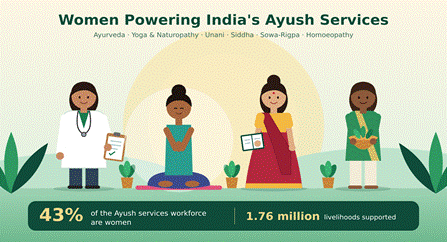
NEW DELHI, 8 October — Women make up 43% of the workforce in India’s AYUSH services sector, and more than half in its organised parts — 53% in hospitals, 57% in day-care centres, 58% in educational institutions and over 60% in spa and wellness resorts — according to a report by the Research and Information System for Developing Countries released for Ayurveda Day 2026 and carried by the Ministry of AYUSH in a release of 8 October 2026. The sector supported about 17.6 lakh direct livelihoods, with more than 10 lakh linked to independent and local clinics.
What India gains
It’s a $37 billion sector in which the majority of the organised workforce is women, and a projection against which the next report can be read.
India sets $1 trillion export target after $ 863 billion year
NEW DELHI, 8 October — India exported $863 billion of goods and services last year and has set a target of $1 trillion for this year, Commerce and Industry Minister Piyush Goyal said at the curtain-raiser for the 31st CII Partnership Summit in New Delhi on 8 October 2026.