

Prabhu Chawla
John Locke, a British thinker, wrote in 1690: “There remains still in the people a supreme power to remove or alter the legislative, when they find the legislative act contrary to the trust reposed in them.” More than three centuries later, India is now caught in exactly such a moment, where the right of the people to change their rulers is being tested against the right of an elected government to complete its term.
Defence Minister Rajnath Singh is not a man given to theatrical outbursts, which is precisely why his charge landed with the weight of a warning. Last week, when he accused Rahul Gandhi and his allies of taking to the streets to topple a popular, elected government, he was not merely scoring a point in the daily duel of Delhi politics. He was naming a fear that has quietly crept into the corridors of power – the fear that the street, long dismissed as noise, may yet become a verdict.
Precise chorus
The chorus followed with drilled precision. Several BJP leaders, including its President Nitin Nabin sharpened the same sword, accusing the Opposition of plotting to seize through agitation what it could not win through the ballot. The most combustible charge was reserved for the end. The BJP alleged that the Opposition was importing the Bangladesh and Nepal models, where governments crumbled before violent crowds, and transplanting them onto Indian soil.
The Congress refused to surrender. Its leaders claimed that to oppose and to depose is the basic right of every citizen in a democracy. They reminded the ruling party that the very same methods had been used to remove Congress governments in the past. The Congress reminded that the BJP’s own leaders had marched at the front of those processions. Street protest, they argued, is a tried and trusted tool of democratic change all over the free world. The real question is not whether citizens may seek change, but how they go about it.
Indian history of political protests bolsters the argument. During the mid-1970s, Jayaprakash Narayan turned a student agitation in Bihar into a national movement against corruption and the abuse of power. The then-prime minister Indira Gandhi responded with the Emergency. The Indian voter responded to her draconian regime by ousting her from power in 1977.
Again, in 1987, the then-defence minister VP Singh walked out of Rajiv Gandhi’s Cabinet with the Bofors scandal as his weapon. During the 1989 Lok Sabha elections, Rajiv was voted out. Once again, the pattern was repeated in 2012 at Ramlila Maidan, where Anna Hazare’s fasts drained the moral standing of the Manmohan Singh Government and set the stage for Modi’s rise in 2014. In each case the target was the Congress. Each agitation also had four vital ingredients: corruption, a credible leader, a slogan that touched the heart, and a common cause that rose above party lines.
Mass movement
Rahul Gandhi has spent the better part of a decade trying to build a similar wave against Modi, with uneven results. He took up one issue at a time, first Rafale, then Adani and Ambani, and most recently the charge of vote chori. Each campaign made an impact, but none grew into a mass movement, because these issues reached the minds of informed voters but rarely entered the homes of ordinary families.
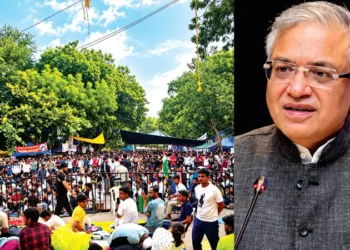
In 2026 came the most unlikely spark. A young man in his thirties, living in America, picked up a word used by the Chief Justice of India and launched the Cockroach Janta Party (CJP). But Abhijeet Dipke, its founder, chose his cause with great cleverness. The NEET paper leak had hurt more than 20 lakh families who had spent their savings, their sleep and their hopes on a single examination. The CJP became the outlet for their anger, and that anger produced results. Education Minister Dharmendra Pradhan resigned and several senior civil servants were moved out. It was a small yet symbolic regime change achieved without a single seat changing hands in Parliament.
Having tasted blood, the protesters went looking for new causes to keep their spirit alive. Rahul wisely turned his attention to Gen Z. From examination reform to unemployment, his Chhatron Ki Goonj campaign struck a chord and carried the concerns of classrooms and coaching centres into the national debate. However, the strongest weapon arrived when the SIR exercise’s manipulations were exposed. What had been a lost argument in the courts became a real grievance in towns and villages. The Opposition parties that had long guarded their own territory suddenly found themselves marching together against a single target.

Unfamiliar ground
The Government finds itself on unfamiliar ground. It knows how to fight political parties. Each new protest weakens the carefully-built story of good governance. This standoff raises a larger question that India has never fully answered. BR Ambedkar told the Constituent Assembly in 1949 that once constitutional methods were available, civil disobedience and street agitation were nothing but the grammar of anarchy. Ram Manohar Lohia held the opposite view, insisting that living nations do not wait five years. Peaceful protest is the lifeblood of a free society, but road blockades that bring cities to a halt and violence that frightens ordinary citizens destroy the very cause they claim to serve.
The Government, however, must resist the temptation to answer dissent with force. A ruling party that faces serious charges of weakening constitutional institutions can least affords to be seen using police, agencies and prisons to silence its critics.
The wiser course is to discover or invent outlets through which the Opposition and the young can vent their grievances, whether through meaningful debate in Parliament, open hearings by committees, or regular dialogue with student bodies. The Opposition, in turn, must accept the reasonable restrictions that the Constitution itself places on protest, so that the right to dissent does not become a licence to disrupt.
Sleepless nights
The movement has not yet spread across the whole country. But it has certainly given the Government sleepless nights. India may well be on the threshold of a revival of democratic protest as a means of changing governments. Karl Popper, an Austrian philosopher, argued that the true strength of democracy lies in allowing citizens to remove their rulers without bloodshed, yet removal is only half the task.

The alternative must be better than what it replaces, and strong enough to govern a nation of 140 crore people. Until a united Opposition finds a cause that unites, a face that inspires and a structure that lasts, they will remain a nuisance to the palace rather than a threat to its foundations.
The Government finds itself on unfamiliar ground. It knows how to fight political parties. Each new protest weakens the carefully-built story of good governance