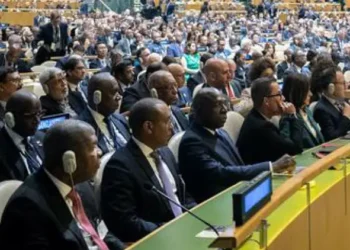
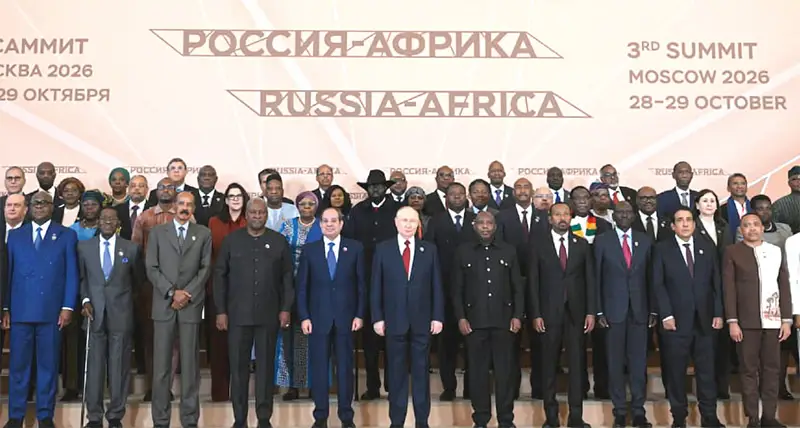
NEW DELHI: Russia on October 28 hosted dozens of African leaders at a Russia-Africa summit, part of Moscow’s efforts to expand its influence across the continent. In his speech at the forum, Russian President Vladimir Putin called for strengthening Africa’s role in making decisions at the International Monetary Fund and the World Bank Group to meet the continent’s needs.
Putin emphasized that Russia delivers grain and fertilizers to more than 40 African countries and stands ready to expand supplies. In 2023, Russia exported 200,000 tonnes of grain to Mali, Somalia, the Central African Republic, Burkina Faso, Eritrea and Zimbabwe. Moscow first hosted the Russia-Africa summit in 2019, and then again in 2023. This week’s summit drew 48 African nations, about 20 of which were represented by their leaders.
Trade between African countries and Russia has exceeded $28bn. It was estimated to be about $16.8bn in 2019, when the first summit was held. But trade is mainly concentrated in a few countries and overshadowed by that of China and the European Union.
Trade between African countries and Russia has exceeded $28bn. It was estimated to be about $16.8bn in 2019, when the first summit was held. But trade is mainly concentrated in a few countries and overshadowed by that of China and the European Union.
As Russia competes with the United States, Europe and China for greater influence across Africa, it has relied on its military contractors to strengthen its sway on many fronts, from the economy to security and politics.
Multipolar world
In his speech, Putin cast his offer to Africa as an “organic part of a global transformation” and an end to Western domination, noting that “we are witnessing a multipolar world becoming a reality — a trend that is both objective and irreversible.” A final declaration and a Russia-Africa Partnership Forum plan should be adopted by the end of the Summit to cover 2027-2029.
The Russia-Africa summit marks a renewed Kremlin effort to bolster ties with a continent of nearly 1.6 billion people that is increasingly assertive on the global stage. Africa’s 54 nations make up the largest voting bloc at the UN.