
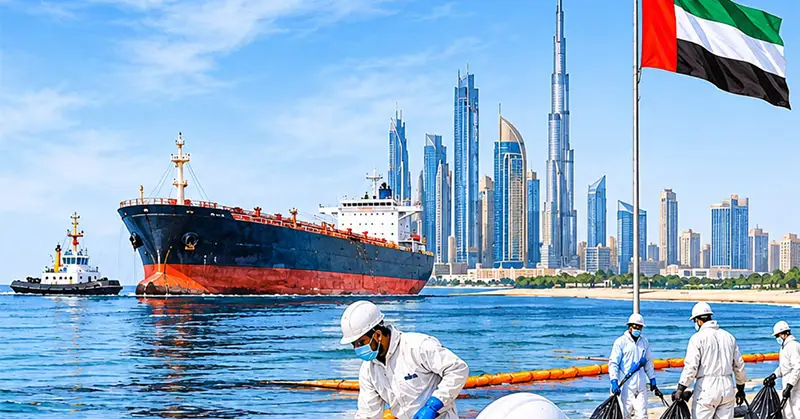
The UAE has said that an oil leak from a tanker had been stopped, with no new leakage detected, as cleanup operations continued along coastlines affected by the spill.
The Ministry of Energy and Infrastructure said it was coordinating with the Ministry of Climate Change and Environment, the National Emergency Crisis and Disaster Management Authority and other relevant agencies to secure the tanker Gem No. 2 and minimise potential risks, according to the state news agency WAM.
The oil slick is concentrated off the northern emirate of Umm Al Quwain and extends partly towards coastal areas in the neighbouring northern emirates of Ras Al Khaimah, Ajman and Sharjah, WAM reported. The density of marine pollution has declined markedly, it added.
Technical teams have repaired damaged parts of the tanker, restored some operating systems and are assessing the integrity of its structure to determine the safest way to handle it
Authorities have temporarily closed some beaches and coastal areas as a precaution, though the ministry said this did not necessarily mean pollution had been detected at every site affected by the closures.
Environment ministry teams are carrying out field surveys, monitoring and cleanup operations in coastal areas reached by the pollution, in coordination with federal and local authorities, WAM said.
Authorities have not said what caused the spill, but shipping sources have told Reuters the vessel was struck by a projectile on October 9, causing a fire that was later extinguished. Since the start of the US-Israeli war with Iran, attacks on commercial vessels in Gulf shipping lanes have driven up security risks for maritime traffic and heightened fears over the conflict’s environmental fallout.
Technical teams have repaired damaged parts of the tanker, restored some operating systems and are assessing the integrity of its structure to determine the safest way to handle it, WAM added, citing the energy ministry. The UAE also said fish and food products available in markets were safe for human consumption and that precautionary measures to protect drinking water supplies would not affect distribution.
The country relies heavily on desalination plants for drinking water, while much of its economy, including ports and industrial facilities, is concentrated along its coastline, making marine contamination particularly sensitive.