
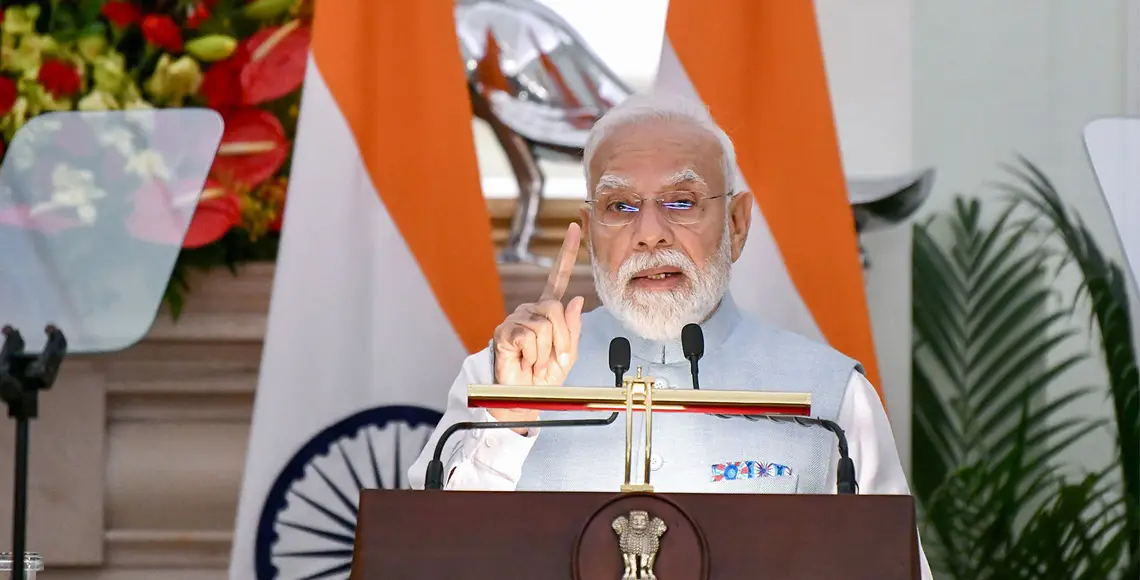
NEW DELHI, 19 November Inaugurating the Annual General Meeting and Annual Convention of the Federation of Indian Chambers of Commerce and Industry (FICCI) at Bharat Mandapam, PM Narendra Modi India Inc not to treat the home market as a place where anything will sell. “Do not take 140 crore Indians for granted as an assured market where anything will sell,” he said. “My countrymen deserve top quality.”
PM Modi placed the challenge against two facts. India remains the world’s fastest-growing major economy, he said, with global institutions expecting growth of about 7%. And in October, he noted, India’s goods exports reached nearly $50 billion — the highest in any single month.
What India gains
The gain is concrete. A domestic market of 140 crore people that insists on world-standard goods pushes Indian makers up the quality ladder at home — and every rung climbed at home is a rung already climbed for Rotterdam, Dubai or Tokyo. October’s record export month shows the ladder can be climbed.
BLITZ DATA CARD
FICCI founded 1927 — centenary on 7 April 2027
Delegates at “Bharat 2047” convention 2,500+
Companies FICCI represents 2.5 lakh+
October 2026 goods exports $49.47 billion (record month)
Growth projection cited by PM about 7%
Sources: Prime Minister’s Office, 18 Nov 2026; Ministry of Commerce and Industry, 13 Nov 2026
Blitz View
A centenary is a good moment for a pledge. FICCI could ask its members to publish a simple “one standard” commitment — the same specification for the domestic and export versions of a product line — and report each year how many lines have moved. It would turn a speech into a measurable habit.
India, Japan strengthen strategic partnership in Tokyo
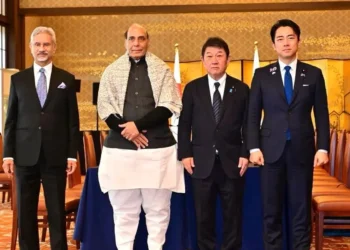
TOKYO, 19 November — Defence Minister Rajnath Singh and External Affairs Minister S. Jaishankar held talks Japanese Foreign Minister Toshimitsu Motegi and Defence Minister Shinjiro Koizumi in Tokyo during for the fourth India-Japan Foreign and Defence Ministers’ Dialogue, the “2+2”.
The format is reserved for India’s closest partners. It puts the foreign and defence ministers of both sides at one table, so that diplomacy and security are planned together rather than in parallel. India and Japan held the first round in New Delhi on 30 November 2019, the second in Tokyo on 8 September 2022 and the third in New Delhi on 20 August 2024.
“Our growing maritime cooperation reflects the deep trust and shared commitment of India and Japan toward ensuring a free, open, and rules-based Indo-Pacific,” Rajnath Singh said. The External Affairs Minister said the two countries must deepen cooperation and strengthen their national capacities to keep the Indo-Pacific free and open.
What India gains
Is a standing seat at the planning table with Asia’s most advanced industrial democracy — the route through which joint exercises become joint manufacturing. The outcome document is expected once the talks close; Blitz will carry it in the next file.
India’s horticulture output set to hit record
NEW DELHI, 19 November India is set to grow a record 3,869.15 lakh tonnes of fruit, vegetables, flowers and plantation crops in 2025-26 — about 386.9 million tonnes — on less land than the year before.
The Third Advance Estimates, released by Agriculture Minister Shivraj Singh Chouhan on 17 November, put output 161.77 lakh tonnes, or 4.36%, above 2024-25’s 3,707.38 lakh tonnes. The area under horticulture fell from 301.36 lakh hectares to 297.21 lakh hectares.
What India gains: more food and more farm income from each acre — the surest answer to a growing population and a fixed land area.
India’s electronics exports surge 44pc in six months
NEW DELHI, 19 November India exported $31.97 billion of electronic goods in April-September 2026-27, up 44% from $22.20 billion a year earlier, the Ministry of Commerce and Industry said on 17 November.
Smartphones still lead, at $18.17 billion, up 35.8%. But the faster growth is elsewhere: non-smartphone electronics rose 56.5% to $13.79 billion, and their share of the basket climbed from about 40% to about 43%.
The sharpest single line is mounted printed circuit boards — exports of $2.10 billion against $63.3 million a year ago, about 33 times the earlier figure. Network and routing equipment nearly doubled to $1.45 billion.
What India gains the shift from assembling phones to making the boards and equipment inside them — the deeper layer of manufacturing where skills and value stay longer.